


JEE Advanced · Physics · 22. AC Circuits
Find the time constant for the given R C circuits in correct order.
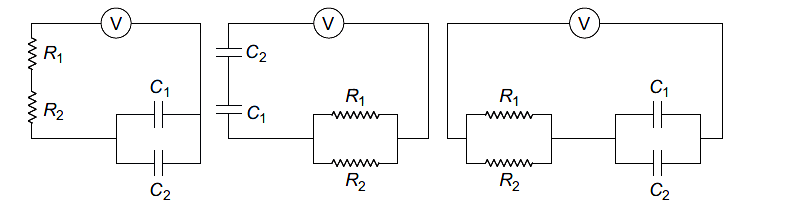
\(R_1=1 \Omega, R_2=2 \Omega, C_1=4 \mu \mathrm{F}, C_2=2 \mu \mathrm{F}\)
- A \(18,4,8 / 9\)
- B \(18,8 / 9,4\)
- C \(4,18,8 / 9\)
- D \(4,8 / 9,18\)
Answer & Solution
Correct Answer
(B) \(18,8 / 9,4\)
Step-by-step Solution
Detailed explanation
\(\tau =C R \)
\( \tau_1 =\left(C_1+C_2\right)\left(R_1+R_2\right)=18 \mu \mathrm{s} \)
\( \tau_2 =\left(\frac{C_1 C_2}{C_1+C_2}\right)\left(\frac{R_1 R_2}{R_1+R_2}\right)=\frac{8}{6} \times \frac{2}{3}=\frac{8}{9} \mu \mathrm{s} \)
\( \tau_2 =\left(C_1+C_2\right)\left(\frac{R_1 R_2}{R_1+R_2}\right)=(6)\left(\frac{2}{3}\right)=4 \mu \mathrm{s}\)
\( \tau_1 =\left(C_1+C_2\right)\left(R_1+R_2\right)=18 \mu \mathrm{s} \)
\( \tau_2 =\left(\frac{C_1 C_2}{C_1+C_2}\right)\left(\frac{R_1 R_2}{R_1+R_2}\right)=\frac{8}{6} \times \frac{2}{3}=\frac{8}{9} \mu \mathrm{s} \)
\( \tau_2 =\left(C_1+C_2\right)\left(\frac{R_1 R_2}{R_1+R_2}\right)=(6)\left(\frac{2}{3}\right)=4 \mu \mathrm{s}\)
See the Complete Solution
Get step-by-step explanations for this and 2.5 Lakh+ more JEE, NEET & CET questions.
- Unlock all solutions
- Practice the full chapter
- Track accuracy across PYQs
4.8 rated on Google Play · 14,000+ reviews
More questions from Physics
- Paragraph:
A small block of mass \(M\) moves on a frictionless surface of an inclined plane, as shown in figure. The angle of the incline suddenly changes from \(60^{\circ}\) to \(30^{\circ}\) at point \(B\). The block is initially at rest at \(A\). Assume that collisions between the block and the incline are totally inelastic \(\left(g=10 \mathrm{~m} / \mathrm{s}^2\right)\)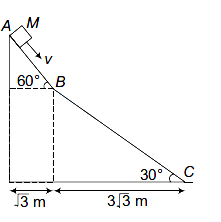
Question:
The speed of the block at point \(B\) immediately after it strikes the second incline isJEE Advanced 2008 Medium - A particle of mass \(m\) is under the influence of the gravitational field of a body of mass \(M(\gg m)\). The particle is moving in a circular orbit of radius \(r_0\) with time period \(T_0\) around the mass \(M\). Then, the particle is subjected to an additional central force, corresponding to the potential energy \(V_{\mathrm{c}}(r)=m \alpha / r^3\), where \(\alpha\) is a positive constant of suitable dimensions and \(r\) is the distance from the center of the orbit. If the particle moves in the same circular orbit of radius \(r_0\) in the combined gravitational potential due to \(M\) and \(V_{\mathrm{c}}(r)\), but with a new time period \(T_1\), then \(\left(T_1^2-T_0^2\right) / T_1^2\) is given by
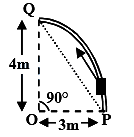
[ \(G\) is the gravitational constant.]JEE Advanced 2024 Medium - Consider an elliptically shaped rail PQ in the vertical plane with and . A block of mass 1 kg is pulled along the rail from P to Q with a force of 18 N, which is always parallel to line PQ (see the figure given). Assuming no frictional losses, the kinetic energy of the block when it reaches Q is Joules. The value of n is (take acceleration due to gravity = )
 JEE Advanced 2014 Hard
 - Two men are walking along a horizontal straight line in the same direction. The man in front walks at a speed and the man behind walks at a speed . A third man is standing at a height above the same horizontal line such that all three men are in a vertical plane. The two walking men are blowing identical whistles which emit a sound of frequency . The speed of sound in air is At the instant, when the moving men are apart, the stationary man is equidistant from them. The frequency of beats in , heard by the stationary man at this instant, is __________.JEE Advanced 2018 Hard
- A vernier calipers has \(1 \mathrm{~mm}\) marks on the main scale. It has 20 equal divisions on the vernier scale which match with 16 main scale divisions. For this vernier calipers, the least count isJEE Advanced 2010 Medium
- A piece of wire is bent in the shape of a parabola \(y=k x^2\) (y-axis vertical) with a bead of mass \(m\) on it. The bead can slide on the wire without friction. It stays at the lowest point of the parabola when the wire is at rest. The wire is now accelerated parallel to the \(x\)-axis with the constant acceleration \(a\). The distance of the new equilibrium position of the bead, where the bead can stays at rest with respect to the wire, from the \(y\)-axis isJEE Advanced 2009 Medium
More PYQs from JEE Advanced
- For an isosceles prism of angle and refractive index it is found that, the angle of minimum deviation is . Which of the following options is/are correct?JEE Advanced 2017 Medium
- An electron and a proton are moving on straight parallel paths with same velocity. They enter a semi-infinite region of uniform magnetic field perpendicular to the velocity. Which of the following statement(s) is/are true?JEE Advanced 2011 Easy
- The reduction potential , in of is
\(\left[\right.\)Given: \(E _{\left( MnO _4^{-}( aq ) / MnO _2(s)\right)}^{ o }=1.68 V ;\) \( E _{\left( MnO _2(s) / Mn ^{2+}( aq )\right)}^{ o }=\) \(1.21 V ; E _{\left( Mn ^{2+}( aq ) / Mn ( s )\right)}^{ o }\) \(=-1.03 V]\)
Truncate/round-off the value to TWO decimal places.JEE Advanced 2022 Medium - If \(x^2-10 a x-11 b=0\) have roots \(c\) and \(d\) and \(x^2-10 c x-11 d=0\) have roots \(a\) and \(b\), then, find \(a+b+c+d\).JEE Advanced 2006 Hard
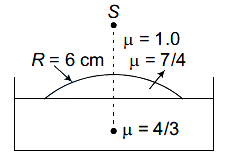
- Water (with refractive index \(=\frac{4}{3}\) ) in a tank is \(18 \mathrm{~cm}\) deep. Oil of refractive index \(\frac{7}{4}\) lies on water making a convex surface of radius of curvature \(R=6 \mathrm{~cm}\) as shown. Consider oil to act as a thin lens. An object \(S\) is placed \(24 \mathrm{~cm}\) above water surface. The location of its image is at \(x \mathrm{~cm}\) above the bottom of the tank. Then, \(x\) is
 JEE Advanced 2011 Hard
 - Regarding the molecular orbital (MO) energy levels for homonuclear diatomic molecules, the INCORRECT statement(s) is(are)JEE Advanced 2025 Medium