


JEE Advanced · Physics · 17. Electrostatics
List-I shows four configurations, each consisting of a pair of ideal electric dipoles. Each dipole has a dipole moment of magnitude \(p\), oriented as marked by arrows in the figures. In all the configurations the dipoles are fixed such that they are at a distance \(2 r\) apart along the \(x\) direction. The midpoint of the line joining the two dipoles is \(X\). The possible resultant electric fields \(\vec{E}\) at \(X\) are given in List-II. Choose the option that describes the correct match between the entries in List-I to those in List-II.
| List-I | List-II | ||
|---|---|---|---|
| \((P)\) | 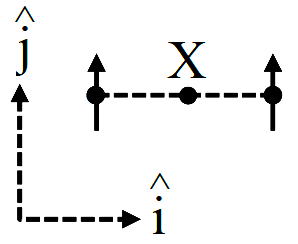 | \((1)\) | \(\vec{E}=0\) |
| \((Q)\) | 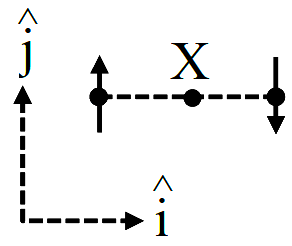 | \((2)\) | \(\vec{E}=-\frac{p}{2 \pi \epsilon_0 \mathrm{r}^3} \hat{\mathrm{j}}\) |
| \((R)\) | 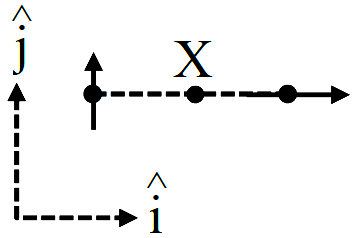 | \((3)\) | \(\vec{E}=-\frac{p}{4 \pi \epsilon_0 \mathrm{r}^3}(\hat{\mathrm{i}}-\hat{\mathrm{j}})\) |
| \((S)\) | 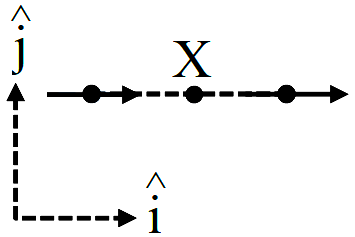 | \((4)\) | \(\vec{E}=\frac{p}{4 \pi \epsilon_0 \mathrm{r}^3}(2 \hat{\mathrm{i}}-\hat{\mathrm{j}})\) |
| \((5)\) | \(\vec{E}=\frac{p}{\pi \epsilon_0 \mathrm{r}^3} \hat{\mathrm{i}}\) |
- A \(\mathrm{P} \rightarrow 3, \mathrm{Q} \rightarrow 1, \mathrm{R} \rightarrow 2, \mathrm{~S} \rightarrow 4\)
- B \(\mathrm{P} \rightarrow 4, \mathrm{Q} \rightarrow 5, \mathrm{R} \rightarrow 3, \mathrm{~S} \rightarrow 1\)
- C \(\mathrm{P} \rightarrow 2, \mathrm{Q} \rightarrow 1, \mathrm{R} \rightarrow 4, \mathrm{~S} \rightarrow 5\)
- D \(\mathrm{P} \rightarrow 2, \mathrm{Q} \rightarrow 1, \mathrm{R} \rightarrow 3, \mathrm{~S} \rightarrow 5\)
Answer & Solution
Correct Answer
(C) \(\mathrm{P} \rightarrow 2, \mathrm{Q} \rightarrow 1, \mathrm{R} \rightarrow 4, \mathrm{~S} \rightarrow 5\)
Step-by-step Solution
Detailed explanation

\(E_{\text {net }}=\frac{-2 k P}{r^3} \hat{j}\)
\(E_{n e t}=\frac{-P \hat{j}}{2 \pi \epsilon_0 r^3}\)
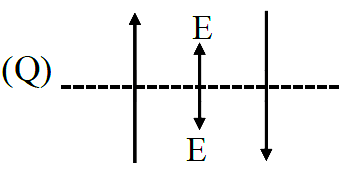
\(\mathrm{E}_{\mathrm{net}}=0\)
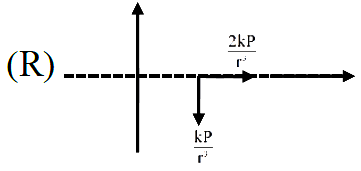
\(\frac{2 \mathrm{P} \hat{\mathrm{i}}}{4 \pi \epsilon_0 \mathrm{r}^3}-\frac{\mathrm{P} \hat{\mathrm{j}}}{4 \pi \epsilon_0 \mathrm{r}^3}\)
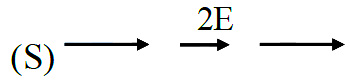
\(\mathrm{E}_{\mathrm{net}}=\frac{4 \mathrm{kP} \hat{\mathrm{i}}}{\mathrm{r}^3}\)
\(\mathrm{P} \rightarrow 2, \mathrm{Q} \rightarrow 1, \mathrm{R} \rightarrow 4, \mathrm{~S} \rightarrow 5\)
Ans. (C)
See the Complete Solution
Get step-by-step explanations for this and 2.5 Lakh+ more JEE, NEET & CET questions.
- Unlock all solutions
- Practice the full chapter
- Track accuracy across PYQs
4.8 rated on Google Play · 14,000+ reviews
More questions from Physics
- In an insulated vessel, \(0.05 \mathrm{~kg}\) steam at \(373 \mathrm{~K}\) and \(0.45 \mathrm{~kg}\) of ice at \(253 \mathrm{~K}\) are mixed. Find the final temperature of the mixture (in kelvin).
\( \text { Given, }L_{\text {fusion }} =80 \mathrm{cal} / \mathrm{g}=336 \mathrm{~J} / \mathrm{g},\) \( L_{\text {vaporization }}=540 \mathrm{cal} / \mathrm{g}=2268 \mathrm{~J} / \mathrm{g}, \)
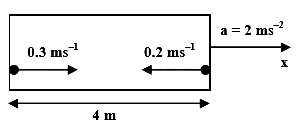
\( S_{\text {ice }} =2100 \mathrm{~J} / \mathrm{kg}, K=0.5 \mathrm{cal} / \mathrm{gK} \text { and } S_{\text {water }}=\) \(4200 \mathrm{~J} / \mathrm{kg}, K=1 \mathrm{cal} / \mathrm{gK} .\)JEE Advanced 2006 Easy - A rocket is moving in a gravity free space with a constant acceleration of along + x direction (see figure). The length of a chamber inside the rocket is 4 m. A ball is thrown from the left end of the chamber in + x direction with a speed of relative to the rocket. At the same time, another ball is thrown in - x direction with a speed of from its right end relative to the rocket. The time in seconds when the two balls hit each other for the first time is
 JEE Advanced 2014 Medium
 - A tiny spherical oil drop carrying a net charge \(q\) is balanced in still air with a vertical uniform electric field of strength \(\frac{81 \pi}{7} \times 10^5 \mathrm{Vm}^{-1}\). When the field is switched off, the drop is observed to fall with terminal velocity \(2 \times 10^{-3} \mathrm{~ms}^{-1}\). Given \(g=9.8 \mathrm{~ms}^{-2}\), viscosity of the air \(=1.8 \times 10^{-5} \mathrm{Ns} \mathrm{m}^{-2}\) and the density of oil \(=900 \mathrm{~kg} \mathrm{~m}^{-3}\), the magnitude of \(q\) isJEE Advanced 2010 Hard
- Which of the following statement(s) is (are) correct about the spectrum of hydrogen atom?JEE Advanced 2021 Medium
- An electric dipole is formed by two charges and located in -plane at and , respectively, as shown in the figure. The electric potential at point due to the dipole is . The charges and are then moved to the points and , respectively. What is the value of electric potential atJEE Advanced 2023 Medium
- and are two identical sound sources of frequency . The source is located at and moves anti-clockwise with a uniform speed on a circular path around , as shown in the figure. There are three points and on this path such that and are diametrically opposite while is equidistant from them. A sound detector is placed at point . The source can move along direction .
[Given: The speed of sound in air is ]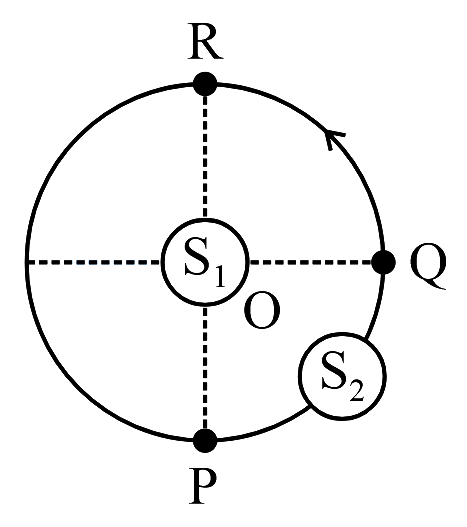
When only is emitting sound and it is at , the frequency of sound measured by the detector in is _____.JEE Advanced 2023 Easy
More PYQs from JEE Advanced
- The area of the region
isJEE Advanced 2021 Easy - Two resistances and are connected to a wire of uniform resistivity, as shown in the figure. The radius of the wire varies linearly along its axis from at to at . A galvanometer connected to the center of the wire, from each end along its axis, shows zero deflection when and are connected to a battery. The value of is _______.
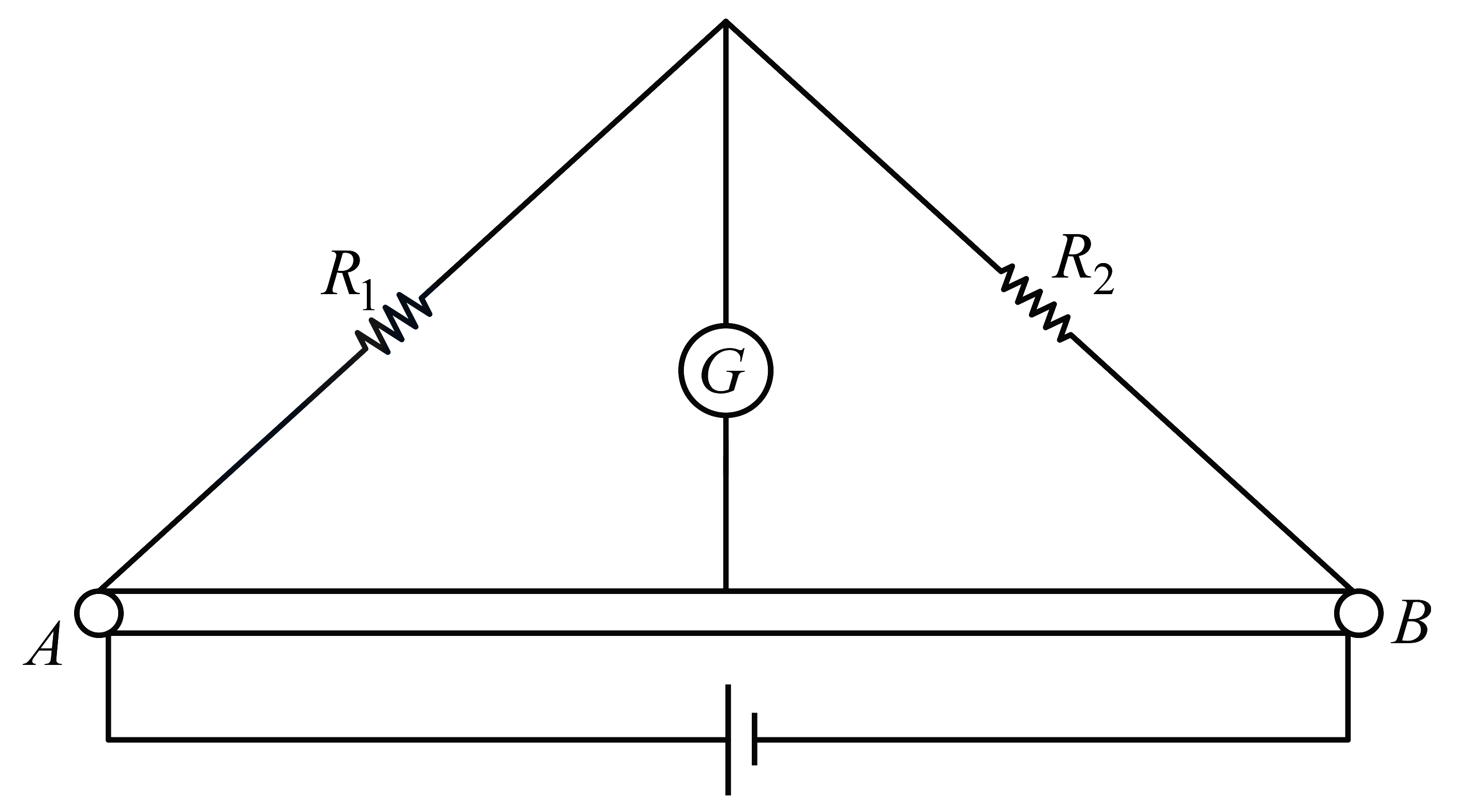 JEE Advanced 2022 Medium
 - Let be the origin and and for some If then which of the following statements is (are) TRUE?JEE Advanced 2021 Medium
- Let \(X\) be a random variable, and let \(P(X=x)\) denote the probability that \(X\) takes the value \(x\). Suppose that the points \((x, P(X=x)), x=0,1,2,3,4\), lie on a fixed straight line in the \(x y\)-plane, and \(P(X=x)=0\) for all \(x \in \mathbb{R}-\{0,1,2,3,4\}\). If the mean of \(X\) is \(\frac{5}{2}\), and the variance of \(X\) is \(\alpha\), then the value of \(24 \alpha\) is ___JEE Advanced 2024 Hard
- Let and be vectors in three-dimensional space, where and are unit vectors which are not perpendicular to each other and .
If the volume of the parallelopiped, whose adjacent sides are represented by the vectors and , is , then the value of isJEE Advanced 2021 Medium - The correct statement(s) concerning the structures E, F and G is are
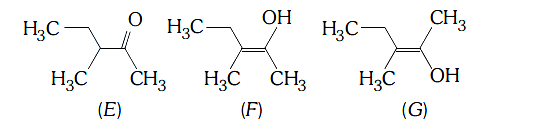 JEE Advanced 2008 Easy