


JEE Advanced · Chemistry · 4. Chemical Bonding
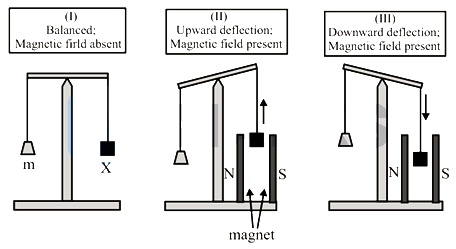
In an experiment, m grams of a compound X (gas/liquid/solid) taken in a container is loaded in a balance as shown in figure I below. In the presence of a magnetic field, the pan with X is either deflected upwards (figure II), or deflected downwards (figure III), depending on the compound X. Identify the correct statement(s).
- A If is deflection of the pan is upwards.
- B If is deflection of the pan is upwards.
- C If deflection of the pan is downwards.
- D If is deflection of the pan is downwards
Answer & Solution
Correct Answer
(A) If is deflection of the pan is upwards.
Step-by-step Solution
Detailed explanation
Paramagnetic substance attracted by magnetic field so magnetic balance show downward deflection.
While diamagnetic substance show repulsion in magnetic field show magnetic balance show upward
deflection.
While diamagnetic substance show repulsion in magnetic field show magnetic balance show upward
deflection.
| Compound | Magnetic Nature | Deflection | |
| Diamagnetic | Upward | ||
| Diamagnetic | Upward | ||
| Paramagnetic | Downward | ||
| Diamagnetic | Upward |
See the Complete Solution
Get step-by-step explanations for this and 2.5 Lakh+ more JEE, NEET & CET questions.
- Unlock all solutions
- Practice the full chapter
- Track accuracy across PYQs
4.8 rated on Google Play · 14,000+ reviews
More questions from Chemistry
- Among \(\mathrm{V}(\mathrm{CO})_6, \mathrm{Cr}(\mathrm{CO})_5, \mathrm{Cu}(\mathrm{CO})_3,\)\(\operatorname{Mn}(\mathrm{CO})_5, \mathrm{Fe}(\mathrm{CO})_5,\left[\mathrm{Co}(\mathrm{CO})_3\right]^{3-},\left[\mathrm{Cr}(\mathrm{CO})_4\right]^{4-}\), and \(\operatorname{Ir}(\mathrm{CO})_3\), the total number of species isoelectronic with \(\mathrm{Ni}(\mathrm{CO})_4\) is ________.
[Given, atomic number:\(\mathrm{V}=23, \mathrm{Cr}=24, \mathrm{Mn}=25,\) \(\mathrm{Fe}=26, \mathrm{Co}=27, \mathrm{Ni}=28, \mathrm{Cu}=29,\) \(\mathrm{Ir}=77\)]JEE Advanced 2024 Easy - The given graphs/data I, II, III and IV represent general trends observed for different physisorption and chemisorption processes under mild conditions of temperature and presure. Which of the following
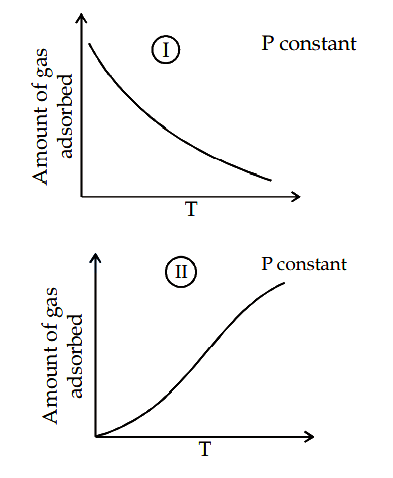
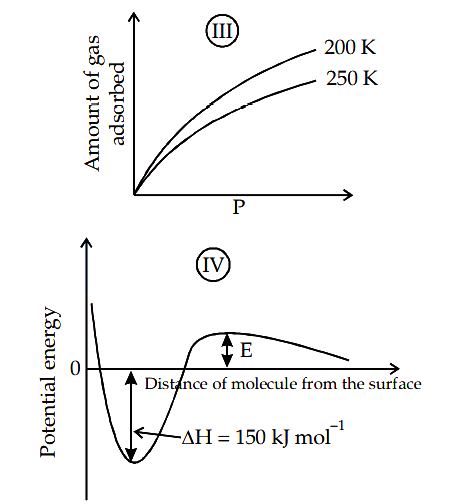 JEE Advanced 2012 Easy
 - For the electrochemical cell, the standard emf of the cell is at When the concentration of is changed to the cell potential changes to at The value of is ________.
(given, where is the Faraday constant and is the gas constants, )JEE Advanced 2018 Medium - Paragraph:
There are some deposits of nitrates and phosphates in earth's crust. Nitrates are more soluble in water. Nitrates are difficult to reduce under the laboratory conditions but microbes do it easily. Ammonia forms large number of complexes with transition metal ions. Hybridisation easily explains the ease of sigma donation capability of \(\mathrm{NH}_3\) and \(\mathrm{PH}_3\). Phosphine is a flammable gas and is prepared from white phosphorus.
Question:
White phosphorus on reaction with \(\mathrm{NaOH}\) gives \(\mathrm{PH}_3\) as one of the products. This is aJEE Advanced 2008 Easy - Paragraph :
Redox reaction play a pivotal role in chemistry and biology. The values of standard redox potential \(\left(E^{\circ}\right)\) of two half-cell reactions decide which way the reaction is expected to proceed. A simple example is a Daniel cell in which zinc goes into solution and copper gets deposited. Given below are a set of half-cell reactions (acidic medium) along with their \(E^{\circ}(V\) with respect to normal hydrogen electrode) values. Using this data obtain the correct explanations to Questions 14-19.
\(\mathrm{I}_2+2 e^{-} \longrightarrow 2 \mathrm{I}^{-} E^{\circ}=0.54 \)
\( \mathrm{Cl}_2+2 e^{-} \longrightarrow 2 \mathrm{Cl}^{-} E^{\circ}=1.36 \)
\( \mathrm{Mn}^{3+}+e^{-} \longrightarrow \mathrm{Mn}^{2+} E^{\circ}=1.50 \)
\( \mathrm{Fe}^{3+}+e^{-} \longrightarrow \mathrm{Fe}^{2+} E^{\circ}=0.77 \)
\( \mathrm{O}_2+4 \mathrm{H}^{+}+4 e^{-} \longrightarrow 2 \mathrm{H}_2 \mathrm{O} E^{\circ}=1.23\)
Question :
Sodium fusion extract, obtained from aniline, on treatment with iron (II) sulphate and \(\mathrm{H}_2 \mathrm{SO}_4\) in presence of air gives a prussian blue precipitate. The blue colour is due to the formation ofJEE Advanced 2007 Medium - The correct statement(s) regarding,
(i)
(ii)
(iii) and
(iv) is /areJEE Advanced 2015 Medium
More PYQs from JEE Advanced
- Reaction of \(\mathbf{x}\) g of \(\mathrm{Sn}\) with \(\mathrm{HCl}\) quantitatively produced a salt. Entire amount of the salt reacted with \(\mathbf{y} g\) of nitrobenzene in the presence of required amount of \(\mathrm{HCl}\) to produce \(1.29 \mathrm{~g}\) of an organic salt (quantitatively).
(Use Molar masses (in \(\mathrm{g} \mathrm{mol}^{-1}\) ) of \(\mathrm{H}, \mathrm{C}, \mathrm{N}, \mathrm{O}, \mathrm{Cl}\) and \(\mathrm{Sn}\) as \(1,12,14,16,35\) and 119 , respectively).
The value of is _______ .JEE Advanced 2021 Easy - The major products obtained from the reactions in List-II are the reactants for the named reactions mentioned in List-I. Match each entry in List-I with the appropriate entry in List-II and choose the correct options.
List - I List - II (P) Stephen reaction (1) 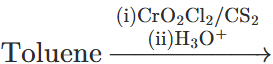
(Q) Sandmeyer reaction (2) 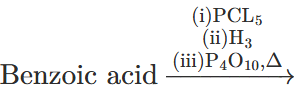
(R) Hoffmann bromamide degradation reaction (3) 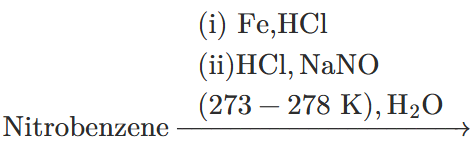
(S) Cannizzaro reaction (4) 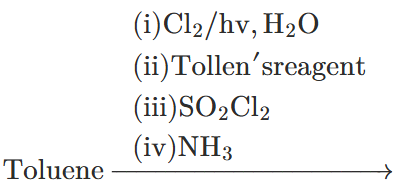
(5) 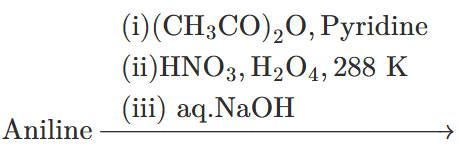 JEE Advanced 2025 Hard
 - Match the following columns
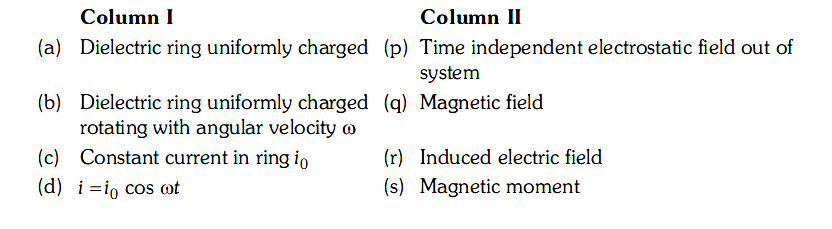 JEE Advanced 2006 Hard
 - For (the set of all real numbers), , Then a =JEE Advanced 2013 Hard
- An incandescent bulb has a thin filament of tungsten that is heated to high temperature by passing an electric current. The hot filament emits black-body radiation. The filament is observed to break up at random locations after a sufficiently long time of operation due to non-uniform evaporation of tungsten from the filament. If the bulb is powered at constant voltage, which of the following statement(s) is(are) true?JEE Advanced 2016 Easy
- Consider all possible permutations of the letters of the word ENDEANOEL. Match the Statements/Expressions in Column I with the Statements/Expressions in Column II.
Column I Column II (A)The number of permutations containing the word ENDEA, is (p) \(5 !\) (B) The number of permutations in which the letter E occurs in the first and the last positions, is (q) \(2 \times 5!\) (C) The number of permutations in which none of the letters D, L, N occurs in the last five positions, is (r) \(7 \times 5!\) (D) The number of permutations in which the letters A, E, O occur only in odd positions, is (s) \(21 \times 5!\) JEE Advanced 2008 Medium