


JEE Advanced · Physics · 13. Thermodynamics
A thermally isolated cylindrical closed vessel of height is kept vertically. It is divided into two equal parts by a diathermic (perfect thermal conductor) frictionless partition of mass . Thus the partition is held initially at a distance of from the top, as shown in the schematic figure below. Each of the two parts of the vessel contains mole of an ideal gas at temperature . The partition is now released and moves without any gas leaking from one part of the vessel to the other. When equilibrium is reached, the distance of the partition from the top (in ) will be ____________ (take the acceleration due to gravity and the universal gas constant).
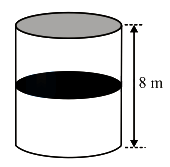
- A 2
- B 4
- C 6
- D 8
Answer & Solution
Correct Answer
(C) 6
Step-by-step Solution
Detailed explanation
Initially for both part
Let final distance of piston from top is
Let final distance of piston from top is
See the Complete Solution
Get step-by-step explanations for this and 2.5 Lakh+ more JEE, NEET & CET questions.
- Unlock all solutions
- Practice the full chapter
- Track accuracy across PYQs
4.8 rated on Google Play · 14,000+ reviews
More questions from Physics
- A train is moving along a straight line with a constant acceleration a. A boy standing in the train throws a ball forward with a speed of \(10 \mathrm{~m} / \mathrm{s}\), at an angle of \(60^{\circ}\) to the horizontal. The boy has to move forward by \(1.15 \mathrm{~m}\) inside the train to catch the ball back at the initial height. The acceleration of the train in \(\mathrm{m} / \mathrm{s}^2\), isJEE Advanced 2011 Medium
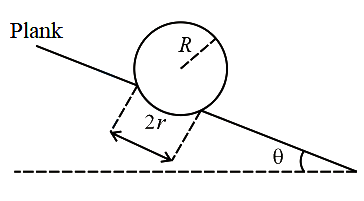
- A football of radius is kept on a hole of radius made on a plank kept horizontally. One end of the plank is now lifted so that it gets tilted making an angle from the horizontal as shown in the figure below. The maximum value of so that the football does not start rolling down the plank satisfies (figure is schematic and not drawn to scale)
 JEE Advanced 2020 Easy
 - An \(\alpha\)-particle and a proton are accelerated from rest by a potential difference of \(100 \mathrm{~V}\). After this, their de Broglie wavelengths are \(\lambda_\alpha\) and \(\lambda_p\) respectively. The ratio \(\frac{\lambda_p}{\lambda_\alpha}\), to the nearest integer, isJEE Advanced 2010 Medium
- One mole of a monatomic ideal gas undergoes the cyclic process \(\mathrm{J} \rightarrow \mathrm{K} \rightarrow \mathrm{L} \rightarrow \mathrm{M} \rightarrow \mathrm{J}\), as shown in the P-T diagram.
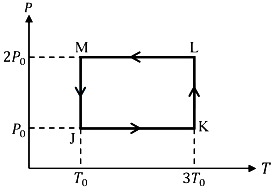
Match the quantities mentioned in List-I with their values in List-II and choose the correct option.
[\(\mathcal{R}\) is the gas constant.]List-I List-II (P) Work done in the complete cyclic process (1) \(R T_0-4 R T_0 \ln 2\) (Q) Change in the internal energy of the gas in the process JK (2) \(0\) (R) Heat given to the gas in the process KL (3) \(3 K T_0\) (S) Change in the internal energy of the gas in the process MJ (4) \(-2 R T_0 \ln 2\) \((5)-3 R T_0 \ln 2\) JEE Advanced 2024 Medium - Two spherical planets \(P\) and \(Q\) have the same uniform density \(\rho\), masses \(M_{P}\) and \(M_{Q}\) and surface areas \(A\) and 4A respectively. A spherical planet \(R\) also has uniform density \(\rho\) and its mass is \(\left(M_{P}+M_{Q}\right)\). The escape velocities from the planets \(P, Q\) and \(R\) are \(V_{P}, V_{Q}\) and \(V_{R}\), respectively. ThenJEE Advanced 2012 Medium
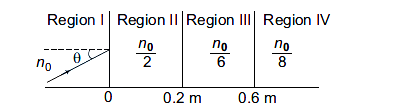
- A light beam is travelling from Region I to Region IV (refer figure). The refractive index in Region I, II, III and IV are \(n_0, \frac{n_0}{2}, \frac{n_0}{6}\) and \(\frac{n_0}{8}\), respectively. The angle of incidence \(\theta\) for which the beam just misses entering Region IV is
 JEE Advanced 2008 Easy
More PYQs from JEE Advanced
- Paragraph :
When a particle of mass \(m\) moves on the \(x\)-axis in a potential of the form \(V(x)=k x^2\), it performs simple harmonic motion.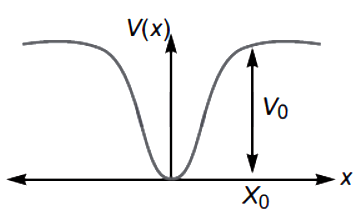
The corresponding time period is proportional to \(\sqrt{\frac{m}{k}}\), as can be seen easily using dimensional analysis. However, the motion of a particle can be periodic even when its potential energy increases on both sides of \(x=0\) in a way different from \(k x^2\) and its total energy is such that the particle does not escape to infinity. Consider a particle of mass \(\mathrm{m}\) moving on the \(x\)-axis. Its potential energy is \(V(x)=\alpha x^4(\alpha>0)\) for \(|x|\) near the origin and becomes a constant equal to \(V_0\) for \(|x| \geq X_0\) (see figure).
Question :
For periodic motion of small amplitude \(A\), the time period \(T\) of this particle is proportional toJEE Advanced 2010 Hard - Paragraph:
The mass of a nucleus \({ }_{Z}^{A} X\) is less than the sum of the masses of \((A-Z)\) number of neutrons and \(Z\) number of protons in the nucleus. The energy equivalent to the corresponding mass difference is known as the binding energy of the nucleus. A heavy nucleus of mass \(M\) can break into two light nuclei of masses \(m_{1}\) and \(m_{2}\) only if \(\left(m_{1}+m_{2}\right) \lt M\). Also two light nuclei of masses \(m_{3}\) and \(m_{4}\) can undergo complete fusion and form a heavy nucleus of mass \(M^{\prime}\) only if \(\left(m_{3}+m_{4}\right) \gt M^{\prime}\). The masses of some neutral atoms are given in the table below:
\(\left(1 u=932 M e V / c^{2}\right)\)
Question:
The kinetic energy (in \(k e V\) ) of the alpha particle, when the nucleus \({ }_{84}^{210} P o\) at rest undergoes alpha decay, isJEE Advanced 2013 Easy - A steady current flows along an infinitely long hollow cylindrical conductor of radius . This cylinder is placed co-axially inside an infinite solenoid of radius . The solenoid has turns per unit length and carries a steady current . Consider a point at a distance from the common axis. The correct statement(s) is(are):JEE Advanced 2013 Medium
- Let \(\vec{w}=\hat{i}+\hat{j}-2 \hat{k}\), and \(\overrightarrow{\mathrm{u}}\) and \(\overrightarrow{\mathrm{v}}\) be two vectors such that \(\vec{u} \times \vec{v}=\vec{w}\) and \(\vec{v} \times \vec{w}=\vec{u}\). Let \(\alpha, \beta, \gamma\) and \(t\) be real numbers such that \(\vec{u}=\alpha \hat{i}+\beta \hat{j}+\gamma \hat{k},-t \alpha+\beta+\gamma=0, \alpha-t \beta+\gamma=0\), and \(\alpha+\beta-t \gamma=0\).
Match each entry in List-I to the correct entry in List-II and choose the correct option.
LIST - I LIST - II (P) \(|\vec{v}|^2\) is equal to (1) 0 (Q) If \(\alpha=\sqrt{3}\),then \(\gamma^2\) is equal to (2) 1 (R) If \(\alpha=\sqrt{3}\),then \((\beta+\gamma)^2\) is equal to (3) 2 (S) If \(\alpha=\sqrt{2}\),then \(t+3\) is equal to (4) 3 (5) 5 JEE Advanced 2025 Hard - In the Young's double slit experiment using a monochromatic light of wavelength , the path difference ( in terms of an integer ) corresponding to any point having half the peak intensity isJEE Advanced 2013 Medium
- A cylindrical vessel of height \(500 \mathrm{~mm}\) has an orifice (small hole) at its bottom. The orifice is initially closed and water is filled in it upto height \(H\). Now the top is completely sealed with a cap and the orifice at the bottom is opened. Some water comes out from the orifice and the water level in the vessel becomes steady with height of water column being 200 \(\mathrm{mm}\). Find the fall in height (in \(\mathrm{mm}\) ) of water level due to opening of the orifice.
[Take atmospheric pressure \(=1.0 \times 10^5 \mathrm{Nm}^{-2}\), density of water \(=1000 \mathrm{~kg} \mathrm{~m}^{-3}\) and \(g=10\) \(\mathrm{ms}^{-2}\). Neglect any effect of surface tension.]JEE Advanced 2009 Easy