


JEE Advanced · Physics · 9. Gravitation
Two spherical planets \(P\) and \(Q\) have the same uniform density \(\rho\), masses \(M_{P}\) and \(M_{Q}\) and surface areas \(A\) and 4A respectively. A spherical planet \(R\) also has uniform density \(\rho\) and its mass is \(\left(M_{P}+M_{Q}\right)\). The escape velocities from the planets \(P, Q\) and \(R\) are \(V_{P}, V_{Q}\) and \(V_{R}\), respectively. Then
- A \(V_{Q}>V_{R}>V_{P}\)
- B \(V_{R}>V_{Q}>V_{P}\)
- C \(V_{R} / V_{P}=3\)
- D \(V_{P} / V_{Q}=\frac{1}{2}\)
Answer & Solution
Correct Answer
(D) \(V_{P} / V_{Q}=\frac{1}{2}\)
Step-by-step Solution
Detailed explanation
Here Planets \(P\) and \(Q\) have the same uniform density ' \(\rho\) ' and surface areas \(A\) and \(4 A\) respectively. Let the mass of \(P, M_{P}\) be \(m\).
Then \(m=\rho \times \frac{4}{3} \pi r^{3}=\rho \times \frac{4}{3} \pi\left[\frac{A}{4 \pi}\right]^{3 / 2}\)
The mass of \(M_{Q}=\rho \times \frac{4}{3} \pi\left[\frac{4 A}{4 \pi}\right]^{3 / 2}=8 \mathrm{~m}\)
\(\therefore \quad\) The mass of Planet \(R=8 \mathrm{~m}+\mathrm{m}=9 \mathrm{~m}\)
If the radius of \(P=r\)
Then the radius of \(Q=2 r\)
\(\left[\because r_{Q}=\left(\frac{4 A}{4 \pi}\right)^{3 / 2}=2\left(\frac{A}{4 \pi}\right)^{3 / 2}\right]\)
and radius of \(R=9^{1 / 3} r\)
\(\left[\begin{array}{l}
\because M_{R}=M_{P}+M_{Q} \\
r_{R}^{3}=r^{3}+(2 r)^{3}=9 r^{3}
\end{array}\right]\)
As we know, escape velocity from the planet
\(V_{e}=\sqrt{\frac{2 G M}{R}} \therefore v_{P}=\sqrt{\frac{2 G M_{P}}{R_{p}}}=\sqrt{\frac{2 G m}{r}} \)
\( v_{Q} =\sqrt{\frac{2 G M_{Q}}{R_{Q}}}=\sqrt{\frac{2 G(8 \mathrm{~m})}{2 r}}=2 v_{P} \)
\( v_{R} =\sqrt{\frac{2 G(9 \mathrm{~m})}{9^{1 / 3} r}}=9^{1 / 3} v_{P}\)
Then \(m=\rho \times \frac{4}{3} \pi r^{3}=\rho \times \frac{4}{3} \pi\left[\frac{A}{4 \pi}\right]^{3 / 2}\)
The mass of \(M_{Q}=\rho \times \frac{4}{3} \pi\left[\frac{4 A}{4 \pi}\right]^{3 / 2}=8 \mathrm{~m}\)
\(\therefore \quad\) The mass of Planet \(R=8 \mathrm{~m}+\mathrm{m}=9 \mathrm{~m}\)
If the radius of \(P=r\)
Then the radius of \(Q=2 r\)
\(\left[\because r_{Q}=\left(\frac{4 A}{4 \pi}\right)^{3 / 2}=2\left(\frac{A}{4 \pi}\right)^{3 / 2}\right]\)
and radius of \(R=9^{1 / 3} r\)
\(\left[\begin{array}{l}
\because M_{R}=M_{P}+M_{Q} \\
r_{R}^{3}=r^{3}+(2 r)^{3}=9 r^{3}
\end{array}\right]\)
As we know, escape velocity from the planet
\(V_{e}=\sqrt{\frac{2 G M}{R}} \therefore v_{P}=\sqrt{\frac{2 G M_{P}}{R_{p}}}=\sqrt{\frac{2 G m}{r}} \)
\( v_{Q} =\sqrt{\frac{2 G M_{Q}}{R_{Q}}}=\sqrt{\frac{2 G(8 \mathrm{~m})}{2 r}}=2 v_{P} \)
\( v_{R} =\sqrt{\frac{2 G(9 \mathrm{~m})}{9^{1 / 3} r}}=9^{1 / 3} v_{P}\)
See the Complete Solution
Get step-by-step explanations for this and 2.5 Lakh+ more JEE, NEET & CET questions.
- Unlock all solutions
- Practice the full chapter
- Track accuracy across PYQs
4.8 rated on Google Play · 14,000+ reviews
More questions from Physics
- One mole of a monoatomic ideal gas goes through a thermodynamic cycle, as shown in the volume versus temperature diagram. The correct statement(s) is/are:
[ is the gas constant]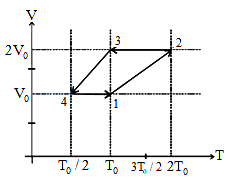 JEE Advanced 2019 Medium
 - Paragraph :
\(\mathbf{P}_{17 \text { - } 19}\) : Paragraph for Questions Nos. 17 to 19 Two discs \(A\) and \(B\) are mounted coaxially on a vertical axle. The discs have moments of inertia I and 2I, respectively about the common axis. Disc \(A\) is imparted an initial angular velocity \(2 \omega\) using the entire potential energy of a spring compressed by a distance \(x_1\). Disc \(B\) is imparted an angular velocity \(\omega\) by a spring having the same spring constant and compressed by a distance \(x_2\). Both the discs rotate in the clockwise direction.
Question :
The loss of kinetic energy during the above process isJEE Advanced 2007 Easy - Three identical capacitors have a capacitance of each and they are uncharged initially. They are connected in a circuit as shown in the figure and is then filled completely with a dielectric material of relative permittivity . The cell electromotive force (emf) . First the switch is closed while the switch is kept open. When the capacitor is fully charged, is opened and is closed simultaneously. When all the capacitors reach equilibrium, the charge on is found to be . The value of =____________.
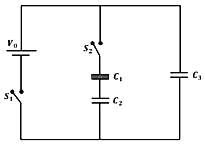 JEE Advanced 2018 Medium
 - In the List-I below, four different paths of a particle are given as functions of time. In these functions, are positive constants of appropriate dimensions and . In each case, the force acting on the particle is either zero or conservative. In List-II, five physical quantities of the particle are mentioned: is the linear momentum, is the angular momentum about the origin, K is the kinetic energy, U is the potential energy and E is the total energy. Match each path in List-I with those quantities in List-II, which are conserved for that path.
LIST -I LIST-II A) P) B) Q) C) R) D) S) T) JEE Advanced 2018 Medium - A block of weight is suspended by copper and steel wires of same cross-sectional area and, length and respectively. Their other ends are fixed on a ceiling as shown in figure. The angles subtended by copper and steel wires with ceiling are and respectively. If elongation in copper wire is and elongation in steel wire is then the ratio is _____.
[Young's modulus for copper and steel are and respectively]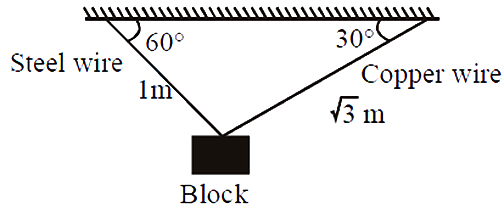 JEE Advanced 2019 Medium
 - Paragraph :
In the figure a container is shown to have a movable (without friction) piston on top. The container and the piston are all made of perfectly insulating material allowing no heat transfer between outside and inside the container. The container is divided into two compartments by a rigid partition made of a thermally conducting material that allows slow transfer of heat. The lower compartment of the container is filled with \(2\) moles of an ideal monatomic gas at \(700 K\) and the upper compartment is filled with \(2\) moles of an ideal diatomic gas at \(400 K\). The heat capacities per mole of an ideal monatomic gas are \(C_{V}=\frac{3}{2} R, C_{P}=\frac{5}{2} R\), and those for an ideal diatomic gas are \(C_{V}=\frac{5}{2} R, C_{P}=\frac{7}{2} R\).
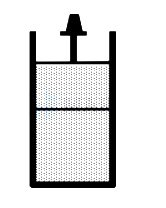
Question :
Consider the partition to be rigidly fixed so that it does not move. When equilibrium is achieved, the final temperature of the gases will beJEE Advanced 2014 Medium
More PYQs from JEE Advanced
- Paragraph:
Scientists are working hard to develop nuclear fusion reactor. Nuclei of heavy hydrogen, \({ }_1^2 \mathrm{H}\) known as deuteron and denoted by \(D\) can be thought of as a candidate for fusion reactor. The \(D\) - \(D\) reaction is \({ }_1^2 \mathrm{H}+{ }_1^2 \mathrm{H} \rightarrow{ }_2^3 \mathrm{He}+n+\) energy. In the core of fusion reactor. A gas of heavy hydrogen is fully ionized into deuteron nuclei and electrons. This collection of \({ }_1^4 \mathrm{H}\) nuclei and electrons is known as plasma. The nuclei move randomly in the reactor core and occasionally come close enough for nuclear fusion to take place. Usually, the temperatures in the reactor core are too high and no material wall can be used to confine the plasma. Special techniques are used which confine the plasma for a time \(t_0\) before the particles fly away from the core. If n is the density (number/volume) of deutrons, the product t \(_0\) is called Lawson number. In one of the criteria, \(a\) reactor is termed successful if Lawson number is greater than \(5 \times 10^{14} \mathrm{scm}^{-3}\).
It may be helpful to use the following : Boltzmann constant \(k=8.6 \times 10^{-5} \mathrm{eV} / \mathrm{K}\); \(\frac{e^2}{4 \pi \varepsilon_0}=1.44 \times 10^{-9} \mathrm{eVm}\)
Question:
In the core of nuclear fusion reactor, the gas becomes plasma because ofJEE Advanced 2009 Medium - The correct option(s) related to the extraction of iron from its ore in the blast furnace operating in the temperature range is(are)JEE Advanced 2022 Medium
- Let \(f: \mathbb{R} \rightarrow \mathbb{R}\) and \(g: \mathbb{R} \rightarrow \mathbb{R}\) be functions defined by
\(f(x)=\left\{\begin{array}{ll}x|x| \sin \left(\frac{1}{x}\right), & x \neq 0, \\ 0, & x=0,\end{array} \quad\right.\) and \(g(x)= \begin{cases}1-2 x, & 0 \leq x \leq \frac{1}{2} \\ 0, & \text { otherwise }\end{cases}\)
Let \(a, b, c, d \in \mathbb{R}\). Define the function \(h: \mathbb{R} \rightarrow \mathbb{R}\) by
\(h(x)=a f(x)+b\left(g(x)+g\left(\frac{1}{2}-x\right)\right)+c(x-g(x))+d g(x), x \in \mathbb{R}\)
Match each entry in List-I to the correct entry in List-II.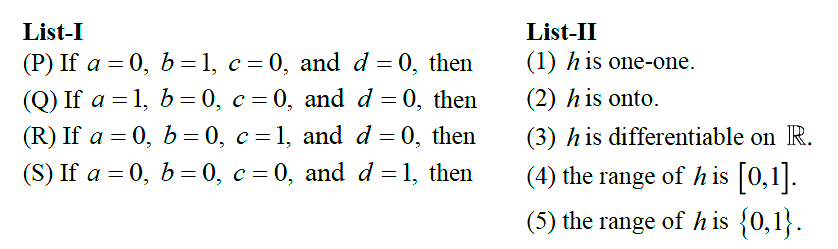
The correct option is :JEE Advanced 2024 Hard - A circular disc of radius carries surface charge density , where is a constant and is the distance from the center of the disc. Electric flux through a large spherical surface that encloses the charged disc completely is . Electric flux through another spherical surface of radius and concentric with the disc is . Then the ratio isJEE Advanced 2020 Hard
- Let be a complex number satisfying , where denotes the complex conjugate of . Let the imaginary part of be nonzero.
Match each entry in List-I to the correct entries in List-II.List - I List - II (P) \(|z|^2\) is equal to (1) 12 (Q) \(|z-\bar{z}|^2\) is equal to (2) 4 (R) \(|z|^2+|z+\bar{z}|^2\) is equal to (3) 8 (S) \(|z+1|^2\) is equal to (4) 10 (5) 7
The correct option isJEE Advanced 2023 Hard - The heating of \(\mathrm{NH}_4 \mathrm{NO}_2\) at \(60-70^{\circ} \mathrm{C}\) and \(\mathrm{NH}_4 \mathrm{NO}_3\) at \(200-250^{\circ} \mathrm{C}\) is associated with the formation of nitrogen containing compounds \(\mathbf{X}\) and \(\mathbf{Y}\), respectively. \(\mathbf{X}\) and \(\mathbf{Y}\), respectively, areJEE Advanced 2025 Easy