


JEE Advanced · Physics · 28. Nuclear Physics
Paragraph:
The mass of a nucleus \({ }_{Z}^{A} X\) is less than the sum of the masses of \((A-Z)\) number of neutrons and \(Z\) number of protons in the nucleus. The energy equivalent to the corresponding mass difference is known as the binding energy of the nucleus. A heavy nucleus of mass \(M\) can break into two light nuclei of masses \(m_{1}\) and \(m_{2}\) only if \(\left(m_{1}+m_{2}\right) \lt M\). Also two light nuclei of masses \(m_{3}\) and \(m_{4}\) can undergo complete fusion and form a heavy nucleus of mass \(M^{\prime}\) only if \(\left(m_{3}+m_{4}\right) \gt M^{\prime}\). The masses of some neutral atoms are given in the table below:

\(\left(1 u=932 M e V / c^{2}\right)\)
Question:
The kinetic energy (in \(k e V\) ) of the alpha particle, when the nucleus \({ }_{84}^{210} P o\) at rest undergoes alpha decay, is
- A
- B
- C
- D
Answer & Solution
Correct Answer
(A)
Step-by-step Solution
Detailed explanation
See the Complete Solution
Get step-by-step explanations for this and 2.5 Lakh+ more JEE, NEET & CET questions.
- Unlock all solutions
- Practice the full chapter
- Track accuracy across PYQs
4.8 rated on Google Play · 14,000+ reviews
More questions from Physics
- Two concentric circular loops, one of radius and the other of radius , lie in the -plane with the origin as their common center, as shown in the figure. The smaller loop carries current in the anti-clockwise direction and the larger loop carries current in the clockwise direction, with denotes the magnetic field at a point in the -plane. Which of the following statement(s) is (are) correct?
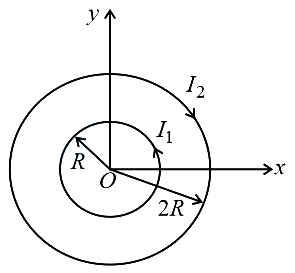 JEE Advanced 2021 Hard
 - A source of constant voltage is connected to a resistance and two ideal inductors and through a switch as shown. There is no mutual inductance between the two inductors. The switch is initially open. At , the switch is closed and current begins to flow. Which of the following options is/are correct?
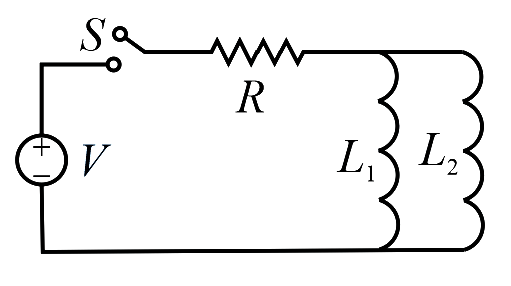 JEE Advanced 2017 Hard
 - Statement I The formula connecting \(u, v\) and \(f\) for a spherical mirror is valid only for mirrors whose sizes are very small compared to their radii of curvature.
Statement II Laws of reflection are strictly valid for plane surfaces, but not for large spherical surfaces.JEE Advanced 2007 Hard - The potential energy of a particle of mass m at a distance r from a fixed point O is given by , where k is a positive constant of appropriate dimensions. This particle is moving in a circular orbit of radius R about the point O. If v is the speed of the particle and L is the magnitude of its angular momentum about O, which of the following statements is (are) true?JEE Advanced 2018 Medium
- A small block of mass of \(0.1 \mathrm{~kg}\) lies on a fixed inclined plane PQ which makes an angle \(\theta\) with the horizontal. A horizontal force of \(1 \mathrm{~N}\) acts on the block through its centre of mass as shown in the figure.
The block remains stationary if (take \(g=10 \mathrm{~m} / \mathrm{s}^{2}\) )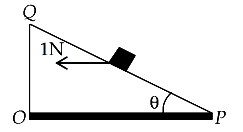 JEE Advanced 2012 Medium
 - Paragraph :
When liquid medicine of density \(\rho\) is to be put in the eye, it is done with the help of a dropper. As the bulb on the top of the dropper is pressed, a drop forms at the opening of the dropper. We wish to estimate the size of the drop.
We first assume that the drop formed at the opening is spherical because that requires a minimum increase in its surface energy. To determine the size, we calculate the net vertical force due to the surface tension \(T\) when the radius of the drop is \(R\). When this force becomes smaller than the weight of the drop, the drop gets detached from the dropper.
Question :
If \(r=5 \times 10^{-4} \mathrm{~m}, \rho=10^3 \mathrm{~kg} \mathrm{~m}^{-3}\), \(g=10 \mathrm{~ms}^{-2}, T=0.11 \mathrm{Nm}^{-1}\), the radius of the drop when it detaches from the dropper is approximatelyJEE Advanced 2010 Easy
More PYQs from JEE Advanced
- If \(w=\alpha+i \beta\), where \(\beta \neq 0\) and \(z \neq 1\) satisfies the condition that \(\left(\frac{w-\bar{w} z}{1-z}\right)\) is purely real, then the set of values of \(z\) isJEE Advanced 2006 Easy
- In the reaction scheme shown below, and are the major products.
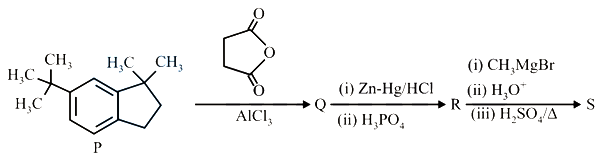
The correct structure ofJEE Advanced 2020 Hard - List I describes four systems, each with two particles and in relative motion as shown in figure. List II gives possible magnitudes of their relative velocities (in ) at time .
Which one of the following options is correct?List-I List-II (I) and are moving on a horizontal circle of radius with uniform angular speed . The initial angular positions of and at time are and respectively. 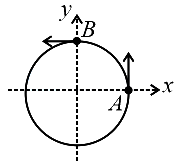
(P) (II) Projectiles and are fired (in the same vertical plane) at and respectively, with the same speed and at from the horizontal plane. The initial separation between and is large enough so that they do not collide, . 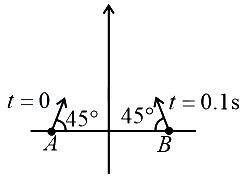
(Q) (III) Two harmonic oscillators and moving in the direction according to and respectively, starting from . Take . 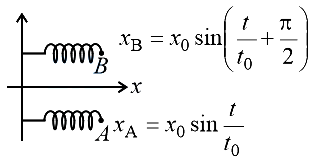
(R) (IV) Particle is rotating in a horizontal circular path of radius on the plane, with constant angular speed . Particle is moving up at a constant speed in the vertical direction as shown in the figure. (Ignore gravity.) 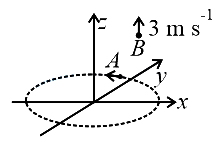
(S) (T) JEE Advanced 2022 Medium - Paragraph:
Let \(a\), b and \(c\) be three real numbers satisfying \(\left[\begin{array}{lll}a & b & c\end{array}\right]\left[\begin{array}{lll}1 & 9 & 7 \\ 8 & 2 & 7 \\ 7 & 3 & 7\end{array}\right]=\left[\begin{array}{lll}0 & 0 & 0\end{array}\right]\)Question:
If the point \(P(a, b, c)\), with reference to Eq. (E), lies on the plane \(2 x+y+z=1\), then the value of \(7 a+b+c\) isJEE Advanced 2011 Easy - Let be a continuous function such that and Then which of the following statements is (are) TRUE?JEE Advanced 2021 Medium
- The compound(s) formed upon combustion of sodium metal in excess air is (are)JEE Advanced 2009 Easy