


JEE Advanced · Physics · 15. Oscillations
Paragraph :
When a particle of mass \(m\) moves on the \(x\)-axis in a potential of the form \(V(x)=k x^2\), it performs simple harmonic motion.
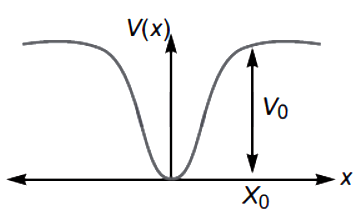
The corresponding time period is proportional to \(\sqrt{\frac{m}{k}}\), as can be seen easily using dimensional analysis. However, the motion of a particle can be periodic even when its potential energy increases on both sides of \(x=0\) in a way different from \(k x^2\) and its total energy is such that the particle does not escape to infinity. Consider a particle of mass \(\mathrm{m}\) moving on the \(x\)-axis. Its potential energy is \(V(x)=\alpha x^4(\alpha>0)\) for \(|x|\) near the origin and becomes a constant equal to \(V_0\) for \(|x| \geq X_0\) (see figure).
Question :
For periodic motion of small amplitude \(A\), the time period \(T\) of this particle is proportional to
- A \(A \sqrt{\frac{m}{\alpha}}\)
- B \(\frac{1}{A} \sqrt{\frac{m}{\alpha}}\)
- C \(A \sqrt{\frac{\alpha}{m}}\)
- D \(\frac{1}{A} \sqrt{\frac{\alpha}{m}}\)
Answer & Solution
Correct Answer
(B) \(\frac{1}{A} \sqrt{\frac{m}{\alpha}}\)
Step-by-step Solution
Detailed explanation
\([\alpha]=\left[\frac{\mathrm{PE}}{x^4}\right]=\left[\frac{\mathrm{ML}^2 \mathrm{~T}^{-2}}{\mathrm{~L}^4}\right]=\left[\mathrm{ML}^{-2} \mathrm{~T}^{-2}\right]\)
\(\therefore {\left[\frac{m}{\alpha}\right]=\left[\mathrm{L}^2 \mathrm{~T}^2\right]}\)
\(\therefore {\left[\frac{1}{A} \sqrt{\frac{m}{\alpha}}\right]=[\mathrm{T}]}\)
As dimensions of amplitude \(A\) is [L].
Hence, the correct option is (b).
\(\therefore {\left[\frac{m}{\alpha}\right]=\left[\mathrm{L}^2 \mathrm{~T}^2\right]}\)
\(\therefore {\left[\frac{1}{A} \sqrt{\frac{m}{\alpha}}\right]=[\mathrm{T}]}\)
As dimensions of amplitude \(A\) is [L].
Hence, the correct option is (b).
See the Complete Solution
Get step-by-step explanations for this and 2.5 Lakh+ more JEE, NEET & CET questions.
- Unlock all solutions
- Practice the full chapter
- Track accuracy across PYQs
4.8 rated on Google Play · 14,000+ reviews
More questions from Physics
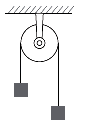
- A light inextensible string that goes over a smooth fixed pulley as shown in the figure connects two blocks of masses \(0.36 \mathrm{~kg}\) and \(0.72 \mathrm{~kg}\). Taking \(g=10 \mathrm{~ms}^{-2}\), find thework done (in Joule) by string on the block of mass \(0.36 \mathrm{~kg}\) during the first second after the system is released from rest.
 JEE Advanced 2009 Hard
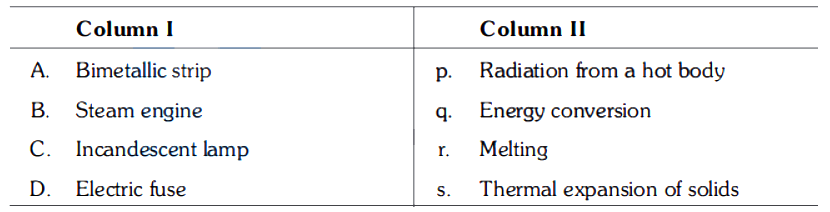
 - Column I gives some devices and Column II gives some processes on which the functioning of these devices depend. Match the devices in Column I with the processes in Column II and indicate your answer by darkening appropriate bubbles in the \(4 \times 4\) matrix given in the ORS.
 JEE Advanced 2007 Medium
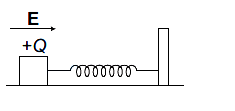
 - A wooden block performs SHM on a frictionless surface with frequency \(v_0\). The block carries a charge \(+Q\) on its surface. If now a uniform electric field \(\mathbf{E}\) is switched on as shown, then the SHM of the block will be
 JEE Advanced 2011 Easy
 - A parallel plate capacitor of capacitance has spacing d between two plates having area The region between the plates is filled with dielectric layers, parallel to its plates, each with thickness The dielectric constant of the layer is For a very large the capacitance is The value of will be____
is the permittivity of free space]JEE Advanced 2019 Hard - Two bodies, each of mass , are kept fixed with a separation of . A particle of mass is projected from the midpoint of the line joining their centers, perpendicular to the line. The gravitational constant is . The correct statement (s) is (are) :JEE Advanced 2013 Medium
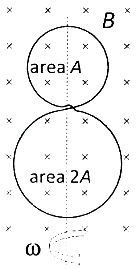
- A circular insulated copper wire loop is twisted to form two loops of area and as shown in the figure. At the point of crossing the wires remain electrically insulated from each other. The entire loop lies in the plane (of the paper). A uniform magnetic field points into the plane of the paper. At , the loop starts rotating about the common diameter as axis with a constant angular velocity in the magnetic field. Which of the following options is/are correct?
 JEE Advanced 2017 Hard
More PYQs from JEE Advanced
- Paragraph:
Let \(U_1\) and \(U_2\) be two urns such that \(U_1\) contains 3 white and 2 red balls and \(U_2\) contains only 1 white ball. A fair coin is tossed. If head appears then 1 ball is drawn at random from \(U_1\) and put into \(U_2\). However, if tail appears then 2 balls are drawn at random from \(U_1\) and put into \(U_2\). Now, 1 ball is drawn at random from \(U_2\).Question:
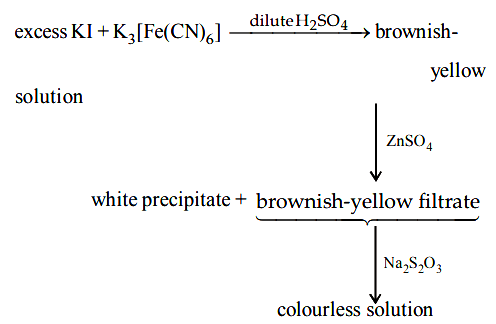
The probability of the drawn ball from \(U_2\) being white isJEE Advanced 2011 Medium - For the given aqueous reactions, which of the statement (s) is (are) true?
 JEE Advanced 2012 Medium
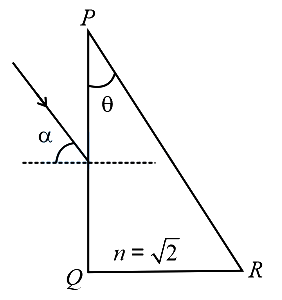
 - A parallel beam of light is incident from air at an angle on the side PQ of a right angled triangular prism of refractive index . Light undergoes total internal reflection in the prism at the face PR when has a minimum value of The angle of the prism is:
 JEE Advanced 2016 Easy
 - Answer the following by appropriately matching the lists based on the information given in the paragraph.
A musical instrument is made using four different metal strings, and with mass per unit length and respectively. The instrument is played by vibrating the strings by varying the free length in between the range and It is found that in string- at free length and tension the fundamental mode frequency is
List-I gives the above four strings while list-II lists the magnitude of some quantity.String String String String
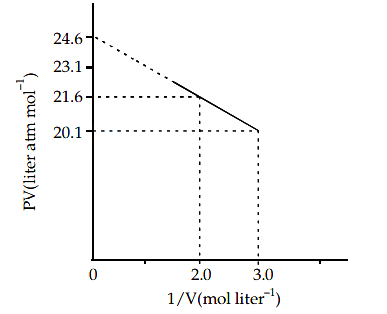
The length of the strings and are kept fixed at and respectively. Strings and are vibrated at their and harmonics, respectively such that all the strings have same frequency. The correct match for the tension in the four strings in the units of will be.JEE Advanced 2019 Easy - For one mole of a van der Waal's gas when \(b=0\) and \(\mathrm{T}=300 \mathrm{~K}\), the PV vs, \(1 / \mathrm{V}\) plot is shown below. The value of the van der Waal's constant \(a\) (atm. liter \({ }^{2} \mathrm{~mol}^{-2}\) ) is :
 JEE Advanced 2012 Easy
 - Paragraph:
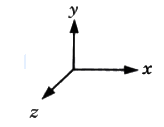
In a thin rectangular metallic strip a constant current \(I\) flows along the positive \(x\)-direction, as shown in the figure. The length, width and thickness of the strip are \(l, w\) and \(d\), respectively.
A uniform magnetic field \(\vec{B}\) is applied on the strip along the positive \(y\)-direction. Due to this, the charge carriers experience a net deflection along the \(z\)-direction. This results in accumulation of charge carriers on the surface \(P Q R S\) and appearance of equal and opposite charges on the face opposite to \(P Q R S\). A potential difference along the \(z\)-direction is thus developed. Charge accumulation continues until the magnetic force is balanced by the electric force. The current is assumed to be uniformly distributed on the cross section of the strip and carried by electrons.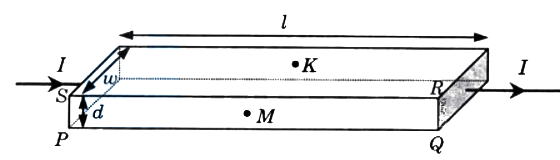
Question:
Consider two different metallic strips (\(1\) and \(2\)) of same dimensions (length \(l\), width \(w\) and thickness \(d\) ) with carrier densities \(n_{1}\) and \(n_{2}\), respectively. Strip \(1\) is placed in magnetic field \(B_{1}\) and strip \(2\) is placed in magnetic field \(B_{2}\), both along positive \(y\)-directions. Then \(V_{1}\) and \(V_{2}\) are the potential differences developed between \(K\) and \(M\) in strips \(1\) and \(2\), respectively. Assuming that the current \(I\) is the same for both the strips, the correct option(s) is(are)JEE Advanced 2015 Medium