


JEE Advanced · Mathematics · 30. Vector Algebra
Let \(\vec{w}=\hat{i}+\hat{j}-2 \hat{k}\), and \(\overrightarrow{\mathrm{u}}\) and \(\overrightarrow{\mathrm{v}}\) be two vectors such that \(\vec{u} \times \vec{v}=\vec{w}\) and \(\vec{v} \times \vec{w}=\vec{u}\). Let \(\alpha, \beta, \gamma\) and \(t\) be real numbers such that \(\vec{u}=\alpha \hat{i}+\beta \hat{j}+\gamma \hat{k},-t \alpha+\beta+\gamma=0, \alpha-t \beta+\gamma=0\), and \(\alpha+\beta-t \gamma=0\).
Match each entry in List-I to the correct entry in List-II and choose the correct option.
| LIST - I | LIST - II | ||
|---|---|---|---|
| (P) | \(|\vec{v}|^2\) is equal to | (1) | 0 |
| (Q) | If \(\alpha=\sqrt{3}\),then \(\gamma^2\) is equal to | (2) | 1 |
| (R) | If \(\alpha=\sqrt{3}\),then \((\beta+\gamma)^2\) is equal to | (3) | 2 |
| (S) | If \(\alpha=\sqrt{2}\),then \(t+3\) is equal to | (4) | 3 |
| (5) | 5 |
- A \((\mathrm{P}) \rightarrow(2),(\mathrm{Q}) \rightarrow(1),(\mathrm{R}) \rightarrow(4),(\mathrm{S}) \rightarrow(5)\)
- B \((\mathrm{P}) \rightarrow(2),(\mathrm{Q}) \rightarrow(4),(\mathrm{R}) \rightarrow(3),(\mathrm{S}) \rightarrow(5)\)
- C \((\mathrm{P}) \rightarrow(2),(\mathrm{Q}) \rightarrow(1),(\mathrm{R}) \rightarrow(4),(\mathrm{S}) \rightarrow(3)\)
- D \((\mathrm{P}) \rightarrow(5),(\mathrm{Q}) \rightarrow(4),(\mathrm{R}) \rightarrow(1),(\mathrm{S}) \rightarrow(3)\)
Answer & Solution
Correct Answer
(A) \((\mathrm{P}) \rightarrow(2),(\mathrm{Q}) \rightarrow(1),(\mathrm{R}) \rightarrow(4),(\mathrm{S}) \rightarrow(5)\)
Step-by-step Solution
Detailed explanation
\(\begin{array}{lll}\vec{u} \times \vec{v}=\vec{w} & \vec{u} \perp \vec{v} & \vec{u} \perp \vec{w} \\ \vec{v} \times \vec{w}=\vec{u} & \vec{v} \perp \vec{w} & \end{array}\)
\(\begin{aligned} & \overrightarrow{\mathrm{w}}=\hat{\mathrm{i}}+\hat{\mathrm{j}}-2 \hat{\mathrm{k}} \\ & \overrightarrow{\mathrm{u}}=\alpha \hat{\mathrm{i}}+\beta \hat{\mathrm{j}}+\gamma \hat{\mathrm{k}}\end{aligned} \quad\left|\begin{array}{ccc}-\mathrm{t} & 1 & 1 \\ 1 & -\mathrm{t} & 1 \\ 1 & 1 & -\mathrm{t}\end{array}\right|=0\)
\(\begin{array}{ll}\vec{u} . \vec{w}=0=\alpha+\beta-2 \gamma & t=-1 \text { or } 2 \\ (\vec{v} . \vec{w}) \times \vec{v}=\vec{u} \times \vec{v} & t=-1 \\ \vec{w}|\vec{v}|^2-0=\vec{w} & \alpha+\beta+\gamma=0 \\ |\vec{v}|=1(P) & t=2 \\ & \alpha=\beta=\gamma\end{array}\)
\(\begin{aligned} & \text { Also, } \vec{u} \times \vec{v}=\vec{w} \\ & |\vec{u}||\vec{v}|=|\vec{w}| \\ & \Rightarrow|\vec{u}|=|\vec{w}|=\sqrt{6}\end{aligned}\)
Case-1:
\(\begin{aligned}
& \mathrm{t}=2 \\
& \alpha=\beta=\gamma \\
& \alpha^2+\beta^2+\gamma^2=6 \\
& \alpha=\sqrt{2},-\sqrt{2} \\
& \text { (S) } \mathrm{t}+3=5
\end{aligned}\)
Case-2:
\(\begin{aligned}
& \mathrm{t}=-1 \\
& \alpha+\beta+\gamma=0 \\
& \alpha+\beta-2 \gamma=0 \\
& \gamma=0, \alpha=-\beta \\
& (\mathrm{Q}) \alpha=\sqrt{3}, \gamma^2=0, \beta=-\sqrt{3} \\
& (\mathrm{R}) \alpha=\sqrt{3}(\gamma+\beta)^2=\beta^2=3 \\
& (\mathrm{P}) \rightarrow(2),(\mathrm{Q}) \rightarrow(1),(\mathrm{R}) \rightarrow(4),(\mathrm{S}) \rightarrow(5)
\end{aligned}\)
\(\begin{aligned} & \overrightarrow{\mathrm{w}}=\hat{\mathrm{i}}+\hat{\mathrm{j}}-2 \hat{\mathrm{k}} \\ & \overrightarrow{\mathrm{u}}=\alpha \hat{\mathrm{i}}+\beta \hat{\mathrm{j}}+\gamma \hat{\mathrm{k}}\end{aligned} \quad\left|\begin{array}{ccc}-\mathrm{t} & 1 & 1 \\ 1 & -\mathrm{t} & 1 \\ 1 & 1 & -\mathrm{t}\end{array}\right|=0\)
\(\begin{array}{ll}\vec{u} . \vec{w}=0=\alpha+\beta-2 \gamma & t=-1 \text { or } 2 \\ (\vec{v} . \vec{w}) \times \vec{v}=\vec{u} \times \vec{v} & t=-1 \\ \vec{w}|\vec{v}|^2-0=\vec{w} & \alpha+\beta+\gamma=0 \\ |\vec{v}|=1(P) & t=2 \\ & \alpha=\beta=\gamma\end{array}\)
\(\begin{aligned} & \text { Also, } \vec{u} \times \vec{v}=\vec{w} \\ & |\vec{u}||\vec{v}|=|\vec{w}| \\ & \Rightarrow|\vec{u}|=|\vec{w}|=\sqrt{6}\end{aligned}\)
Case-1:
\(\begin{aligned}
& \mathrm{t}=2 \\
& \alpha=\beta=\gamma \\
& \alpha^2+\beta^2+\gamma^2=6 \\
& \alpha=\sqrt{2},-\sqrt{2} \\
& \text { (S) } \mathrm{t}+3=5
\end{aligned}\)
Case-2:
\(\begin{aligned}
& \mathrm{t}=-1 \\
& \alpha+\beta+\gamma=0 \\
& \alpha+\beta-2 \gamma=0 \\
& \gamma=0, \alpha=-\beta \\
& (\mathrm{Q}) \alpha=\sqrt{3}, \gamma^2=0, \beta=-\sqrt{3} \\
& (\mathrm{R}) \alpha=\sqrt{3}(\gamma+\beta)^2=\beta^2=3 \\
& (\mathrm{P}) \rightarrow(2),(\mathrm{Q}) \rightarrow(1),(\mathrm{R}) \rightarrow(4),(\mathrm{S}) \rightarrow(5)
\end{aligned}\)
See the Complete Solution
Get step-by-step explanations for this and 2.5 Lakh+ more JEE, NEET & CET questions.
- Unlock all solutions
- Practice the full chapter
- Track accuracy across PYQs
4.8 rated on Google Play · 14,000+ reviews
More questions from Mathematics
- Let \(\mathbb{R}^3\) denote the three-dimensional space. Take two points \(P=(1,2,3)\) and \(Q=(4,2,7)\). Let \(\operatorname{dist}(X, Y)\) denote the distance between two points \(X\) and \(Y\) in \(\mathbb{R}^3\). Let
\(\begin{gathered}S=\left\{X \in \mathbb{R}^3:(\operatorname{dist}(X, P))^2-(\operatorname{dist}(X, Q))^2=50\right\} \text { and } \\T=\left\{Y \in \mathbb{R}^3:(\operatorname{dist}(Y, Q))^2-(\operatorname{dist}(Y, P))^2=50\right\} .\end{gathered}\)
Then which of the following statements is (are) TRUE?JEE Advanced 2024 Medium - Let \(f, g\) and \(h\) be real-valued functions defined on the interval \([0,1]\) by \(f(x)=e^{x^2}+e^{-x^2}, \quad g(x)=x e^{x^2}+e^{-x^2}\) and \(h(x)=x^2 e^{x^2}+e^{-x^2}\). If \(a, b\) and \(c\) denote respectively, the absolute maximum of \(f, g\) and \(h\) on \([0,1]\), thenJEE Advanced 2010 Easy
- Let \(a\) and \(b\) be two nonzero real numbers. If the coefficient of \(x^5\) in the expansion of \(\left(a x^2+\frac{70}{27 b x}\right)^4\) is equal to the coefficient of \(x^{-5}\) in the expansion of \(\left(a x-\frac{1}{b x^2}\right)^7\), then the value of \(2 b\) isJEE Advanced 2023 Easy
- Let and . Then which of the following statements is(are) true?JEE Advanced 2023 Hard
- Let be the set consisting of the first terms of the arithmetic progression and be the set consisting of the first terms of the arithmetic progression . Then, the number of elements in the set is___.JEE Advanced 2018 Medium
- Paragraph:
Read the following passage and answer the questions.
Let \(A B C D\) be a square of side length 2 units. \(C_2\) is the circle through vertices \(A, B, C, D\) and \(C_1\) is the circle touching all the sides of square \(A B C D\). \(L\) is the line through \(A\).Question:
A line \(M\) through \(A\) is drawn parallel to \(B D\). Points \(S\) moves such that its distances from the line \(B D\) are the vertex \(A\) are equal. If locus of \(S\) cuts \(M\) at \(T_2\) and \(T_3\) and \(A C\) at \(T_1\), then area of \(\Delta T_1 T_2 T_3\) isJEE Advanced 2006 Medium
More PYQs from JEE Advanced
- The qualitative sketches I, II and III given below show the variation of surface tension with molar concentration of three different aqueous solutions of KCl, and at room temperature. The correct assignment of the sketches is -
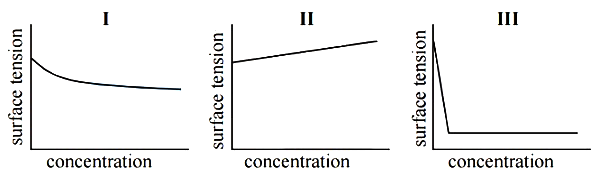 JEE Advanced 2016 Hard
 - Paragraph:
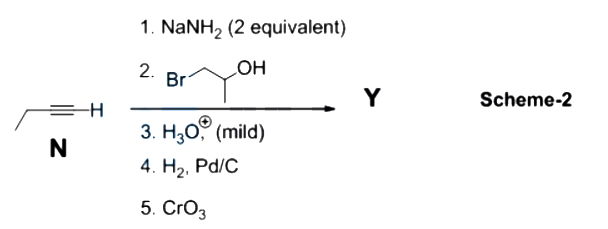
Schemes \(1\) and \(2\) describe sequential transformation of alkynes \(\mathbf{M}\) and \(\mathbf{N}\). Consider only the major products formed in each step for both the schemes.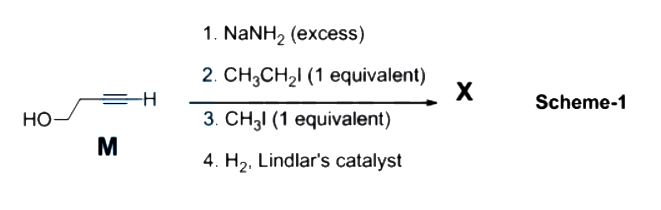
Question:
The correct statement with respect to product \(\mathbf{Y}\) isJEE Advanced 2014 Medium - The line \(2 x+y=1\) is tangent to the hyperbola \(\frac{x^2}{a^2}-\frac{y^2}{b^2}=1\). If this line passes through the point of intersection of the nearest directrix and the \(x\)-axis, then the eccentricity of the hyperbola isJEE Advanced 2010 Medium
- Among \(H_2, H e_2^{+}, L i_2, B e_2, B_2, C_2, N_2, O_2^{-}\), and \(F_2\), the number of diamagnetic species is -
(Atomic number : \(H=1, H e=2, L i=3, B e=4, B=5,\) \(C=6, N =7, O=8, F=9\) )JEE Advanced 2017 Easy - Paragraph:
Modern trains are based on Maglev technology in which trains are magnetically leviated, which runs its EDS Maglev system.
There are coils on both sides of wheels. Due to motion of train, current induces in the coil of track which levitate it. This is in accordance with Lenz's law. If trains lower down then due to Lenz's law a repulsive force increases due to which train gets uplifted and if it goes much high then there is a net downward force disc to gravity. The advantage of Maglev train is that there is no friction between the train and the track, thereby reducing power consumption and enabling the train to attain very high speeds.
Disadvantage of Maglev train is that as it slows down the electromagnetic forces decreases and it becomes difficult to keep it leviated and as it moves forward according to Lenz law, there is an electromagnetic drag force.
Question:
What is the disadvantage of this system?JEE Advanced 2006 Easy - Paragraph:
The coordination number of \(\mathrm{Ni}^{2+}\) is 4 .
\(\mathrm{NiCl}_2+\mathrm{KCN}\) (excess) \(\rightarrow A\) (cyano complex)
\(\mathrm{NiCl}_2+\) conc. \(\mathrm{HCl}\) (excess) \(\rightarrow B\) (chloro complex)
Question:
The IUPAC name of \(A\) and \(B\) areJEE Advanced 2006 Medium