


JEE Advanced · Mathematics · 6. Binomial Theorem
The coefficients of three consecutive terms of are in the ratio . Then
- A 21
- B 34
- C 6
- D 8
Answer & Solution
Correct Answer
(C) 6
Step-by-step Solution
Detailed explanation
\({ }^{ n +5} C _{ r -1}:{ }^{ n +5} C _{ r }:{ }^{ n +5} C _{ r +1}=5: 10: 14 \)
\( \Rightarrow \frac{(n+5)!}{(r-1)!(n-r+6)!}: \frac{(n+5)!}{(r)!(n-r+5)!}:\) \(\frac{(n+5)!}{(r+1)!(n-r+4)!}=5: 10: 14 \)
\( \Rightarrow \frac{1}{(r-1)!(n-r+6)!}: \frac{1}{(r)!(n-r+5)!}:\) \(\frac{1}{(r+1)!(n-r+4)!}=5: 10: 14 \)
\( \Rightarrow \frac{(r+1) r}{(n-r+6)!}: \frac{r+1}{(n-r+5)!}: \frac{1}{(n-r+4)!}=\) \(5: 10: 14 \)
\( \Rightarrow(r+1) r:(r+1)(n-r+6):(n~-\) \(r+6)(n-r+5)=5: 10: 14 \)
\( \Rightarrow \frac{(r+1)(n-r+6)}{(r+1) r}=\frac{10}{5}\) and \(\frac{(n-r+6)(n-r+5)}{(r+1)(n-r+6)}=\frac{14}{10} \)
\( \Rightarrow \frac{(n-r+6)}{r}=2\) and \(\frac{(n-r+5)}{(r+1)}=\frac{7}{5} \)
\( \Rightarrow n=3 r-6\) and \(n =\frac{12 r-18}{5} \)
\( \Rightarrow 3 r-6=\frac{12 r-18}{5}=n \)
\( \Rightarrow 15 r-30=12 r-18\)
\(\Rightarrow r=4\)
\(\Rightarrow n=6\)
\( \Rightarrow \frac{(n+5)!}{(r-1)!(n-r+6)!}: \frac{(n+5)!}{(r)!(n-r+5)!}:\) \(\frac{(n+5)!}{(r+1)!(n-r+4)!}=5: 10: 14 \)
\( \Rightarrow \frac{1}{(r-1)!(n-r+6)!}: \frac{1}{(r)!(n-r+5)!}:\) \(\frac{1}{(r+1)!(n-r+4)!}=5: 10: 14 \)
\( \Rightarrow \frac{(r+1) r}{(n-r+6)!}: \frac{r+1}{(n-r+5)!}: \frac{1}{(n-r+4)!}=\) \(5: 10: 14 \)
\( \Rightarrow(r+1) r:(r+1)(n-r+6):(n~-\) \(r+6)(n-r+5)=5: 10: 14 \)
\( \Rightarrow \frac{(r+1)(n-r+6)}{(r+1) r}=\frac{10}{5}\) and \(\frac{(n-r+6)(n-r+5)}{(r+1)(n-r+6)}=\frac{14}{10} \)
\( \Rightarrow \frac{(n-r+6)}{r}=2\) and \(\frac{(n-r+5)}{(r+1)}=\frac{7}{5} \)
\( \Rightarrow n=3 r-6\) and \(n =\frac{12 r-18}{5} \)
\( \Rightarrow 3 r-6=\frac{12 r-18}{5}=n \)
\( \Rightarrow 15 r-30=12 r-18\)
\(\Rightarrow r=4\)
\(\Rightarrow n=6\)
See the Complete Solution
Get step-by-step explanations for this and 2.5 Lakh+ more JEE, NEET & CET questions.
- Unlock all solutions
- Practice the full chapter
- Track accuracy across PYQs
4.8 rated on Google Play · 14,000+ reviews
More questions from Mathematics
- Let \(\mathbb{R}\) denote the set of all real numbers. Let \(f: \mathbb{R} \rightarrow \mathbb{R}\) be defined by
\(f(x)= \begin{cases}\frac{6 x+\sin x}{2 x+\sin x} & \text { if } x \neq 0 \\ \frac{7}{3} & \text { if } x=0\end{cases}\)
Then which of the following statements is (are) TRUE?JEE Advanced 2025 Hard - Let
Column 1 contains information about zeros of and
Column 2 contains information about the limiting behaviour of and at infinity.
Column 3 contains information about increasing-decreasing nature of and
Which of the following options is the only Incorrect combination?Column 1 Column 2 Column 3 (I) for some (i) (P) is increasing in (0, 1) (II) for some (ii) (Q) is decreasing in (III) for some (iii) (R) is increasing in (0, 1) (IV) for some (iv) (S) is decreasing in JEE Advanced 2017 Hard - Let \(f(x)\) be differentiable on the interval \((0, \infty)\) such that \(f(1)=1\), and \(\lim _{t \rightarrow x} \frac{t^2 f(x)-x^2 f(t)}{t-x}=1\) for each \(x>0\). Then, \(f(x)\) isJEE Advanced 2007 Medium
- Let \(P, Q, R\) and \(S\) be the points on the plane with position vectors \(-2 \hat{\mathbf{i}}-\hat{\mathbf{j}}, 4 \hat{\mathbf{i}}, 3 \hat{\mathbf{i}}+3 \hat{\mathbf{j}}\) an \(\mathrm{d}-3 \hat{\mathbf{i}}+2 \hat{\mathbf{j}}\) respectively. The quadrilateral \(P Q R S\) must be aJEE Advanced 2010 Easy
- The value of \(\lim _{x \rightarrow 0} \frac{1}{x^3} \int_0^x \frac{t \log (1+t)}{t^4+4} d t\) isJEE Advanced 2010 Easy
- Paragraph:
Let \(A_1, G_1, H_1\) denote the arithmetic, geometric and harmonic means respectively, of two distinct positive numbers. For \(n \geq 2\), let \(A_{n-1}\) and \(H_{n-1}\) has arithmetic, geometric and harmonic means as \(A_n, G_n, H_n\), respectively.
Question:
Which of the following statements is correct?JEE Advanced 2007 Hard
More PYQs from JEE Advanced
- Paragraph:
Read the following passage and answer the questions.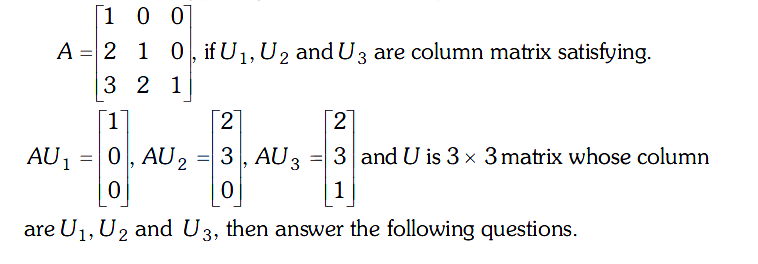
Question:
The value of the elements of \(U^{-1}\) isJEE Advanced 2006 Medium - let be defined by
List – I List – II (A) is (P) Onto but not one – one (B) is (Q) neither continuous nor one-one (C) of is (R) differentiable but not one-one (D) is (S) continuous and one-one JEE Advanced 2014 Medium - Paragraph:
Let \(F_{1}\left(x_{1}, 0\right)\) and \(F_{2}\left(x_{2}, 0\right)\), for \(x_{1}<0\) and \(x_{2}>0\), be the foci of the ellipse \(\frac{x^{2}}{9}+\frac{y^{2}}{8}=1 .\) Suppose a parabola having vertex at the origin and focus at \(F_{2}\) intersects the ellipse at point \(M\) in the first quadrant and at point \(N\) in the fourth quadrant.
Question:
If the tangents to the ellipse at \(M\) and \(N\) meet at \(R\) and the normal to the parabola at \(M\) meets the \(x\)-axis at \(Q\), then the ratio of area of the triangle \(M Q R\) to area of the quadrilateral \(M F_{1} N F_{2}\) isJEE Advanced 2016 Medium - Let the straight line \(\mathrm{y}=2 \mathrm{x}\) touch a circle with center \((0, \alpha), \alpha>0\), and radius \(\mathrm{r}\) at a point \(\mathrm{A}_1\). Let \(\mathrm{B}_1\) be the point on the circle such that the line segment \(A_1 B_1\) is a diameter of the circle. Let \(\alpha+r=5+\sqrt{5}\).
Match each entry in List-I to the correct entry in List-II.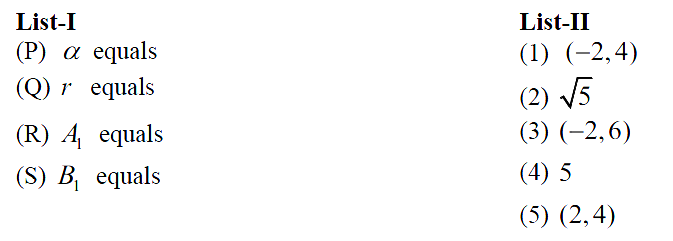
The correct option isJEE Advanced 2024 Easy - Columns 1, 2 and 3 contain starting materials, reaction conditions and type of reactions respectively.
The only CORRECT combination in which the reaction proceeds through radical mechanism isColumn 1 Column 2 Column 3 (I) Toulene (i) \(NaOH\) \( /Br _2\) (P) Condensation (II) Acetophenone (ii) \(B r_2 / h v\) (Q) Carboxylation (III) Benzaldehyde (iii) \(\left( CH _3 CO \right)_2\) \(O / CH _3\) \(COOK\) (R) Substitution (IV) Phenol (iv) \(NaOH\) \(/CO _2\) (S) Haloform JEE Advanced 2017 Medium - Let and be two biased coins such that the probabilities of getting head in a single toss are and , respectively. Suppose is the number of heads that appear when is tossed twice, independently, and suppose is the number of heads that appear when is tossed twice, independently. Then the probability that the roots of the quadratic polynomial are real and equal, isJEE Advanced 2020 Medium