


JEE Advanced · Mathematics · 12. Circle
Let the straight line \(\mathrm{y}=2 \mathrm{x}\) touch a circle with center \((0, \alpha), \alpha>0\), and radius \(\mathrm{r}\) at a point \(\mathrm{A}_1\). Let \(\mathrm{B}_1\) be the point on the circle such that the line segment \(A_1 B_1\) is a diameter of the circle. Let \(\alpha+r=5+\sqrt{5}\).
Match each entry in List-I to the correct entry in List-II.
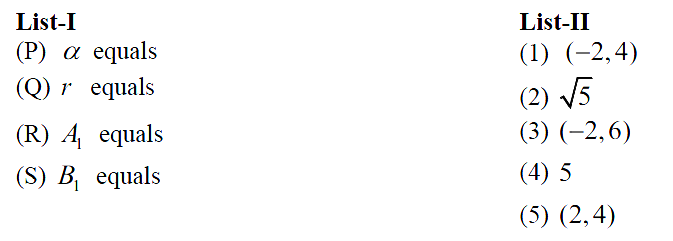
The correct option is
- A \((\mathrm{P}) \rightarrow(4) \quad(\mathrm{Q}) \rightarrow(2) \quad(\mathrm{R}) \rightarrow(1) \quad(\mathrm{S}) \rightarrow(3)\)
- B \((\mathrm{P}) \rightarrow(2) \quad(\mathrm{Q}) \rightarrow(4) \quad(\mathrm{R}) \rightarrow(1) \quad(\mathrm{S}) \rightarrow(3)\)
- C \((\mathrm{P}) \rightarrow(4) \quad(\mathrm{Q}) \rightarrow(2) \quad(\mathrm{R}) \rightarrow(5) \quad(\mathrm{S}) \rightarrow(3)\)
- D \((\mathrm{P}) \rightarrow(2) \quad(\mathrm{Q}) \rightarrow(4) \quad(\mathrm{R}) \rightarrow(3) \quad(\mathrm{S}) \rightarrow(5)\)
Answer & Solution
Correct Answer
(C) \((\mathrm{P}) \rightarrow(4) \quad(\mathrm{Q}) \rightarrow(2) \quad(\mathrm{R}) \rightarrow(5) \quad(\mathrm{S}) \rightarrow(3)\)
Step-by-step Solution
Detailed explanation
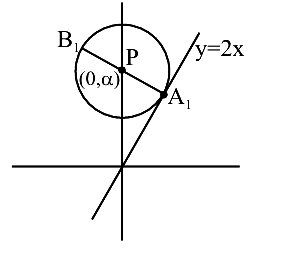
Consider centre as \(\mathrm{P}(0, \alpha), \alpha>0\)
\(\left|\frac{2(0)-\alpha}{\sqrt{5}}\right|=r\)
\(\begin{aligned}& |-\alpha|=\sqrt{5} r \\& \alpha=\sqrt{5} r \\& \therefore \alpha+r=5+\sqrt{5} \\& \sqrt{5} r+r=\sqrt{5}(\sqrt{5}+1) \\& r=\sqrt{5}, \alpha=5 \\& \therefore P(0,5)\end{aligned}\)
Foot of perpendicular from \(\mathrm{P}\) to line \(2 \mathrm{x}-\mathrm{y}=0\)
\(\begin{aligned}& \frac{x-0}{2}=\frac{y-5}{-1}=\frac{-(2(0)-5)}{5}=1 \\& x=2, y=4 \quad A_1(2,4)\end{aligned}\)
Let \(\mathrm{B}(\mathrm{p}, \mathrm{q})\)
\(\therefore \frac{\mathrm{p}+2}{2}=0, \frac{\mathrm{q}+4}{2}=5\)
\(\therefore \mathrm{p}=-2, \mathrm{q}=6 \quad \mathrm{~B}(-2,6)\)
See the Complete Solution
Get step-by-step explanations for this and 2.5 Lakh+ more JEE, NEET & CET questions.
- Unlock all solutions
- Practice the full chapter
- Track accuracy across PYQs
4.8 rated on Google Play · 14,000+ reviews
More questions from Mathematics
- Let \(\mathbb{R}^3\) denote the three-dimensional space. Take two points \(P=(1,2,3)\) and \(Q=(4,2,7)\). Let \(\operatorname{dist}(X, Y)\) denote the distance between two points \(X\) and \(Y\) in \(\mathbb{R}^3\). Let
\(\begin{gathered}S=\left\{X \in \mathbb{R}^3:(\operatorname{dist}(X, P))^2-(\operatorname{dist}(X, Q))^2=50\right\} \text { and } \\T=\left\{Y \in \mathbb{R}^3:(\operatorname{dist}(Y, Q))^2-(\operatorname{dist}(Y, P))^2=50\right\} .\end{gathered}\)
Then which of the following statements is (are) TRUE?JEE Advanced 2024 Medium - Let and be two distinct common tangents to the ellipse and the parabola . Suppose that the tangent touches and at the points and , respectively and the tangent touches and at the points and , respectively. Then which of the following statements is(are) true?JEE Advanced 2023 Medium
- Let and be non zero real numbers such that . Then which of the following is/are true?JEE Advanced 2017 Medium
- Let be defined by Then which of the following statements is(are) TRUE?JEE Advanced 2021 Easy
- Let \(P(6,3)\) be a point on the hyperbola \(\frac{x^2}{a^2}-\frac{y^2}{b^2}=1\). If the normal at the point \(P\) intersects the \(X\)-axis at \((9,0)\), then the eccentricity of the hyperbola isJEE Advanced 2011 Easy
- For a non-zero complex number \(z\), let \(\arg (z)\) denote the principal argument of \(z\), with \(-\pi <\arg (z) \leq \pi\). Let \(\omega\) be the cube root of unity for which \(0 <\arg (\omega) <\pi\). Let \(\alpha=\arg \left(\sum_{n=1}^{2025}(-\omega)^n\right)\).
Then the value of \(\frac{3 \alpha}{\pi}\) is ___________JEE Advanced 2025 Easy
More PYQs from JEE Advanced
- The value of
\(\sec ^{-1}\left(\frac{1}{4} \sum_{k=0}^{10} \sec (\frac{7 \pi}{12}+\frac{k \pi}{2}\right) \sec (\frac{7 \pi}{12}\) \(+\frac{(k+1) \pi}{2}))\) in the interval \(\left[-\frac{\pi}{4}, \frac{3 \pi}{4}\right]\) equalsJEE Advanced 2019 Medium - A uniform capillary tube of inner radius is dipped vertically into a beaker filled with water. The water rises to a height in the capillary tube above the water surface in the beaker. The surface tension of water is . The angle of contact between water and the wall of the capillary tube is . Ignore the mass of water in the meniscus. Which of the following statements is (are) true?JEE Advanced 2018 Medium
- An electrochemical cell is fueled by the combustion of butane at 1 bar and 298 K . Its cell potential is \(\frac{\boldsymbol{X}}{\boldsymbol{F}} \times 10^3\) volts, where \(\boldsymbol{F}\) is the Faraday constant. The value of \(\boldsymbol{X}\) is \(\qquad\) .
Use : Standard Gibbs energies of formation at 298 K are : \(\Delta_f G_{\mathrm{CO}_2}^{\circ}=-394 \mathrm{~kJ} \mathrm{~mol}^{-1}\);
\(\Delta_f G_{\text {water }}^{\circ}=-237 \mathrm{~kJ} \mathrm{~mol}^{-1} ; \Delta_f G_{\text {butane }}^{\circ}\) \(=-18 \mathrm{~kJ} \mathrm{~mol}^{-1}\)JEE Advanced 2025 Hard - Let and be two biased coins such that the probabilities of getting head in a single toss are and , respectively. Suppose is the number of heads that appear when is tossed twice, independently, and suppose is the number of heads that appear when is tossed twice, independently. Then the probability that the roots of the quadratic polynomial are real and equal, isJEE Advanced 2020 Medium
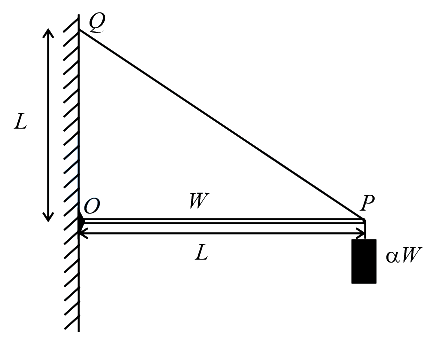
- One end of a horizontal uniform beam of weight and length is hinged on a vertical wall at point and its other end is supported by a light inextensible rope. The other end of the rope is fixed at point , at a height above the hinge at point . A block of weight is attached at the point of the beam, as shown in the figure (not to scale). The rope can sustain a maximum tension of . Which of the following statement(s) is(are) correct?
 JEE Advanced 2021 Hard
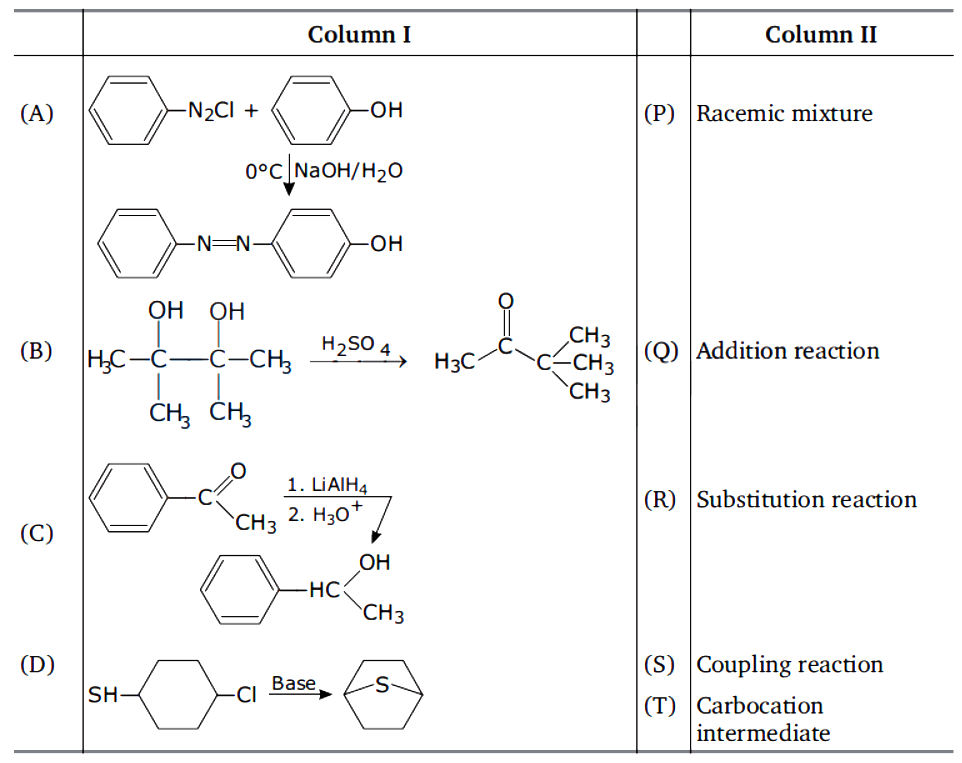
 - Match the reaction in Column I with appropriate options in Column II
 JEE Advanced 2010 Hard