


JEE Advanced · Mathematics · 25. AOD
Let \(\mathbb{R}\) denote the set of all real numbers. Let \(f: \mathbb{R} \rightarrow \mathbb{R}\) be defined by
\(f(x)= \begin{cases}\frac{6 x+\sin x}{2 x+\sin x} & \text { if } x \neq 0 \\ \frac{7}{3} & \text { if } x=0\end{cases}\)
Then which of the following statements is (are) TRUE?
- A The point \(x=0\) is a point of local maxima of \(f\)
- B The point \(x=0\) is a point of local minima of \(f\)
- C Number of points of local maxima of \(f\) in the interval \([\pi, 6 \pi]\) is 3
- D Number of points of local minima of \(f\) in the interval \([2 \pi, 4 \pi]\) is 1
Answer & Solution
Correct Answer
(B) The point \(x=0\) is a point of local minima of \(f\)
Step-by-step Solution
Detailed explanation

since \(3>\frac{7}{3} \Rightarrow 3>f(0)\)
\(\Rightarrow x=0\) is local minima ....option (B) is correct
Now,
\(\begin{aligned}
& f(x)=\frac{6 x+\sin x}{2 x+\sin x}=1+\frac{4 x}{2 x+\sin x} \\
& f^{\prime}(x)=\frac{4[(2 x+\sin x) \cdot 1-x(2+\cos x)]}{(2 x+\sin x)^2}=\frac{4(\sin x-x \cos x)}{(2 x+\sin x)^2} \\
& =\frac{4 \cos x(\tan x-x)}{(2 x+\sin x)^2}
\end{aligned}\)
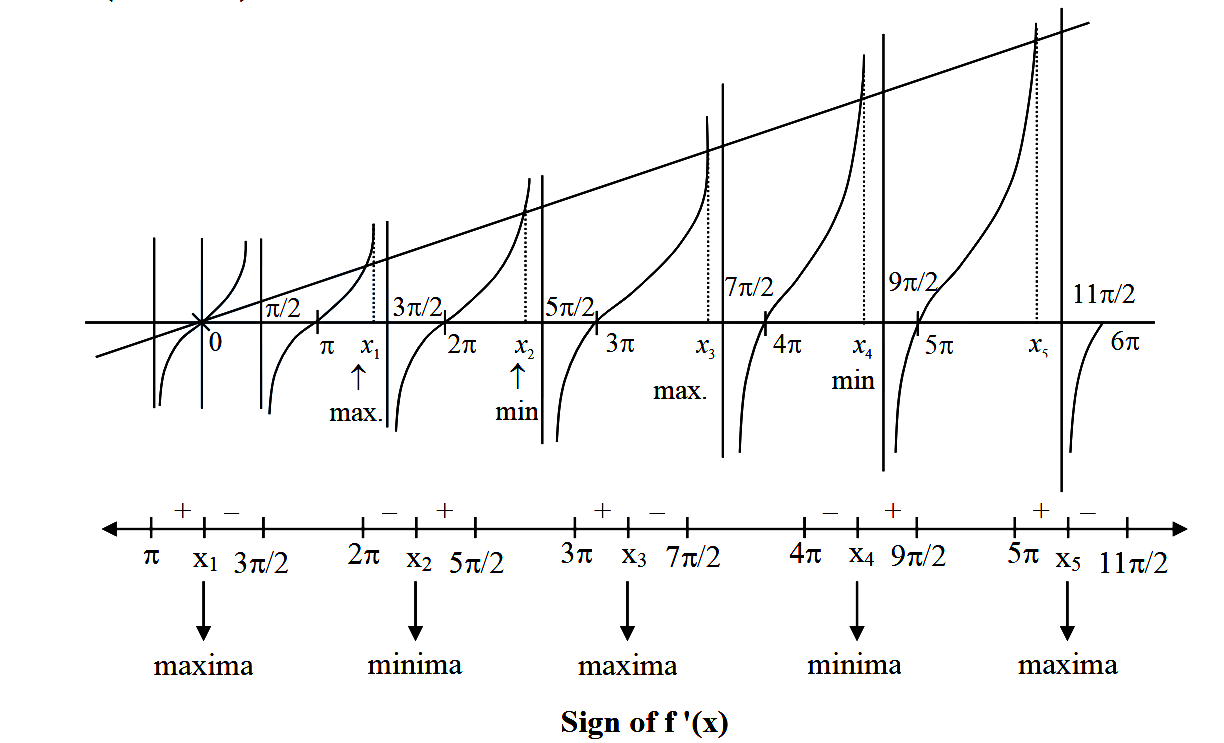
Options (C) \& (D) are also correct.
See the Complete Solution
Get step-by-step explanations for this and 2.5 Lakh+ more JEE, NEET & CET questions.
- Unlock all solutions
- Practice the full chapter
- Track accuracy across PYQs
4.8 rated on Google Play · 14,000+ reviews
More questions from Mathematics
- Let , where Suppose is a matrix such that, where and is the identity matrix of order 3. If and thenJEE Advanced 2016 Hard
- The total number of ways in which 5 balls of different colours can be distributed among 3 persons so that each person gets at least one ball isJEE Advanced 2012 Hard
- Let
Let be all the points of local maximum of and be all the points of local minimum of
Then which of the following options is/are correct?JEE Advanced 2019 Hard - In , let L be a straight line passing through the origin. Suppose that all the points on L are at a constant distance from the two planes and Let M be the locus of the feet of the perpendiculars drawn from the points on L to the plane . Which of the following points lie (s) on M ?JEE Advanced 2015 Medium
- Paragraph:
The circle \(x^2+y^2-8 x=0\) and hyperbola \(\frac{x^2}{9}-\frac{y^2}{4}=1\) intersect at the points \(A\) and \(B\).Question:
Equation of a common tangent with positive slope to the circle as well as to the hyperbola isJEE Advanced 2010 Medium -
Column I Column II (A) In \(R ^2\), if the magnitude of the projection vector of the vector \(\alpha \hat{ i }+\beta \hat{ j }\) on \(\sqrt{3} \hat{ i }+\hat{ j }\) is \(\sqrt{3}\) and if \(\alpha=2+\sqrt{3} \beta\), then possible value (s) of \(|\alpha|\) is (are) (P) 1 (B) Let a and b be real numbers such that the function \(f ( x )=\left\{\begin{array}{cc}-3 ax ^2-2, & x <1 \\ bx + a ^2, & x \geq 1\end{array}\right.\) is differentiable for all \(x \in R\). Then possible value ( s ) of a is (are) (Q) 2 (C)Let \(\omega \neq 1\) be a complex cube roots of unity. If \(\left(3-3 \omega+2 \omega^2\right)^{4 n+3}\) \(+~\left(2+3 \omega-3 \omega^2\right)^{4 n+3}\) \(~+\left(-3+2 \omega+3 \omega^2\right)^{4 n+3}=0\) then possible value \((s)\) of \(n\) is (are) (R) 3 (D) Let the harmonic mean of two positive real numbers \(a\) and \(b 4\). If \(q\) is a positive real number such that \(a , 5, q , b\) is an arithmetic progression, then the value \(( s )\) of \(| q - a |\) is (are) (S) 4 (T) 5 JEE Advanced 2015 Hard
More PYQs from JEE Advanced
- Let \(f: I R \rightarrow I R\) be defined as \(f(x)=|x|+\left|x^{2}-1\right|\). The total number of points at which \(f\) attains either a local maximum or a local minimum isJEE Advanced 2012 Medium
- Consider the following transformations of a compound .
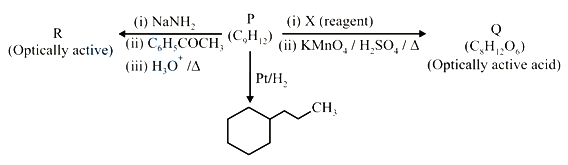
Choose the correct option(s).JEE Advanced 2020 Medium - A uniform electric field, is applied in a region. A charged particle of mass carrying positive charge is projected in this region with an initial speed of . This particle is aimed to hit a target , which is away from its entry point into the field as shown schematically in the figure. Take . Then
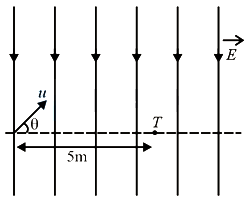 JEE Advanced 2020 Easy
 - During Searle's experiment, zero of the Vernier scale lies between and of the main scale. The division of the Vernier scale exactly coincides with one of the main scale divisions. When an additional load of 2 kg is applied to the wire, the zero of the Vernier scale still lies between and of the main scale but now the division of Vernier scale coincides with one of the main scale divisions. The length of the thin metallic wire is 2 m and its cross-sectional area is . The least count of the Vernier scale is . The maximum percentage error in the Young's modulus of the wire isJEE Advanced 2014 Easy
- Let \(E\) and \(F\) be two independent events. The probability that exactly one of them occurs is \(11 / 25\) and the probability of none of them occurring is \(2 / 25\). If \(P(T)\) denotes the probability of occurrence of the event \(T\), thenJEE Advanced 2011 Hard
- A positive point charge of \(10^{-8} \mathrm{C}\) is kept at a distance of 20 cm from the center of a neutral conducting sphere of radius 10 cm . The sphere is then grounded and the charge on the sphere is measured. The grounding is then removed and subsequently the point charge is moved by a distance of 10 cm further away from the center of the sphere along the radial direction. Taking \(\frac{1}{4 \pi \epsilon_0}=9 \times 10^9 \mathrm{Nm}^2 / \mathrm{C}^2\) (where \(\epsilon_0\) is the permittivity of free space), which of the following
statements is/are correct: :JEE Advanced 2025 Medium