


JEE Advanced · Mathematics · 16. Limits
Let \(f(x)\) be differentiable on the interval \((0, \infty)\) such that \(f(1)=1\), and \(\lim _{t \rightarrow x} \frac{t^2 f(x)-x^2 f(t)}{t-x}=1\) for each \(x>0\). Then, \(f(x)\) is
- A
\(\frac{1}{3 x}+\frac{2 x^2}{3}\)
- B
\(-\frac{1}{3 x}+\frac{4 x^2}{3}\)
- C
\(-\frac{1}{x}+\frac{2}{x^2}\)
- D
\(\frac{1}{x}\)
Answer & Solution
Correct Answer
(A)
\(\frac{1}{3 x}+\frac{2 x^2}{3}\)
Step-by-step Solution
Detailed explanation
\[
\text { } \lim _{t \rightarrow x} \frac{t^2 f(x)-x^2 f(t)}{t-x}=1
\]
\[
\begin{aligned}
& \Rightarrow & x^2 f^{\prime}(x)-2 x f(x)+1 & =0 \\
& \Rightarrow & \frac{x^2 f^{\prime}(x)-2 x f(x)}{\left(x^2\right)^2}+\frac{1}{x^4} & =0 \\
& \Rightarrow & \frac{d}{d x}\left(\frac{f(x)}{x^2}\right) & =-\frac{1}{x^4} \\
\Rightarrow & & f(x) & =c x^2+\frac{1}{3 x} \text { also } f(1)=1 \Rightarrow c=\frac{2}{3} . \\
& \text { Hence, } & f(x) & =\frac{2}{3} x^2+\frac{1}{3 x}
\end{aligned}
\]
\text { } \lim _{t \rightarrow x} \frac{t^2 f(x)-x^2 f(t)}{t-x}=1
\]
\[
\begin{aligned}
& \Rightarrow & x^2 f^{\prime}(x)-2 x f(x)+1 & =0 \\
& \Rightarrow & \frac{x^2 f^{\prime}(x)-2 x f(x)}{\left(x^2\right)^2}+\frac{1}{x^4} & =0 \\
& \Rightarrow & \frac{d}{d x}\left(\frac{f(x)}{x^2}\right) & =-\frac{1}{x^4} \\
\Rightarrow & & f(x) & =c x^2+\frac{1}{3 x} \text { also } f(1)=1 \Rightarrow c=\frac{2}{3} . \\
& \text { Hence, } & f(x) & =\frac{2}{3} x^2+\frac{1}{3 x}
\end{aligned}
\]
See the Complete Solution
Get step-by-step explanations for this and 2.5 Lakh+ more JEE, NEET & CET questions.
- Unlock all solutions
- Practice the full chapter
- Track accuracy across PYQs
4.8 rated on Google Play · 14,000+ reviews
More questions from Mathematics
- A student appears for a quiz consisting of only true-false type questions and answers all the questions. The student knows the answers of some questions and guesses the answers for the remaining questions. Whenever the student knows the answer of a question, he gives the correct answer. Assume that the probability of the student giving the correct answer for a question, given that he has guessed it, is \(\frac{1}{2}\). Also assume that the probability of the answer for a question being guessed, given that the student's answer is correct, is \(\frac{1}{6}\). Then the probability that the student knows the answer of a randomly chosen question isJEE Advanced 2024 Medium
- Match the following.
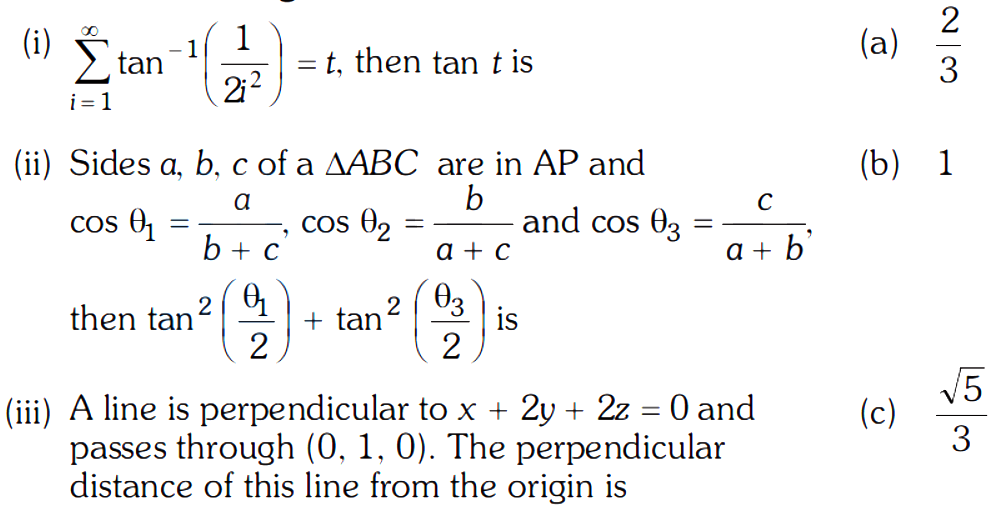 JEE Advanced 2006 Medium
 - Let be a complex number satisfying , where denotes the complex conjugate of . Let the imaginary part of be nonzero.
Match each entry in List-I to the correct entries in List-II.List - I List - II (P) \(|z|^2\) is equal to (1) 12 (Q) \(|z-\bar{z}|^2\) is equal to (2) 4 (R) \(|z|^2+|z+\bar{z}|^2\) is equal to (3) 8 (S) \(|z+1|^2\) is equal to (4) 10 (5) 7
The correct option isJEE Advanced 2023 Hard - Let be a set with exactly elements and be a set with exactly elements. If is the number of one-one functions from and is the number of onto functions from , then the value of is _____-.JEE Advanced 2018 Medium
- Let
Column 1 contains information about zeros of and
Column 2 contains information about the limiting behaviour of and at infinity.
Column 3 contains information about increasing-decreasing nature of and
Which of the following options is the only Correct combination?Column 1 Column 2 Column 3 (I) for some (i) (P) is increasing in (0, 1) (II) for some (ii) (Q) is decreasing in (III) for some (iii) (R) is increasing in (0, 1) (IV) for some (iv) (S) is decreasing in JEE Advanced 2017 Hard - Let m and n be two positive integers greater than 1. If then the value of isJEE Advanced 2015 Medium
More PYQs from JEE Advanced
- One end of a horizontal thick copper wire of length and radius is welded to an end of another horizontal thin copper wire of length and radius. When the arrangement stretched by applying forces at two ends, the ratio of the elongation in the thin wire to that in the thick wire isJEE Advanced 2013 Easy
- If the distance between the plane \(A x-2 y+z=d\) and the plane containing the lines \(\frac{x-1}{2}=\frac{y-2}{3}=\frac{z-3}{4} \quad\) and \(\frac{x-2}{3}=\frac{y-3}{4}=\frac{z-4}{5}\) is \(\sqrt{6}\), then \(|d|\) isJEE Advanced 2010 Easy
- Paragraph:
The reactions of \(\mathrm{Cl}_{2}\) gas with cold-dilute and hot-concentrated \(\mathrm{NaOH}\) in water give sodium salts of two (different) oxoacids of chlorine, \(\boldsymbol{P}\) and \(\boldsymbol{Q}\), respectively. The \(\mathrm{Cl}_{2}\) gas reacts with \(\mathrm{SO}_{2}\) gas, in presence of charcoal, to give a product \(\boldsymbol{R}\). \(\boldsymbol{R}\) reacts with white phosphorus to give a compound \(\boldsymbol{S}\). On hydrolysis, \(\boldsymbol{S}\) gives an oxoacid of phosphorus, \(\boldsymbol{T}\).
Question:
\(P\) and \(Q\), respectively, are the sodium salts ofJEE Advanced 2013 Medium - The compound (s) that exhibit (s) geometrical isomerism is (are)JEE Advanced 2009 Easy
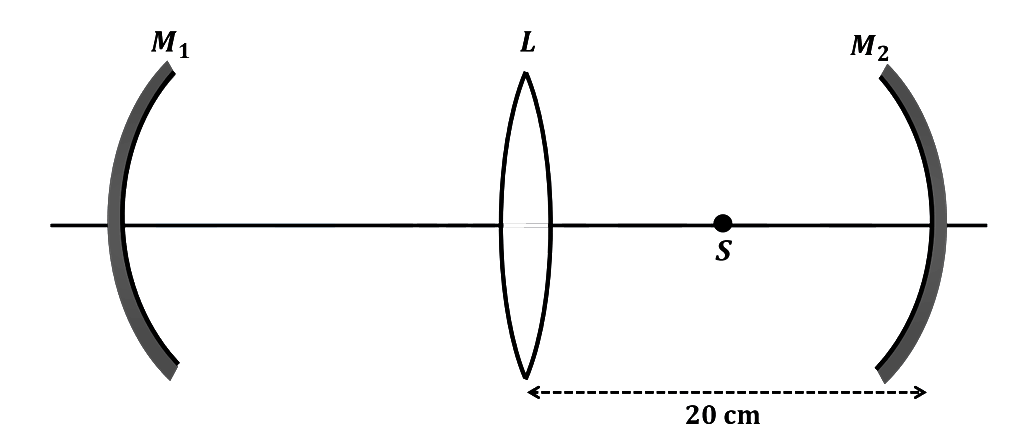
- An optical arrangement consists of two concave mirrors and , and a convex lens with a common principal axis, as shown in the figure. The focal length of is . The radii of curvature of and are and , respectively. The distance between and is . A point object is placed at the mid-point between and on the axis. When the distance between and is , one of the images coincides with . The value of is _____(Consider the case which gives minimum value).
 JEE Advanced 2023 Medium
 - The reaction of \(P_2\) with \(X\) leads selectively to \(\mathrm{P}_4 \mathrm{O}_6\). The \(\mathrm{X}\) isJEE Advanced 2009 Easy