


JEE Advanced · Mathematics · 25. AOD
Let
Column 1 contains information about zeros of and
Column 2 contains information about the limiting behaviour of and at infinity.
Column 3 contains information about increasing-decreasing nature of and
| Column 1 | Column 2 | Column 3 |
| (I) for some | (i) | (P) is increasing in (0, 1) |
| (II) for some | (ii) | (Q) is decreasing in |
| (III) for some | (iii) | (R) is increasing in (0, 1) |
| (IV) for some | (iv) | (S) is decreasing in |
- A (II) (iv) (Q)
- B (III) (i) (R)
- C (I) (iii) (P)
- D (II) (iii) (P)
Answer & Solution
Correct Answer
(B) (III) (i) (R)
Step-by-step Solution
Detailed explanation
See the Complete Solution
Get step-by-step explanations for this and 2.5 Lakh+ more JEE, NEET & CET questions.
- Unlock all solutions
- Practice the full chapter
- Track accuracy across PYQs
4.8 rated on Google Play · 14,000+ reviews
More questions from Mathematics
- The point \(P\) is the intersection of the straight line joining the points \(Q(2,3,5)\) and \(R(1,-1,4)\) with the plane \(5 x-4 y-\) \(z=1\). If \(S\) is the foot of the perpendicular drawn from the point \(T(2,1,4)\) to \(Q R\), then the length of the line segment \(P S\) isJEE Advanced 2012 Medium
- The quadratic equation with real coefficients has purely imaginary roots. Then the equation hasJEE Advanced 2014 Medium
- Let \(g_{i}:\left[\frac{\pi}{8}, \frac{3 \pi}{8}\right] \rightarrow \mathbb{R}, i=1,2\), and \(f:\left[\frac{\pi}{8}, \frac{3 \pi}{8}\right] \rightarrow \mathbb{R}\) be functions such that \(g_{1}(x)=1, g_{2}(x)=|4 x-\pi|\) and \(f(x)=\sin ^{2} x\), for all \(x \in\left[\frac{\pi}{8}, \frac{3 \pi}{8}\right]\)
Define
\[
S_{i}=\int_{\frac{\pi}{8}}^{\frac{3 \pi}{8}} f(x) \cdot g_{i}(x) d x, \quad i=1,2
\]
The value of is ___.JEE Advanced 2021 Medium - Paragraph:
A circle \(C\) of radius 1 is inscribed in an equilateral \(\triangle P Q R\). The points of contact of \(C\) with the sides \(P Q, Q R, R P\) are \(D, E, F\) respectively. The line \(P Q\) is given by the equation
\(\sqrt{3} x+y-6=0\) and the point \(D\) is \(\left(\frac{3 \sqrt{3}}{2}, \frac{3}{2}\right)\). Further, it is given that the origin and the centre of \(C\) are on the same side of the line \(P Q\).Question:
The equation of circle \(C\) isJEE Advanced 2008 Easy - For , let . Then the minimum value of the function defined by isJEE Advanced 2023 Easy
- Let \(\mathbb{R}\) denote the set of all real numbers. Let \(f: \mathbb{R} \rightarrow \mathbb{R}\) be a function such that \(f(x)>0\) for all \(x \in \mathbb{R}\), and \(f(x+y)=f(x) f(y)\) for all \(x, y \in \mathbb{R}\).
Let the real numbers \(\mathrm{a}_1, \mathrm{a}_2 \ldots, \mathrm{a}_{50}\) be in an arithmetic progression. If \(f\left(\mathrm{a}_{31}\right)=64 f\left(\mathrm{a}_{25}\right)\), and \(\sum_{i=1}^{50} f\left(a_i\right)=3\left(2^{25}+1\right)\) then the value of \(\sum_{i=6}^{30} f\left(a_i\right)\) is ________JEE Advanced 2025 Easy
More PYQs from JEE Advanced
- Paragraph:
One twirls a circular ring (of mass \(M\) and radius \(R\) ) near the tip of one's finger as shown in Figure 1 . In the process the finger never loses contact with the inner rim of the ring. The finger traces out the surface of a cone, shown by the dotted line. The radius of the path traced out by the point where the ring and the finger is in contact is \(r\). The finger rotates with an angular velocity \(\omega_{0}\). The rotating ring rolls without slipping on the outside of a smaller circle described by the point where the ring and the finger is in contact (Figure 2). The coefficient of friction between the ring and the finger is \(\mu\) and the acceleration due to gravity is \(g\).
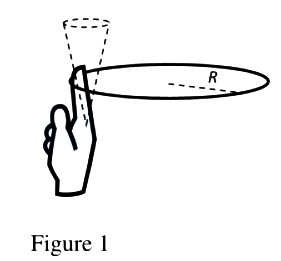
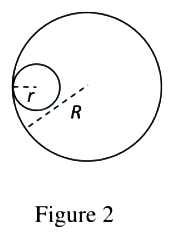
Question:
The minimum value of \(\omega_{0}\) below which the ring will drop down isJEE Advanced 2017 Medium - Paragraph :
A thermal power plant produces electric power of \(600 \mathrm{~kW}\) at \(4000 \mathrm{~V}\), which is to be transported to a place \(20 \mathrm{~km}\) away from the power plant for consumers' usage. It can be transported either directly with a cable of large current carrying capacity or by using a combination of step-up and step-down transformers at the two ends. The drawback of the direct transmission is the large energy dissipation. In the method using transformers, the dissipation is much smaller. In this method, a step-up transformer is used at the plant side so that the current is reduced to a smaller value. At the consumers' end, a step-down transformer is used to supply power to the consumers at the specified lower voltage. It is reasonable to assume that the power cable is purely resistive and the transformers are ideal with a power factor unity. All the currents and voltages mentioned are rms values.
Question :
In the method using the transformers, assume that the ratio of the number of turns in the primary to that in the secondary in the step-up transformer is \(1: 10\). If the power to the consumers has to be supplied at \(200 \mathrm{~V}\), the ratio of the number of turns in the primary to that in the secondary in the step-down transformer isJEE Advanced 2013 Medium - A current carrying infinitely long wire is kept along the diameter of a circular wire loop, without touching it, the correct statement(s) is(are)JEE Advanced 2012 Medium
- The wavelength of the first spectral line in the Balmer series of hydrogen atom is \(6561 Å\). The wavelength of the second spectral line in the Balmer series of singly ionized helium atom isJEE Advanced 2011 Medium
- A symmetric star shaped conducting wire loop is carrying a steady state current as shown in the figure. The distance between the diametrically opposite vertices of the star is .
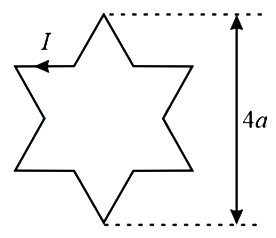 JEE Advanced 2017 Easy
 - Three students \(S_1, S_2\) and \(S_1\) are given a problem to solve. Consider the following events :
\(U:\) At least one of \(S_1, S_2\) and \(S_3\) can solve the problem,
\(V: S_1\) can solve the problem, given that neither \(\mathrm{S}_2\) nor \(\mathrm{S}_3\) can solve the problem,
\(W: S_2\) can solve the problem and \(S_3\) cannot solve the problem,
\(T: S_3\) can solve the problem.
For any event \(E\), let \(P(E)\) denote the probability of \(E\).
If \(P(U)=\frac{1}{2}, P(V)=\frac{1}{10}\) and \(P(W)=\frac{1}{12}\), then \(P(T)\) is equal toJEE Advanced 2025 Medium