


JEE Advanced · Mathematics · 30. Vector Algebra
Let \(P, Q, R\) and \(S\) be the points on the plane with position vectors \(-2 \hat{\mathbf{i}}-\hat{\mathbf{j}}, 4 \hat{\mathbf{i}}, 3 \hat{\mathbf{i}}+3 \hat{\mathbf{j}}\) an \(\mathrm{d}-3 \hat{\mathbf{i}}+2 \hat{\mathbf{j}}\) respectively. The quadrilateral \(P Q R S\) must be a
- A
parallelogram, which is neither a rhombus nor a rectangle
- B
square
- C
rectangle, but not a square
- D
rhombus, but not a square
Answer & Solution
Correct Answer
(A)
parallelogram, which is neither a rhombus nor a rectangle
Step-by-step Solution
Detailed explanation
\(m_{P Q}=\frac{1}{6}, m_{S R}=\frac{1}{6}, \quad m_{R Q}=-3\), \(m_{S P}=-3\)
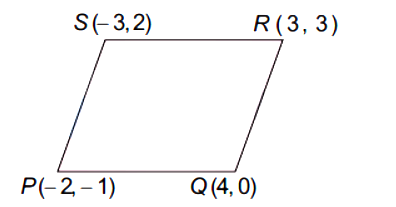
\(\Rightarrow\) Parallelogram
But neither \(P R=S Q\) nor \(P R \perp S Q\).
\(\therefore\) Parallelogram, which is neither a rhombus nor a rectangle.
\(\Rightarrow\) Parallelogram
But neither \(P R=S Q\) nor \(P R \perp S Q\).
\(\therefore\) Parallelogram, which is neither a rhombus nor a rectangle.
See the Complete Solution
Get step-by-step explanations for this and 2.5 Lakh+ more JEE, NEET & CET questions.
- Unlock all solutions
- Practice the full chapter
- Track accuracy across PYQs
4.8 rated on Google Play · 14,000+ reviews
More questions from Mathematics
- Let \(P\left(x_1, y_1\right)\) and \(Q\left(x_2, y_2\right)\) be two distinct points on the ellipse
\(\frac{x^2}{9}+\frac{y^2}{4}=1\)
such that \(y_1>0\), and \(y_2>0\). Let C denote the circle \(x^2+y^2=9\), and \(M\) be the point \((3,0)\).
Suppose the line \(x=x_1\) intersects \(C\) at \(R\), and the line \(x=x_2\) intersects \(C\) at \(S\), such that the \(y\)-coordinates of \(R\) and \(S\) are positive. Let \(\angle R O M=\frac{\pi}{6}\) and \(\angle S O M=\frac{\pi}{3}\), where \(O\) denotes the origin \((0,0)\). Let \(|X Y|\) denote the length of the line segment \(X Y\).
Then which of the following statements is (are) TRUE?JEE Advanced 2025 Hard - Let and be two unit vectors such that For some let If and the vector is inclined at the same angle to both and then the value of isJEE Advanced 2018 Medium
- Of the three independent events , and , the probability that only occurs is , only occurs is and only occurs is . Let the probability that none of events , or occurs satisfy the equations and . All the given probabilities are assumed to lie in the interval .
Then JEE Advanced 2013 Hard - Paragraph:
There are \(n\) urns each containing \((n+1)\) balls such that the ith urn contains \(i\) white balls and \((n+1-i)\) red balls. Let \(u_i\) be the event of selecting ith urn, \(i=1,2,3, \ldots, n\) and \(W\) denotes the event of getting a white balls.Question:
If \(n\) is even and \(E\) denotes the event of choosing even numbered urn \(\left(P\left(u_i\right)=\frac{1}{n}\right)\), then the value of \(P(W / E)\) isJEE Advanced 2006 Medium - If where takes only principal values, then the value of isJEE Advanced 2015 Easy
- Two adjacent sides of a parallelogram \(A B C D\) are given by \(\overrightarrow{\mathbf{A B}}=2 \hat{\mathbf{i}}+10 \hat{\mathbf{j}}+11 \hat{\mathbf{k}}\) and \(\overrightarrow{\mathbf{A D}}=-\hat{\mathbf{i}}+2 \hat{\mathbf{j}}+2 \hat{\mathbf{k}}\). The side \(A D\) is rotated by an acute angle \(\alpha\) in the plane of the parallelogram so that \(A D\) becomes \(A D^{\prime}\). If \(A D^{\prime}\) makes a right angle with the side \(A B\), then the cosine of the angle \(\alpha\) is given byJEE Advanced 2010 Easy
More PYQs from JEE Advanced
- Let \(\mathbb{N}\) denote the set of all natural numbers, and \(\mathbb{Z}\) denote the set of all integers. Consider the functions \(f: \mathbb{N} \rightarrow \mathbb{Z}\) and \(g: \mathbb{Z} \rightarrow \mathbb{N}\) defined by
\(f(n)= \begin{cases}(n+1) / 2 & \text { if } n \text { is odd } \\ (4-n) / 2 & \text { if } n \text { is even }\end{cases}\) And
\(g(n)=\left\{\begin{array}{cc}3+2 n & \text { if } n \geq 0 \\ -2 n & \text { if } n <0\end{array}\right.\)
Define \((g \circ f)(n)=g(f(n))\) for all \(n \in \mathbb{N}\), and \((f \circ g)(n)=f(g(n))\) for all \(n \in \mathbb{Z}\).
Then which of the following statements is (are) TRUE?JEE Advanced 2025 Hard - For any integer let The value of the expression isJEE Advanced 2015 Easy
- The correct match of the group reagents in List-I for precipitating the metal ion given in List-II from solutions, is
List - I List - II (P) Passing \(H _2 S\) in the presence of \(NH _4 OH\) (1) \(Cu ^{2+}\) (Q) \(\left( NH _4\right)_2 CO _3\) in the presence of \(NH _4 OH\) (2) \(Al ^{3+}\) (R) \(NH _4 OH\) in the presence of \(NH _4 Cl\) (3) \(Mn ^{2+}\) (S) Passing \(H _2 S\) in the presence of dilute HCl (4) \(Ba ^{2+}\) (5) \(Mg ^{2+}\) JEE Advanced 2025 Easy - A hydrogen atom, initially at rest in its ground state, absorbs a photon of frequency \(v_1\) and ejects the electron with a kinetic energy of 10 eV . The electron then combines with a positron at rest to form a positronium atom in its ground state and simultaneously emits a photon of frequency \(v_2\). The center of mass of the resulting positronium atom moves with a kinetic energy of 5 eV . It is given that positron has the same mass as that of electron and the positronium atom can be considered as a Bohr atom, in which the electron and the positron orbit around their center of mass. Considering no other energy loss during the whole process, the difference between the two photon energies (in eV ) is \(\qquad\)JEE Advanced 2025 Hard
- (I) 1, 2-dihydroxy benzene
(II) 1, 3-dihydroxy benzene
(III) 1, 4-dihydroxy benzene
(IV) Hydroxy benzene
The increasing order of boiling points of above mentioned alcohols isJEE Advanced 2006 Medium - Let \(f, g\) and \(h\) be real-valued functions defined on the interval \([0,1]\) by \(f(x)=e^{x^2}+e^{-x^2}, \quad g(x)=x e^{x^2}+e^{-x^2}\) and \(h(x)=x^2 e^{x^2}+e^{-x^2}\). If \(a, b\) and \(c\) denote respectively, the absolute maximum of \(f, g\) and \(h\) on \([0,1]\), thenJEE Advanced 2010 Easy