


JEE Advanced · Mathematics · 8. Trigonometric Equations
Let \(f: \mathbb{R} \rightarrow \mathbb{R}\) be a function defined by \(f(x)=\left\{\begin{array}{cc}x^2 \sin \left(\frac{\pi}{x^2}\right), & \text { if } x \neq 0 \\ 0, & \text { if } x=0\end{array}\right.\) Then which of the following statements is TRUE?
- A \(f(x)=0\) has infinitely many solutions in the interval \(\left[\frac{1}{10^{10}}, \infty\right)\).
- B \(f(x)=0\) has no solutions in the interval \(\left[\frac{1}{\pi}, \infty\right)\).
- C The set of solutions of \(f(x)=0\) in the interval \(\left(0, \frac{1}{10^{10}}\right)\) is finite
- D \(f(x)=0\) has more than 25 solutions in the interval \(\left(\frac{1}{\pi^2}, \frac{1}{\pi}\right)\).
Answer & Solution
Correct Answer
(D) \(f(x)=0\) has more than 25 solutions in the interval \(\left(\frac{1}{\pi^2}, \frac{1}{\pi}\right)\).
Step-by-step Solution
Detailed explanation
Option-1 : \(\mathrm{f}(\mathrm{x})=\mathrm{x}^2 \sin \frac{\pi}{\mathrm{x}^2}\)
\(f(x)=0 \Rightarrow \sin \frac{\pi}{x^2}=0 \Rightarrow \frac{\pi}{x^2}=n \pi, n \in N\)
\(\mathrm{x}^2=\frac{1}{\mathrm{n}} \Rightarrow \mathrm{x}=\frac{1}{\sqrt{\mathrm{n}}}\)
\(\frac{1}{\sqrt{\mathrm{n}}} \geq \frac{1}{10^{10}} \Rightarrow 10^{10} \geq \sqrt{\mathrm{n}} \Rightarrow \mathrm{n} \leq 10^{20}\), finite number of solutions
Option-2 : \(\mathrm{x}=\frac{1}{\sqrt{\mathrm{n}}} \Rightarrow \frac{1}{\sqrt{\mathrm{n}}}>\frac{1}{\pi} \Rightarrow \pi>\sqrt{\mathrm{n}} \Rightarrow \mathrm{n} < \pi^2\), Number of solutions is 9
Option-3 \(: \mathrm{x}=\frac{1}{\sqrt{\mathrm{n}}}, \frac{1}{\sqrt{\mathrm{n}}} < \frac{1}{10^{10}} \Rightarrow \sqrt{\mathrm{n}}>10^{10} \Rightarrow \mathrm{n}>10^{20}\), Infinite number of solutions
Option-4 : \(\frac{1}{\pi^2} < \frac{1}{\sqrt{\mathrm{n}}} < \frac{1}{\pi} \Rightarrow \sqrt{\mathrm{n}} \in\left(\pi, \pi^2\right) \Rightarrow \mathrm{n} \in\left(\pi^2, \pi^4\right)\), Definitely more than 25 solutions
\(f(x)=0 \Rightarrow \sin \frac{\pi}{x^2}=0 \Rightarrow \frac{\pi}{x^2}=n \pi, n \in N\)
\(\mathrm{x}^2=\frac{1}{\mathrm{n}} \Rightarrow \mathrm{x}=\frac{1}{\sqrt{\mathrm{n}}}\)
\(\frac{1}{\sqrt{\mathrm{n}}} \geq \frac{1}{10^{10}} \Rightarrow 10^{10} \geq \sqrt{\mathrm{n}} \Rightarrow \mathrm{n} \leq 10^{20}\), finite number of solutions
Option-2 : \(\mathrm{x}=\frac{1}{\sqrt{\mathrm{n}}} \Rightarrow \frac{1}{\sqrt{\mathrm{n}}}>\frac{1}{\pi} \Rightarrow \pi>\sqrt{\mathrm{n}} \Rightarrow \mathrm{n} < \pi^2\), Number of solutions is 9
Option-3 \(: \mathrm{x}=\frac{1}{\sqrt{\mathrm{n}}}, \frac{1}{\sqrt{\mathrm{n}}} < \frac{1}{10^{10}} \Rightarrow \sqrt{\mathrm{n}}>10^{10} \Rightarrow \mathrm{n}>10^{20}\), Infinite number of solutions
Option-4 : \(\frac{1}{\pi^2} < \frac{1}{\sqrt{\mathrm{n}}} < \frac{1}{\pi} \Rightarrow \sqrt{\mathrm{n}} \in\left(\pi, \pi^2\right) \Rightarrow \mathrm{n} \in\left(\pi^2, \pi^4\right)\), Definitely more than 25 solutions
See the Complete Solution
Get step-by-step explanations for this and 2.5 Lakh+ more JEE, NEET & CET questions.
- Unlock all solutions
- Practice the full chapter
- Track accuracy across PYQs
4.8 rated on Google Play · 14,000+ reviews
More questions from Mathematics
- Equation of the plane containing the straight line \(\frac{x}{2}=\frac{y}{3}=\frac{z}{4}\) and perpendicular to the plane containing the straight lines \(\frac{x}{3}=\frac{y}{4}=\frac{z}{2}\) and \(\frac{x}{4}=\frac{y}{2}=\frac{z}{3}\) isJEE Advanced 2010 Medium
- Let be a complex number satisfying , where denotes the complex conjugate of . Let the imaginary part of be nonzero.
Match each entry in List-I to the correct entries in List-II.List - I List - II (P) \(|z|^2\) is equal to (1) 12 (Q) \(|z-\bar{z}|^2\) is equal to (2) 4 (R) \(|z|^2+|z+\bar{z}|^2\) is equal to (3) 8 (S) \(|z+1|^2\) is equal to (4) 10 (5) 7
The correct option isJEE Advanced 2023 Hard - Let and be two distinct common tangents to the ellipse and the parabola . Suppose that the tangent touches and at the points and , respectively and the tangent touches and at the points and , respectively. Then which of the following statements is(are) true?JEE Advanced 2023 Medium
- If \(f(x)=\left\{\begin{array}{cc}-x-\frac{\pi}{2}, & x \leq-\frac{\pi}{2} \\ -\cos x, & -\frac{\pi}{2} < x \leq 0 \\ x-1, & 0 < x \leq 1 \\ \log x, & x>1\end{array}\right.\), thenJEE Advanced 2011 Medium
- Let \(y^{\prime}(x)+y(x) g^{\prime}(x)=g(x) g^{\prime}(x) y(0)=0, x \in R\), where \(f^{\prime}(x)\) denotes \(\frac{d f(x)}{d x}\) and \(g(x)\) is a given non-constant differentiable function on \(R\) with \(g(0)=g(2)=0\). Then, the value of \(y\) (2) is...JEE Advanced 2011 Easy
- Let \(\mathbb{R}\) denote the set of all real numbers. Let \(f: \mathbb{R} \rightarrow \mathbb{R}\) and \(g: \mathbb{R} \rightarrow(0,4)\) be functions defined by \(f(x)=\log _e\left(x^2+2 x+4\right)\), and \(g(x)=\frac{4}{1+e^{-2 x}}\)
Define the composite function \(f \circ g^{-1}\) by \(\left(f \circ g^{-1}\right)(x)=\left(g^{-1}(x)\right)\), where \(g^{-1}\) is the inverse of the function \(g\).
Then the value of the derivative of the composite function \(f \circ g^{-1}\) at \(x=2\) is ________ .JEE Advanced 2025 Hard
More PYQs from JEE Advanced
- The \(\beta\)-decay process, discovered around 1900 , is basically the decay of a neutron \((n)\). In the laboratory, a proton \((p)\) and an electron \(\left(e^{-}\right)\)are observed as the decay products of the neutron. Therefore, considering the decay of a neutron as a two-body decay process, it was predicted theoretically that the kinetic energy of the electron should be a constant. But experimentally, it was observed that the electron kinetic energy has continuous spectrum. Considering a three-body decay process, i.e.
\(n \rightarrow p+e^{-}+\bar{v}_{e}\), around 1930, Pauli explained the observed electron energy spectrum. Assuming the anti-neutrino \(\left(\bar{v}_{e}\right)\) to be massless and possessing negligible energy, and the neutron to be at rest, momentum and energy conservation principles are applied. From this calculation, the maximum kinetic energy of the electron is \(0.8 \times 10^{6} \mathrm{eV}\). The kinetic energy carried by the proton is only the recoil energy.
Question:
If the anti-neutrino had a mass of \(3 \mathrm{eV} / \mathrm{c}^{2}\) (where \(\mathrm{c}\) is the speed of light) instead of zero mass, what should be the range of the kinetic energy, \(K\), of the electron?JEE Advanced 2012 Hard - Paragraph:
Upon heating \(\mathrm{KClO}_{3}\) in the presence of catalytic amount of \(\mathrm{MnO}_{2}\), a gas \(\mathbf{W}\) is formed. Excess amount of \(\mathbf{W}\) reacts with white phosphorus to give \(\mathbf{X}\). The reaction of \(\mathbf{X}\) with pure \(\mathrm{HNO}_{3}\) gives \(\mathbf{Y}\) and \(\mathbf{Z}\).
Question:
\(\mathbf{Y}\) and \(\mathbf{Z}\) are, respectivelyJEE Advanced 2017 Medium - Assuming that Hund's rule is violated, the bond order and magnetic nature of the diatomic molecule \(\mathrm{B}_2\) isJEE Advanced 2010 Medium
- During an experiment with a metre bridge, the galvanometer shows a null point when the jockey is pressed at using a standard resistance of ,as shown in the figure. The least count of the scale used in the metre bridge is . The unknown resistance is
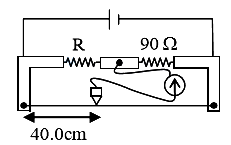 JEE Advanced 2014 Easy
 - A monochromatic beam of light is incident at on one face of an equilateral prism of refractive index and emerges from the opposite face making an angle with the normal (see the figure). For the value of is and . The value of is
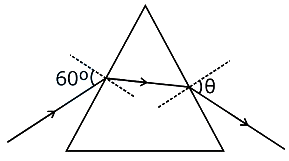 JEE Advanced 2015 Hard
 - A small object is placed 50 cm to the left of thin convex lens of focal length 30 cm. A convex spherical mirror of radius of curvature 100 cm is placed to the right of the lens at a distance of 50 cm. The mirror is tilted such that the axis of the mirror is at an angle to the axis of the lens, as shown in the figure. If the origin of the coordinate system is taken to be at the centre of the lens, the coordinates (in cm) of the point (x, y) at which the image is formed are:
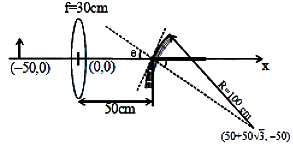 JEE Advanced 2016 Hard