


JEE Advanced · Mathematics · 29. Differential Eqns
Let \(y^{\prime}(x)+y(x) g^{\prime}(x)=g(x) g^{\prime}(x) y(0)=0, x \in R\), where \(f^{\prime}(x)\) denotes \(\frac{d f(x)}{d x}\) and \(g(x)\) is a given non-constant differentiable function on \(R\) with \(g(0)=g(2)=0\). Then, the value of \(y\) (2) is...
- A 0
- B 8
- C 9
- D 10
Answer & Solution
Correct Answer
(A) 0
Step-by-step Solution
Detailed explanation
\(\frac{d y}{d x}+y \cdot g^{\prime}(x)=g(x) g^{\prime}(x)\)
\[
\mathrm{IF}=e^{\int g^{\prime}(x) d x}=e^{g(x)}
\]
\(\therefore\) Solution is
\[
y\left(e^{g(x)}\right)=\int g(x) \cdot g^{\prime}(x) \cdot e^{g(x)} d x+C
\]
Put \(g(x)=t, g^{\prime}(x) d x=d t\)
\[
\begin{aligned}
& y\left(e^{g(x)}\right)=\int t \cdot e^t d t+C \\
= & t \cdot e^t-\int 1 \cdot e^t d t+C=t \cdot e^t-e^t+C \\
& y e^{g(x)}=(g(x)-1) e^{g(x)}+C \quad \ldots(\mathrm{i})
\end{aligned}
\]
Given, \(y(0)=0, g(0)=g(2)=0\)
\(\therefore\) Eq. (i) becomes,
\[
\begin{aligned}
& \quad y(0) \cdot e^{g(0)}=(g(0)-1) \cdot e^{g(0)}+C \\
& \Rightarrow \quad 0=(-1) \cdot 1+C \Rightarrow C=1 \\
& \therefore \quad y(x) \cdot e^{g(x)}=(g(x)-1) e^{g(x)}+1 \\
& \Rightarrow \quad y(2) \cdot e^{g(2)}=(g(2)-1) e^{g(2)}+1 \\
& \text { where, } \quad g(2)=0 \\
& \Rightarrow \quad y(2) \cdot 1=(-1) \cdot 1+1 \Rightarrow y(2)=0
\end{aligned}
\]
\[
\mathrm{IF}=e^{\int g^{\prime}(x) d x}=e^{g(x)}
\]
\(\therefore\) Solution is
\[
y\left(e^{g(x)}\right)=\int g(x) \cdot g^{\prime}(x) \cdot e^{g(x)} d x+C
\]
Put \(g(x)=t, g^{\prime}(x) d x=d t\)
\[
\begin{aligned}
& y\left(e^{g(x)}\right)=\int t \cdot e^t d t+C \\
= & t \cdot e^t-\int 1 \cdot e^t d t+C=t \cdot e^t-e^t+C \\
& y e^{g(x)}=(g(x)-1) e^{g(x)}+C \quad \ldots(\mathrm{i})
\end{aligned}
\]
Given, \(y(0)=0, g(0)=g(2)=0\)
\(\therefore\) Eq. (i) becomes,
\[
\begin{aligned}
& \quad y(0) \cdot e^{g(0)}=(g(0)-1) \cdot e^{g(0)}+C \\
& \Rightarrow \quad 0=(-1) \cdot 1+C \Rightarrow C=1 \\
& \therefore \quad y(x) \cdot e^{g(x)}=(g(x)-1) e^{g(x)}+1 \\
& \Rightarrow \quad y(2) \cdot e^{g(2)}=(g(2)-1) e^{g(2)}+1 \\
& \text { where, } \quad g(2)=0 \\
& \Rightarrow \quad y(2) \cdot 1=(-1) \cdot 1+1 \Rightarrow y(2)=0
\end{aligned}
\]
See the Complete Solution
Get step-by-step explanations for this and 2.5 Lakh+ more JEE, NEET & CET questions.
- Unlock all solutions
- Practice the full chapter
- Track accuracy across PYQs
4.8 rated on Google Play · 14,000+ reviews
More questions from Mathematics
- Let \(S=\left\{(x, y) \in \mathbb{R} \times \mathbb{R}: x \geq 0, y \geq 0, y^2 \leq 4 x, y^2 \leq 12-2 x\right.\) and \(\left.3 y+\sqrt{8} x \leq 5 \sqrt{8}\right\}\). If the area of the region \(S\) is \(\alpha \sqrt{2}\), then \(\alpha\) is equal toJEE Advanced 2024 Medium
- Let be the number of red and black balls, respectively, in box I. Let be the number of red and black balls, respectively, in box II.
One of the two boxes, box I and box II, was selected at random and a ball was drawn randomly out of this box. The balls was found to be red. If the probability that this red ball was drawn from box II is , then the correct option(s) with the possible values of is(are)JEE Advanced 2015 Medium - The slope of the tangent to the curve at the point (1, 3) is ________.JEE Advanced 2014 Medium
- The product of all positive real values of satisfying the equation isJEE Advanced 2022 Medium
- The value of the integral isJEE Advanced 2018 Easy
- Consider the lines given by
\[
L_1: x+3 y-5=0, L_2: 3 x-k y-1=0, L_3: 5 x+2 y-12=0
\]
Match the Statements/Expressions in Column I with the Statements/Expressions in Column II.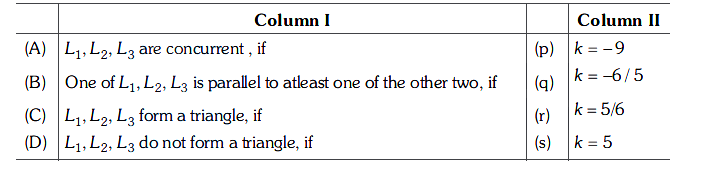 JEE Advanced 2008 Medium
More PYQs from JEE Advanced
- Suppose four distinct positive numbers \(a_1, a_2, a_3\) and \(a_4\) are in GP. Let \(b_1=a_1\), \(b_2=b_1+a_2, b_3=b_2+a_3\) and \(b_4=b_3+a_4\).
Statement 1 The numbers \(b_1, b_2, b_3\) and \(b_4\) are neither in AP nor in GP.
Statement 2 The numbers \(b_1, b_2, b_3\) and \(b_4\) are in HP.JEE Advanced 2008 Easy - Let \(f_{1}:(0, \infty) \rightarrow \mathbb{R}\) and \(f_{2}:(0, \infty) \rightarrow \mathbb{R}\) be defined by
\[
f_{1}(x)=\int_{0}^{x} \prod_{j=1}^{21}(t-j)^{j} d t, \quad x > 0
\(
and
\]
f_{2}(x)=98(x-1)^{50}-600(x-1)^{49}+2450, \quad x > 0
\)
where, for any positive integer \(n\) and real numbers \(a_{1}, a_{2}, \ldots, a_{n}, \prod_{i=1}^{n} a_{i}\) denotes the product of \(a_{1}, a_{2}, \ldots, a_{n} .\) Let \(m_{i}\) and \(n_{i}\), respectively, denote the number of points of local minima and the number of points of local maxima of function \(f_{i}, i=1,2\), in the interval \((0, \infty)\).
The value of is ____.JEE Advanced 2021 Medium - The straight line \(2 x-3 y=1\) divides the circular region \(x^2+y^2 \leq 6\) into two parts. If \(S=\left\{\left(2, \frac{3}{4}\right),\left(\frac{5}{2}, \frac{3}{4}\right),\left(\frac{1}{4},-\frac{1}{4}\right),\left(\frac{1}{8}, \frac{1}{4}\right)\right\}\), then the number of point(s) in \(S\) lying inside the smaller part isJEE Advanced 2011 Medium
- The greatest integer less than or equal to isJEE Advanced 2022 Medium
- A projectile is thrown from a point \(\mathrm{O}\) on the ground at an angle \(45^{\circ}\) from the vertical and with a speed \(5 \sqrt{2} \mathrm{~m} / \mathrm{s}\). The projectile at the highest point of its trajectory splits into two equal parts. One part falls vertically down to the ground, \(0.5 \mathrm{~s}\) after the splitting. The other part, \(t\) seconds after the splitting, falls to the ground at a distance \(x\) meters from the point O. The acceleration due to gravity \(g=10 \mathrm{~m} / \mathrm{s}^{2}\).
The value of is ________.JEE Advanced 2021 Easy - Paragraph:
Consider the lines: \(L_1: \frac{x+1}{3}=\frac{y+2}{1}=\frac{z+1}{2}, L_2: \frac{x-2}{1}=\frac{y+2}{2}=\frac{z-3}{3}\)Question:
The distance of the point \((1,1,1)\) from the plane passing through the point \((-1,-2,-1)\) and whose normal is perpendicular to both the lines \(L_1\) and \(L_2\), isJEE Advanced 2008 Easy