


JEE Advanced · Mathematics · 23. C&D
If \(f(x)=\left\{\begin{array}{cc}-x-\frac{\pi}{2}, & x \leq-\frac{\pi}{2} \\ -\cos x, & -\frac{\pi}{2} < x \leq 0 \\ x-1, & 0 < x \leq 1 \\ \log x, & x>1\end{array}\right.\), then
- A
\(f(x)\) is continuous at \(x=-\frac{\pi}{2}\)
- B
\(f(x)\) is not differentiable at \(x=0\)
- C
\(f(x)\) is differentiable at \(x=1\)
- D
\(f(x)\) is differentiable at \(x=-\frac{3}{2}\)
Answer & Solution
Correct Answer
(A)
\(f(x)\) is continuous at \(x=-\frac{\pi}{2}\)
Step-by-step Solution
Detailed explanation
\(f(x)=\left\{\begin{array}{cc}-x-\frac{\pi}{2}, & x \leq-\frac{\pi}{2} \\ -\cos x, & -\frac{\pi}{2} < x \leq 0 \\ x-1, & 0 < x \leq 1 \\ \log x, & x>1\end{array}\right.\)
Continuity at \(x=-\frac{\pi}{2}\),
\[
\begin{aligned}
& f\left(-\frac{\pi}{2}\right)=-\left(-\frac{\pi}{2}\right)-\frac{\pi}{2}=0 \\
& \mathrm{RHL} \Rightarrow \lim _{h \rightarrow 0}-\cos \left(-\frac{\pi}{2}+h\right)=0
\end{aligned}
\]
\(\therefore\) Continuous at \(x=0\)
Continuity at \(x=0 \Rightarrow f(0)=-1\) \(\mathrm{RHL} \Rightarrow \lim _{h \rightarrow 0}(0+h)-1=-1\)
\(\therefore\) Continuous at \(x=0\)
Continuity at \(x=1 ; f(1)=0\) \(\mathrm{RHL} \Rightarrow \lim _{h \rightarrow 0} \log (1+h)=0\)
\(\therefore\) Continuous at \(x=1\)
Here, \(f^{\prime}(x)=\left\{\begin{array}{cc}-1, & x \leq-\frac{\pi}{2} \\ \sin x, & -\frac{\pi}{2} < x \leq 0 \\ 1, & 0 < x \leq 1 \\ \frac{1}{x}, & x>1\end{array}\right.\)
Differentiable at \(x=0\), \(\mathrm{LHD}=0, \mathrm{RHD}=1\)
\(\therefore \quad\) Not differentiable at \(x=0\)
Differentiable at \(x=1\), \(\mathrm{LHD}=1, \mathrm{RHD}=1\)
\(\therefore\) Differentiable at \(x=1\)
Also, for \(x=-\frac{3}{2} \Rightarrow f(x)=-x-\frac{3}{2}\)
\(\therefore\) Differentiable at \(x=-\frac{3}{2}\)
Continuity at \(x=-\frac{\pi}{2}\),
\[
\begin{aligned}
& f\left(-\frac{\pi}{2}\right)=-\left(-\frac{\pi}{2}\right)-\frac{\pi}{2}=0 \\
& \mathrm{RHL} \Rightarrow \lim _{h \rightarrow 0}-\cos \left(-\frac{\pi}{2}+h\right)=0
\end{aligned}
\]
\(\therefore\) Continuous at \(x=0\)
Continuity at \(x=0 \Rightarrow f(0)=-1\) \(\mathrm{RHL} \Rightarrow \lim _{h \rightarrow 0}(0+h)-1=-1\)
\(\therefore\) Continuous at \(x=0\)
Continuity at \(x=1 ; f(1)=0\) \(\mathrm{RHL} \Rightarrow \lim _{h \rightarrow 0} \log (1+h)=0\)
\(\therefore\) Continuous at \(x=1\)
Here, \(f^{\prime}(x)=\left\{\begin{array}{cc}-1, & x \leq-\frac{\pi}{2} \\ \sin x, & -\frac{\pi}{2} < x \leq 0 \\ 1, & 0 < x \leq 1 \\ \frac{1}{x}, & x>1\end{array}\right.\)
Differentiable at \(x=0\), \(\mathrm{LHD}=0, \mathrm{RHD}=1\)
\(\therefore \quad\) Not differentiable at \(x=0\)
Differentiable at \(x=1\), \(\mathrm{LHD}=1, \mathrm{RHD}=1\)
\(\therefore\) Differentiable at \(x=1\)
Also, for \(x=-\frac{3}{2} \Rightarrow f(x)=-x-\frac{3}{2}\)
\(\therefore\) Differentiable at \(x=-\frac{3}{2}\)
See the Complete Solution
Get step-by-step explanations for this and 2.5 Lakh+ more JEE, NEET & CET questions.
- Unlock all solutions
- Practice the full chapter
- Track accuracy across PYQs
4.8 rated on Google Play · 14,000+ reviews
More questions from Mathematics
- Let and be three non - coplanar unit vectors such that the angle between every pair of them is If , where p, q and r are scalars, then the value of is _______JEE Advanced 2014 Medium
- Consider the cube in the first octant with sides and OR of length , along the x-axis, y-axis and z-axis, respectively, where is the origin. Let be the centre of the cube and be the vertex of the cube opposite to the origin such that lies on the diagonal . If and , then the value of is ______.JEE Advanced 2018 Easy
- Match the following.
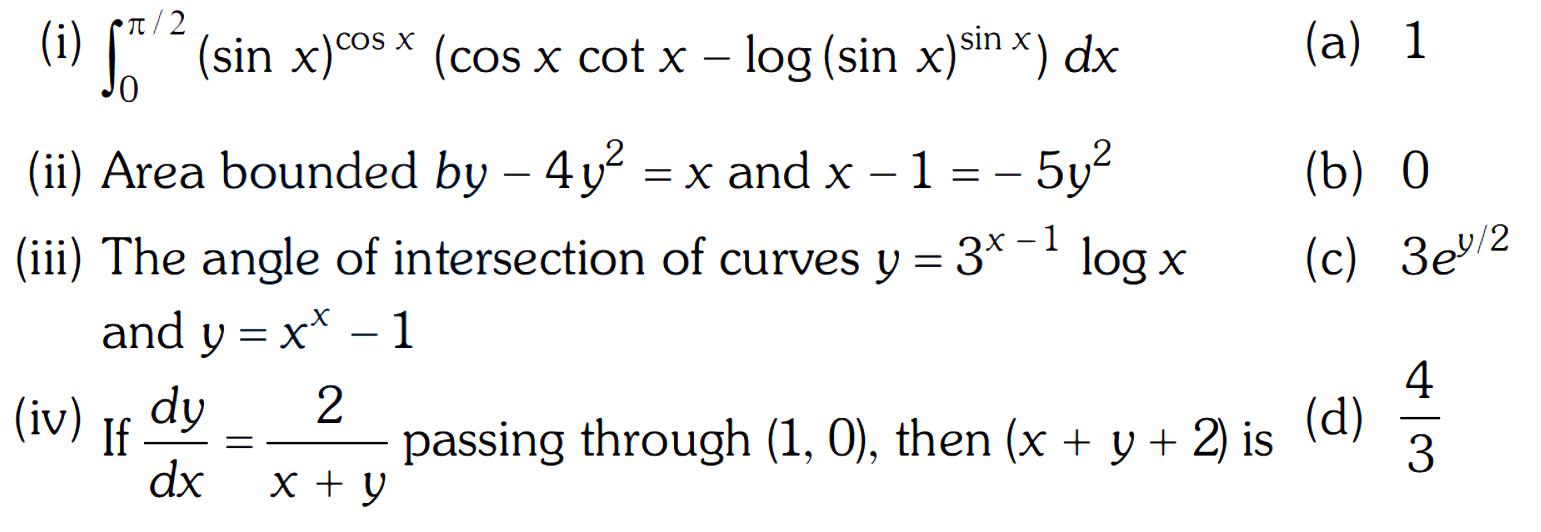 JEE Advanced 2006 Hard
 - The slope of the tangent to the curve at the point (1, 3) is ________.JEE Advanced 2014 Medium
- Let be a invertible matrix with real entries and let denote the identity matrix. , then which of the following statements is/are ALWAYS TRUE?JEE Advanced 2020 Easy
- If the distance between the plane \(A x-2 y+z=d\) and the plane containing the lines \(\frac{x-1}{2}=\frac{y-2}{3}=\frac{z-3}{4} \quad\) and \(\frac{x-2}{3}=\frac{y-3}{4}=\frac{z-4}{5}\) is \(\sqrt{6}\), then \(|d|\) isJEE Advanced 2010 Easy
More PYQs from JEE Advanced
- Paragraph:
The figure shows a surface \(X Y\) separating two transparent media, medium-1 and medium-2. The lines \(a b\) and \(c d\) represent wavefronts of a light wave travelling in medium-1 and incident on \(X Y\). The lines ef and \(g h\) represent wavefronts of the light wave in medium-2 after refraction.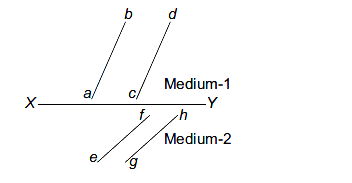
Question:
Light travels as aJEE Advanced 2007 Easy - The reactivity of compound Z with different halogens under appropriate conditions is given below:
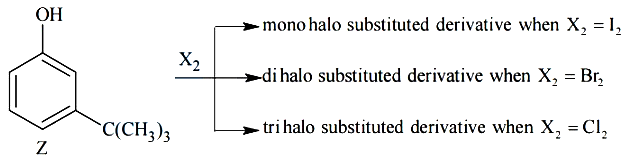
The observed pattern of electrophilic substitution can be explained byJEE Advanced 2014 Hard - In the balanced condition, the values of the resistances of the four arms of a Wheatstone bridge are shown in the figure below. The resistance has temperature coefficient . If the temperature of is increased by the voltage developed between and will be __________ volt.
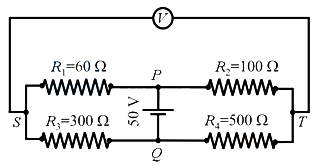 JEE Advanced 2020 Medium
 - Match the following for the given process
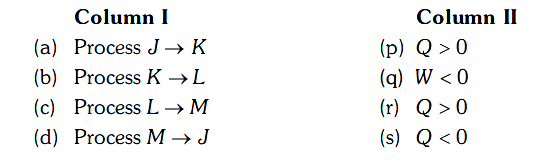
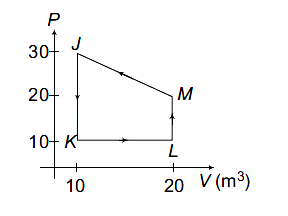 JEE Advanced 2006 Medium
 - The compound (s) having peroxide linkage is(are) :JEE Advanced 2024 Easy
- In an insulated vessel, \(0.05 \mathrm{~kg}\) steam at \(373 \mathrm{~K}\) and \(0.45 \mathrm{~kg}\) of ice at \(253 \mathrm{~K}\) are mixed. Find the final temperature of the mixture (in kelvin).
\( \text { Given, }L_{\text {fusion }} =80 \mathrm{cal} / \mathrm{g}=336 \mathrm{~J} / \mathrm{g},\) \( L_{\text {vaporization }}=540 \mathrm{cal} / \mathrm{g}=2268 \mathrm{~J} / \mathrm{g}, \)
\( S_{\text {ice }} =2100 \mathrm{~J} / \mathrm{kg}, K=0.5 \mathrm{cal} / \mathrm{gK} \text { and } S_{\text {water }}=\) \(4200 \mathrm{~J} / \mathrm{kg}, K=1 \mathrm{cal} / \mathrm{gK} .\)JEE Advanced 2006 Easy