


JEE Advanced · Mathematics · 16. Limits
Let \(\alpha\) and \(\beta\) be the real numbers such that \(\lim _{x \rightarrow 0} \frac{1}{x^3}\left(\frac{\alpha}{2} \int_0^x \frac{1}{1-t^2} d t+\beta x \cos x\right)=2\). Then the value of \(\alpha+\beta\) is _______
- A 2.4
- B 2.45
- C 5.12
- D 3.19
Answer & Solution
Correct Answer
(A) 2.4
Step-by-step Solution
Detailed explanation
\(\lim _{x \rightarrow 0} \frac{\frac{\alpha}{2} \int_0^x \frac{1}{1-t^2} d t+\beta x \cos x}{x^3}\)
\(\begin{aligned} & =\lim _{x \rightarrow 0} \frac{\frac{\alpha}{2}\left(\frac{1}{1-x^2}\right)+\beta \cos x-\beta x \sin x}{3 x^2} \\ & =\frac{\frac{\alpha}{2}\left(1-x^2\right)^{-1}+\beta\left(1-\frac{x^2}{2!}+\frac{x^4}{4!} \ldots\right)-\beta x\left(x-\frac{x^3}{3!}+\frac{x^5}{5!} \ldots\right)}{3 x^2} \\ & =\frac{\frac{\alpha}{2}\left(1+x^2+x^4 \ldots\right)+\beta\left(1-\frac{x^2}{2!}+\frac{x^4}{4!} \ldots\right)-\beta\left(x^2-\frac{x^4}{3!} \ldots\right)}{3 x^2}\end{aligned}\)
\(\begin{aligned} & =\frac{\left(\frac{\alpha}{2}+\beta\right)+\mathrm{x}^2\left(\frac{\alpha}{2}-\frac{\beta}{2}-\beta\right)+\mathrm{x}^4() \ldots}{3 \mathrm{x}^2}=2(\text { Given }) \\ & \therefore \frac{\alpha}{2}+\beta=0 \text { and } \frac{\alpha-3 \beta}{6}=2 \\ & \Rightarrow \alpha=-2 \beta \text { and } \alpha=12+3 \beta \\ & \Rightarrow \beta=-\frac{12}{5} \text { and } \alpha=\frac{24}{5}\end{aligned}\)
\(\therefore \alpha+\beta=\frac{12}{5}=2.40\)
\(\begin{aligned} & =\lim _{x \rightarrow 0} \frac{\frac{\alpha}{2}\left(\frac{1}{1-x^2}\right)+\beta \cos x-\beta x \sin x}{3 x^2} \\ & =\frac{\frac{\alpha}{2}\left(1-x^2\right)^{-1}+\beta\left(1-\frac{x^2}{2!}+\frac{x^4}{4!} \ldots\right)-\beta x\left(x-\frac{x^3}{3!}+\frac{x^5}{5!} \ldots\right)}{3 x^2} \\ & =\frac{\frac{\alpha}{2}\left(1+x^2+x^4 \ldots\right)+\beta\left(1-\frac{x^2}{2!}+\frac{x^4}{4!} \ldots\right)-\beta\left(x^2-\frac{x^4}{3!} \ldots\right)}{3 x^2}\end{aligned}\)
\(\begin{aligned} & =\frac{\left(\frac{\alpha}{2}+\beta\right)+\mathrm{x}^2\left(\frac{\alpha}{2}-\frac{\beta}{2}-\beta\right)+\mathrm{x}^4() \ldots}{3 \mathrm{x}^2}=2(\text { Given }) \\ & \therefore \frac{\alpha}{2}+\beta=0 \text { and } \frac{\alpha-3 \beta}{6}=2 \\ & \Rightarrow \alpha=-2 \beta \text { and } \alpha=12+3 \beta \\ & \Rightarrow \beta=-\frac{12}{5} \text { and } \alpha=\frac{24}{5}\end{aligned}\)
\(\therefore \alpha+\beta=\frac{12}{5}=2.40\)
See the Complete Solution
Get step-by-step explanations for this and 2.5 Lakh+ more JEE, NEET & CET questions.
- Unlock all solutions
- Practice the full chapter
- Track accuracy across PYQs
4.8 rated on Google Play · 14,000+ reviews
More questions from Mathematics
- Let \(S_n=\sum_{k=0}^n \frac{n}{n^2+k n+k^2}\) and \(T_n=\sum_{k=0}^{n-1} \frac{n}{n^2+k n+k^2}\), for \(n=1,2,3, \ldots\), thenJEE Advanced 2008 Medium
- The locus of the orthocentre of the triangle formed by the lines \((1+p) x-p y+p(1+p)=0\), \((1+q) x-q y+q(1+q)=0\) and \(y=0\), where \(p \neq q\), isJEE Advanced 2009 Hard
- Let
Let be all the points of local maximum of and be all the points of local minimum of
Then which of the following options is/are correct?JEE Advanced 2019 Hard - A man walks a distance of 3 units from the origin towards the North-East \(\left(\mathrm{N} 45^{\circ} \mathrm{E}\right)\) direction. From there, he walks a distance of 4 units towards the North-West ( \(\mathrm{N} 45^{\circ} \mathrm{W}\) ) direction to reach a point \(P\). Then, the position of \(P\) in the Argand plane isJEE Advanced 2007 Easy
- Let \(A B C D\) be a quadrilateral with area 18 , with side \(A B\) parallel to the side \(C D\) and \(A B=2 C D\). Let \(A D\) be perpendicular to \(A B\) and \(C D\). If a circle is drawn inside the quadrilateral \(A B C D\) touching all the sides, then its radius isJEE Advanced 2007 Hard
- Let \(f: \mathbb{R} \rightarrow \mathbb{R}\) and \(g: \mathbb{R} \rightarrow \mathbb{R}\) be functions defined by
\(f(x)=\left\{\begin{array}{ll}x|x| \sin \left(\frac{1}{x}\right), & x \neq 0, \\ 0, & x=0,\end{array} \quad\right.\) and \(g(x)= \begin{cases}1-2 x, & 0 \leq x \leq \frac{1}{2} \\ 0, & \text { otherwise }\end{cases}\)
Let \(a, b, c, d \in \mathbb{R}\). Define the function \(h: \mathbb{R} \rightarrow \mathbb{R}\) by
\(h(x)=a f(x)+b\left(g(x)+g\left(\frac{1}{2}-x\right)\right)+c(x-g(x))+d g(x), x \in \mathbb{R}\)
Match each entry in List-I to the correct entry in List-II.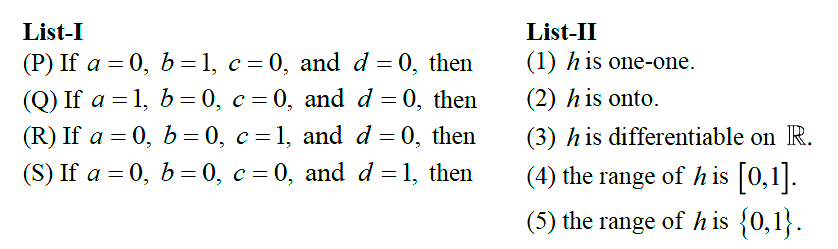
The correct option is :JEE Advanced 2024 Hard
More PYQs from JEE Advanced
- A block of mass \(2 \mathrm{~kg}\) is free to move along the \(x\)-axis. It is at rest and from \(t\) \(=0\) onwards it is subjected to a time-dependent force \(F(t)\) in the \(x\) direction. The force \(F(t)\) varies with \(t\) as shown in the figure. The kinetic energy of the block after \(4.5 \mathrm{~s}\) is
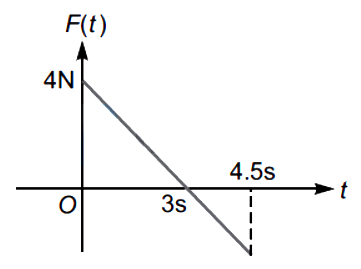 JEE Advanced 2010 Easy
 - Paragraph:
Chemical reactions involve interaction of atoms and molecules. A large number of atoms/molecules (approximately \(6.023 \times 10^{23}\) ) are present in a few grams of any chemical compound varying with their atomic/molecular masses. To handle such large numbers conveniently, the mole concept was introduced. This concept has implications in diverse areas such as analytical chemistry, biochemistry, electrochemistry and radiochemistry. The following example illustrates a typical case, involving chemical/electrochemical reaction, which requires a clear understanding of the mole concept.
A \(4.0\) molar aqueous solution of \(\mathrm{NaCl}\) is prepared and \(500 \mathrm{~mL}\) of this solution is electrolysed. This leads to the evolution of chlorine gas at one of electrodes (atomic mass: \(\mathrm{Na}=23, \mathrm{Hg}=200 ; 1\) faraday \(=96500\) coulombs).
Question:
If the cathode is a Hg electrode, the maximum weight \((g)\) of amalgam formed from this solution isJEE Advanced 2007 Medium - Paragraph :
The capacitor of capacitance \(C\) can be charged (with the help of a resistance \(R\) ) by a voltage source \(V\), by closing switch \(S_1\) while keeping switch \(S_2\) open. The capacitor can be connected in series with an inductor \(L\) by closing switch \(S_2\) and opening \(S_1\).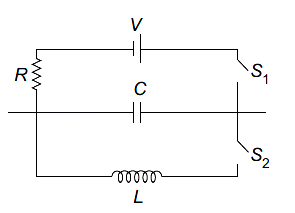
Question :
If the total charge stored in the \(L C\) circuit is \(Q_0\), then for \(t \geq 0\)JEE Advanced 2006 Hard - The synthesis of 3-octyne is achieved by adding a bromoalkane into a mixture of sodium amide and an alkyne. The bromoalkane and alkyne respectively areJEE Advanced 2010 Easy
- Let be the ellipse . For any three distinct points and on , let be the mid-point of the line segment joining and , and be the mid-point of the line segment joining and . Then the maximum possible value of the distance between and , as and vary on , is _____.JEE Advanced 2021 Medium
- Consider the following cell reaction,
\(2 \mathrm{Fe}(\mathrm{s})+\mathrm{O}_2(g)+4 \mathrm{H}^{+}(a q) \longrightarrow \)
\( 2 \mathrm{Fe}^{2+}(a q)+2 \mathrm{H}_2 \mathrm{O}(l), E^{\circ}=1.67 \mathrm{~V} \)
\( \text {At } {\left[\mathrm{Fe}^{2+}\right]=10^{-3} \mathrm{M}, \mathrm{P}\left(\mathrm{O}_2\right)=0.1 \mathrm{~atm}}\)
and \(\mathrm{pH}=3\), the cell potential at \(25^{\circ} \mathrm{C}\) isJEE Advanced 2011 Easy