


JEE Advanced · Physics · 6. Work Power Energy
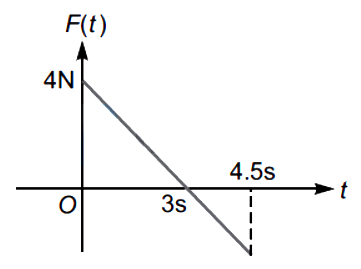
A block of mass \(2 \mathrm{~kg}\) is free to move along the \(x\)-axis. It is at rest and from \(t\) \(=0\) onwards it is subjected to a time-dependent force \(F(t)\) in the \(x\) direction. The force \(F(t)\) varies with \(t\) as shown in the figure. The kinetic energy of the block after \(4.5 \mathrm{~s}\) is
- A \(4.50 \mathrm{~J}\)
- B \(7.50 \mathrm{~J}\)
- C \(5.06 \mathrm{~J}\)
- D \(14.06 \mathrm{~J}\)
Answer & Solution
Correct Answer
(C) \(5.06 \mathrm{~J}\)
Step-by-step Solution
Detailed explanation
Area under \(F\) - \(t\) graph \(=\) momentum
\(
\begin{aligned}
&=P=\sqrt{2 k m} \\
& \therefore \quad k=\frac{A^2}{2 m} \\
&(A=\text { net area of } F-t \text { graph) } \\
&=\frac{\left\{\left(\frac{4 \times 3}{2}\right)-\left(\frac{1.5 \times 2}{2}\right)\right\}^2}{2 \times 2}=5.0625 \mathrm{~J}
\end{aligned}
\)
\(\therefore\) The correct option is (c).
\(
\begin{aligned}
&=P=\sqrt{2 k m} \\
& \therefore \quad k=\frac{A^2}{2 m} \\
&(A=\text { net area of } F-t \text { graph) } \\
&=\frac{\left\{\left(\frac{4 \times 3}{2}\right)-\left(\frac{1.5 \times 2}{2}\right)\right\}^2}{2 \times 2}=5.0625 \mathrm{~J}
\end{aligned}
\)
\(\therefore\) The correct option is (c).
See the Complete Solution
Get step-by-step explanations for this and 2.5 Lakh+ more JEE, NEET & CET questions.
- Unlock all solutions
- Practice the full chapter
- Track accuracy across PYQs
4.8 rated on Google Play · 14,000+ reviews
More questions from Physics
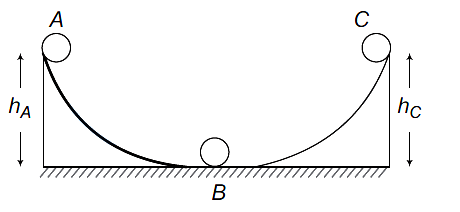
- A ball moves over a fixed track as shown in the figure. From \(A\) to \(B\) the ball rolls without slipping. If surface \(B C\) is frictionless and \(K_A, K_B\) and \(K_C\) are kinetic energies of the ball at \(A, B\) and \(C\) respectively, then
 JEE Advanced 2006 Medium
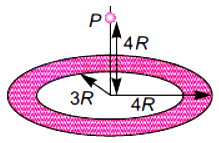
 - A thin uniform annular disc (see figure) of mass \(M\) has outer radius \(4 R\) and inner radius \(3 R\). The work required to take a unit mass from point \(P\) on its axis to infinity is
 JEE Advanced 2010 Hard
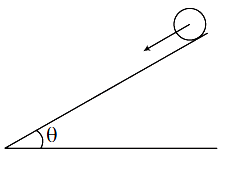
 - A solid sphere is in pure rolling motion on an inclined surface having inclination \(\theta\).
 JEE Advanced 2006 Medium
 - The filament of a light bulb has surface area The filament can be considered as a black body at temperature emitting radiation like a point source when viewed from far. At night the light bulb is observed from a distance of . Assume the pupil of the eyes of the observer to be circular with radius . Then: (Take Stefan-Boltzmann constant Wiens' displacement constant , Planck's constant , speed of light in vacuum )JEE Advanced 2020 Hard
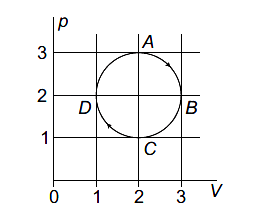
- The figure shows the \(p-V\) plot of an ideal gas taken through a cycle \(A B C D A\). The part \(A B C\) is a semi-circle and \(C D A\) is half of an ellipse. Then,
 JEE Advanced 2009 Medium
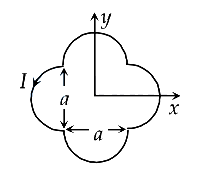
 - A loop carrying current \(I\) lies in the \(x-y\) plane as shown in the figure. The unit vector \(\hat{k}\) is coming out of the plane of the paper. The magnetic moment of the current loop is
 JEE Advanced 2012 Medium
More PYQs from JEE Advanced
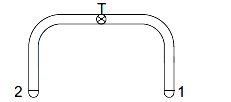
- A glass tube of uniform internal radius \((r)\) has a valve separating the two identical ends. Initially, the valve is in a tightly closed position. End 1 has a hemispherical soap bubble of radius \(r\). End 2 has sub-hemispherical soap bubble as shown in figure. Just after opening the valve,
 JEE Advanced 2008 Medium
 - Let denote the set of all the terms of an infinite arithmetic progression with first term a and common difference If then equals ____JEE Advanced 2019 Medium
- Paragraph:
Let \(A, B, C\) be three sets of complex numbers as defined below.
\(A=\{z ; \operatorname{lm} z \geq 1\} ; B=\{z:|z-2-i|=3\} ;\) \(C=\{z: \operatorname{Re}((1-i) z)=\sqrt{2}\}\).
Question:
Let \(z\) be any point in \(A \cap B \cap C\) and let \(w\) be any point satisfying \(|w-2-i| < 3\). Then, \(|z|-|w|+3\) lies betweenJEE Advanced 2008 Medium - Let where and are real number, and is the identity matrix. If is the minimum of the set { and is the minimum of the set then the value of isJEE Advanced 2019 Hard
- Paragraph:
The key feature of Bohr's theory of spectrum of hydrogen atom is the quantization of angular momentum when an electron is revolving around a proton. We will extend this to a general rotational motion to find quantized rotational energy of a diatomic molecule assuming it to be rigid. The rule to be applied is Bohr's quantization condition.
Question:
In a CO molecule, the distance between \(\mathrm{C}\) (mass \(=12 \mathrm{amu}\) ) and \(\mathrm{O}\) (mass = \(16 \mathrm{amu}\) ), where \(1 \mathrm{amu}=\frac{5}{3} \times 10^{-27} \mathrm{~kg}\), is close toJEE Advanced 2010 Medium - Let the straight line \(x=b\) divide the area enclosed by \(y=(1-x)^2, y=0\) and \(x=0\) into two parts \(R_1(0 \leq x \leq b)\) and \(R_2(b \leq x \leq 1)\) such that \(R_1-R_2=\frac{1}{4}\). Then, \(b\) equals toJEE Advanced 2011 Medium