


JEE Advanced · Chemistry · 17. Electrochemistry
Consider the following cell reaction,
\(2 \mathrm{Fe}(\mathrm{s})+\mathrm{O}_2(g)+4 \mathrm{H}^{+}(a q) \longrightarrow \)
\( 2 \mathrm{Fe}^{2+}(a q)+2 \mathrm{H}_2 \mathrm{O}(l), E^{\circ}=1.67 \mathrm{~V} \)
\( \text {At } {\left[\mathrm{Fe}^{2+}\right]=10^{-3} \mathrm{M}, \mathrm{P}\left(\mathrm{O}_2\right)=0.1 \mathrm{~atm}}\)
and \(\mathrm{pH}=3\), the cell potential at \(25^{\circ} \mathrm{C}\) is
- A \(1.47 \mathrm{~V}\)
- B \(1.77 \mathrm{~V}\)
- C \(1.87 \mathrm{~V}\)
- D \(1.57 \mathrm{~V}\)
Answer & Solution
Correct Answer
(D) \(1.57 \mathrm{~V}\)
Step-by-step Solution
Detailed explanation
The half reactions are \(\mathrm{Fe}(s) \longrightarrow \mathrm{Fe}^{2+}(\mathrm{aq})+2 e^{-} \times 2\)
\(\mathrm{O}_2(g)+4 \mathrm{H}^{+}+4 e^{-} \longrightarrow 2 \mathrm{H}_2 \mathrm{O}+2 \mathrm{Fe}(s) \)
\( +\mathrm{O}_2(g)+4 \mathrm{H}^{+} \longrightarrow 2 \mathrm{Fe}^{2+}(a q)+2 \mathrm{H}{ }_2 \mathrm{O}(l) \)
\( E=E^{\circ}-\frac{0.059}{4} \log \frac{\left(10^{-3}\right)^2}{\left(10^{-3}\right)^4(0.1)}=1.57 \mathrm{~V}\)
\(\mathrm{O}_2(g)+4 \mathrm{H}^{+}+4 e^{-} \longrightarrow 2 \mathrm{H}_2 \mathrm{O}+2 \mathrm{Fe}(s) \)
\( +\mathrm{O}_2(g)+4 \mathrm{H}^{+} \longrightarrow 2 \mathrm{Fe}^{2+}(a q)+2 \mathrm{H}{ }_2 \mathrm{O}(l) \)
\( E=E^{\circ}-\frac{0.059}{4} \log \frac{\left(10^{-3}\right)^2}{\left(10^{-3}\right)^4(0.1)}=1.57 \mathrm{~V}\)
See the Complete Solution
Get step-by-step explanations for this and 2.5 Lakh+ more JEE, NEET & CET questions.
- Unlock all solutions
- Practice the full chapter
- Track accuracy across PYQs
4.8 rated on Google Play · 14,000+ reviews
More questions from Chemistry
- For the reaction, \(\mathbf{X}(s) \rightleftharpoons \mathbf{Y}(s)+\mathbf{Z}(g)\), the plot of \(\ln \frac{p_{\mathbf{Z}}}{p^{\theta}}\) versus \(\frac{10^{4}}{T}\) is given below (in solid line), where \(p_{\mathbf{Z}}\) is the pressure (in bar) of the gas \(\mathbf{Z}\) at temperature \(T\) and \(p^{\theta}=1\) bar.
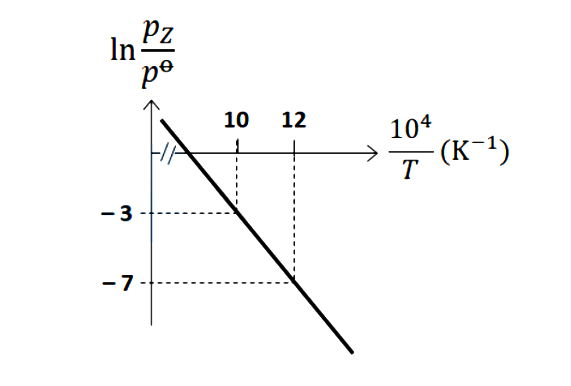
(Given, \(\frac{\mathrm{d}(\ln K)}{\mathrm{d}\left(\frac{1}{T}\right)}=-\frac{\Delta H^{\theta}}{R}\), where the equilibrium constant, \(K=\frac{p_{z}}{p^{\theta}}\) and the gas constant, \(\mathrm{R}=8.314 \mathrm{~J} \mathrm{~K}^{-1} \mathrm{~mol}^{-1}\) )
The value of (in ) for the given reaction, at is ___.JEE Advanced 2021 Hard - Paragraph:
There are some deposits of nitrates and phosphates in earth's crust. Nitrates are more soluble in water. Nitrates are difficult to reduce under the laboratory conditions but microbes do it easily. Ammonia forms large number of complexes with transition metal ions. Hybridisation easily explains the ease of sigma donation capability of \(\mathrm{NH}_3\) and \(\mathrm{PH}_3\). Phosphine is a flammable gas and is prepared from white phosphorus.
Question:
White phosphorus on reaction with \(\mathrm{NaOH}\) gives \(\mathrm{PH}_3\) as one of the products. This is aJEE Advanced 2008 Easy - The desired product X can be prepared by reacting the major product of the reactions in LIST-I with one or more appropriate reagents in LIST-II.
(given, order of migratory aptitude: aryl > alkyl hydrogen)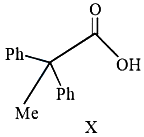
LIST-I LIST -II A) 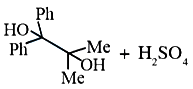
P) B) 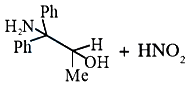
Q) C) 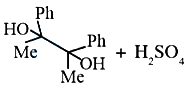
R) Fehling solution D) 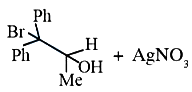
S) T) JEE Advanced 2018 Medium - LIST-I contains compounds and LIST-II contains reactions
Match each compound in LIST-I with its formation reaction(s) in LIST-II, and choose the correct optionList - I List - II (I) \(H _2 O _2\) (P) \(Mg \left( HCO _3\right)_2+ Ca\) \((OH)_2 \rightarrow\) (II) \(Mg ( OH )_2\) (Q) \(BaO _2+ H _2 SO _4 \rightarrow\) (III) \(BaCl _2\) (R) \(Ca \left( OH _2\right) 2\) \(+ MgCl _2 \rightarrow\) (IV) \(CaCO _3\) (S) \(BaO _2+ HCl \rightarrow\) (T) \(Ca \left( HCO _3\right)_2\) \(+ Ca ( OH )_2\) JEE Advanced 2022 Easy - The correct stability order of the following resonance structure is
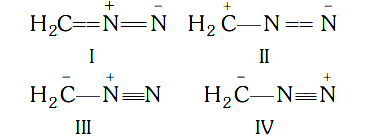 JEE Advanced 2009 Medium
 - The direct conversion of \(A\) to \(B\) is difficult, hence it is carried out by the following shown path.
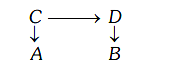
Given \(\Delta S_{(A \rightarrow C)}=50 \mathrm{eu}, \quad \Delta S_{(C \rightarrow D)}=30 \mathrm{eu}, \quad\) \(\Delta S_{(B \rightarrow D)}=20 \mathrm{eu}\) where eu is entropy unit, then \(\Delta S_{(A \rightarrow B)}\) isJEE Advanced 2006 Medium
More PYQs from JEE Advanced
- Consider all possible isomeric ketones, including stereoisomers of MW = 100. All these isomers are independently reacted with (NOTE: stereoisomers are also reacted separately). The total number of ketones that give a racemic product(s) is/areJEE Advanced 2014 Medium
- Paragraph :
When liquid medicine of density \(\rho\) is to be put in the eye, it is done with the help of a dropper. As the bulb on the top of the dropper is pressed, a drop forms at the opening of the dropper. We wish to estimate the size of the drop.
We first assume that the drop formed at the opening is spherical because that requires a minimum increase in its surface energy. To determine the size, we calculate the net vertical force due to the surface tension \(T\) when the radius of the drop is \(R\). When this force becomes smaller than the weight of the drop, the drop gets detached from the dropper.Question :
After the drop detaches, its surface energy isJEE Advanced 2010 Easy - List I contains four combinations of two lenses ( 1 and 2 ) whose focal lengths (in cm ) are indicated in the figures. In all cases, the object is placed 20 cm from the first lens on the left, and the distance between the two lenses is 5 cm . List II contains the positions of the final images.
Which one of the following options is correct?List - I List - II (I) 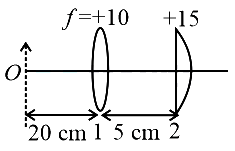
(P) Final image is formed at 7.5 cm on the right side of lens 2. (II) 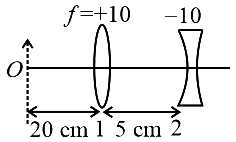
(Q) Final image is formed at 60.0 cm on the right side of lens 2. (III) 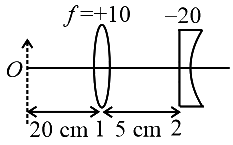
(R) Final image is formed at 30.0 cm on the left side of lens 2. (IV) 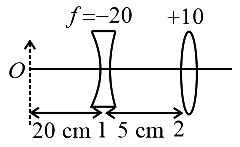
(S) Final image is formed at
6.0 cm on the right side of lens 2.(T) Final image is formed at 30.0 cm on the right side of lens 2. JEE Advanced 2022 Hard - Match the following.
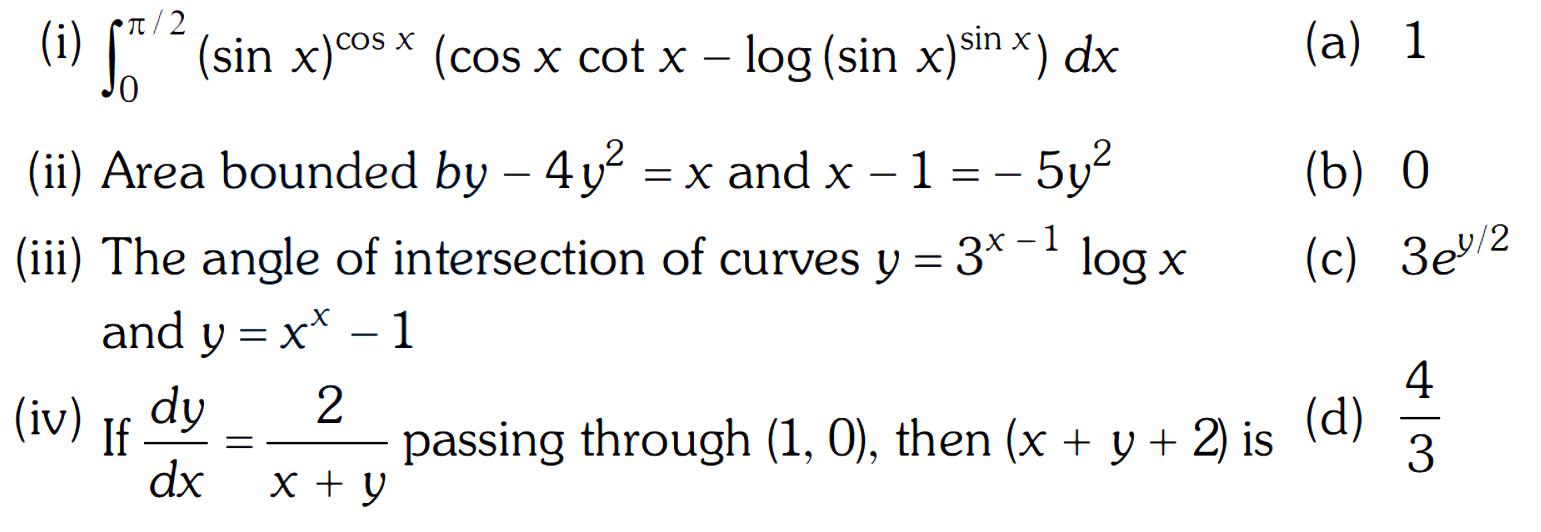 JEE Advanced 2006 Hard
 - A student is performing an experiment using a resonance column and a tuning fork of frequency \(244 s^{-1}\). He is told that the air in the tube has been replaced by another gas (assume that the column remains filled with the gas). If the minimum height at which resonance occurs is \((0.350 \pm 0.005) m\), the gas in the tube is (Useful information: \(\sqrt{167\text{ RT}}=640\text{ J}^{\frac{1}{2}}\text{ mol}^{-\frac{1}{2}} ;\) \(\sqrt{140\text{ RT}}=590\text{ J}^{\frac{1}{2}}\text{ mole}^{-\frac{1}{2}}\) . The molar masses M in grams are given in the options. Take the values of \(\sqrt{\frac{10}{\text M }}\) for each gas as given there.)JEE Advanced 2014 Easy
- Paragraph:
If a continuous \(f\) defined on the real line \(R\), assume positive and negative values in \(R\), then the equation \(f(x)=0\) has a root in \(R\). For example, if it is known that a continuous function \(f\) on \(R\) is positive at some point and its minimum values is negative, then the equation \(f(x)=0\) has a root in \(R\).
Consider \(f(x)=k e^x-x\) for all real \(x\), where \(k\) is real constant.Question:
For \(k>0\), the set of all values of \(k\) for which \(k e^x-x=0\) has two distinct roots, isJEE Advanced 2007 Medium