


JEE Advanced · Mathematics · 12. Circle
Let \(A B C D\) be a quadrilateral with area 18 , with side \(A B\) parallel to the side \(C D\) and \(A B=2 C D\). Let \(A D\) be perpendicular to \(A B\) and \(C D\). If a circle is drawn inside the quadrilateral \(A B C D\) touching all the sides, then its radius is
- A
3
- B
2
- C
\(\frac{3}{2}\)
- D
1
Answer & Solution
Correct Answer
(B)
2
Step-by-step Solution
Detailed explanation
\[
\text { } 18=\frac{1}{2}(3 \alpha)(2 r) \Rightarrow \alpha r=6
\]
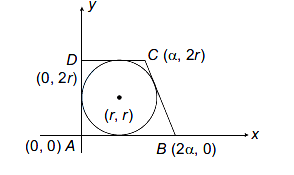
Line, \(y=-\frac{2 r}{\alpha}(x-2 \alpha)\) is tangent to circle
\[
\begin{aligned}
(x-r)^2+(y-r)^2 & =r^2 \\
2 \alpha & =3 r \text { and } \alpha=6 \\
r & =2
\end{aligned}
\]
\[
\begin{aligned}
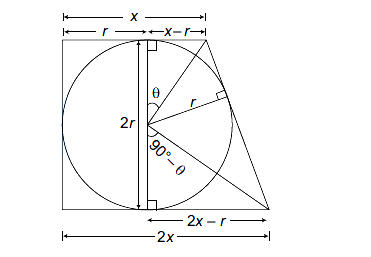
\frac{1}{2}(x+2 x) \times 2 r & =18 \\
x r & =6 \\
\tan \theta & =\frac{x-r}{r} \\
\tan \left(90^{\circ}-\theta\right) & =\frac{2 x-r}{r} \\
\frac{x-r}{r} & =\frac{r}{2 x-r} \times(2 x-3 r)=0
\end{aligned}
\]
\[
x=\frac{3 r}{2}
\]
From Eqs. (i) and (ii), we get
\[
r=2
\]
\text { } 18=\frac{1}{2}(3 \alpha)(2 r) \Rightarrow \alpha r=6
\]
Line, \(y=-\frac{2 r}{\alpha}(x-2 \alpha)\) is tangent to circle
\[
\begin{aligned}
(x-r)^2+(y-r)^2 & =r^2 \\
2 \alpha & =3 r \text { and } \alpha=6 \\
r & =2
\end{aligned}
\]
\[
\begin{aligned}
\frac{1}{2}(x+2 x) \times 2 r & =18 \\
x r & =6 \\
\tan \theta & =\frac{x-r}{r} \\
\tan \left(90^{\circ}-\theta\right) & =\frac{2 x-r}{r} \\
\frac{x-r}{r} & =\frac{r}{2 x-r} \times(2 x-3 r)=0
\end{aligned}
\]
\[
x=\frac{3 r}{2}
\]
From Eqs. (i) and (ii), we get
\[
r=2
\]
See the Complete Solution
Get step-by-step explanations for this and 2.5 Lakh+ more JEE, NEET & CET questions.
- Unlock all solutions
- Practice the full chapter
- Track accuracy across PYQs
4.8 rated on Google Play · 14,000+ reviews
More questions from Mathematics
- Consider \(L_1: 2 x+3 y+p-3=0 ; L_2: 2 x+3 y+p+3=0\) where \(p\) is a real number and \(C: x^2+y^2+6 x-10 y+30=0\).
Statement 1 If line \(L_1\) is a chord of circle \(C\), then line \(L_2\) is not always a diameter of circle \(C\).
Statement 2 If line \(L_1\) is a diameter of circle \(C\), then line \(L_2\) is not a chord of circle \(C\).JEE Advanced 2008 Easy - Let \(a_1, a_2, a_3, \ldots, a_{11}\) be real numbers satisfying \(a_1=15,27-2 a_2>0\) and \(a_k=2 a_{k-1}-a_{k-2}\) for \(k=3,4, \ldots, 11\).
If \(\frac{a_1^2+a_2^2+\ldots+a_{11}^2}{11}=90\), then the value of \(\frac{a_1+a_2+\ldots+a_{11}}{11}\) is equal toJEE Advanced 2010 Medium - The total number of distinct for which isJEE Advanced 2016 Medium
- The value of \(\int_{\sqrt{\log 2}}^{\sqrt{\log 3}} \frac{x \sin x^2}{\sin x^2+\sin \left(\log 6-x^2\right)} d x\) isJEE Advanced 2011 Medium
- The area of the region isJEE Advanced 2019 Easy
- Let \(X\) be a random variable, and let \(P(X=x)\) denote the probability that \(X\) takes the value \(x\). Suppose that the points \((x, P(X=x)), x=0,1,2,3,4\), lie on a fixed straight line in the \(x y\)-plane, and \(P(X=x)=0\) for all \(x \in \mathbb{R}-\{0,1,2,3,4\}\). If the mean of \(X\) is \(\frac{5}{2}\), and the variance of \(X\) is \(\alpha\), then the value of \(24 \alpha\) is ___JEE Advanced 2024 Hard
More PYQs from JEE Advanced
- Paragraph:
Consider the functions defined implicitly by the equation \(y^3-3 y+x=0\) on various intervals in the real line. If \(x \in(-\infty,-2) \cup(2, \infty)\), the equation implicitly defines a unique real valued differentiable function \(y=f(x)\). If \(x \in(-2,2)\), the equation implicitly defines a unique real valued differentiable function \(y=g(x)\), satisfying \(g(0)=0\).Question:
The area of the region bounded by the curve \(y=f(x)\), the \(X\)-axis and the lines \(x=a\) and \(x=b\), where \(-\infty < a < b < -2\), isJEE Advanced 2008 Medium - If the straight lines \(\frac{x-1}{2}=\frac{y+1}{k}=\frac{z}{2}\) and \(\frac{x+1}{5}=\frac{y+1}{2}=\frac{z}{k}\) are coplanar, then the plane (s) containing these two lines is (are)JEE Advanced 2012 Medium
- Four persons independently solve a certain problem correctly with probabilities . Then the probability that the problem is solved correctly by at least one of them isJEE Advanced 2013 Medium
- Paragraph:
When a particle is restricted to move along \(x\)-axis between \(x=0\) and \(x=a\), where \(a\) is of nanometer dimension, its energy can take only certain specific values. The allowed energies of the particle moving in such a restricted region, correspond to the formation of standing waves with nodes at its ends \(x=0\) and \(x=a\). The wavelength of this standing wave is related to the liner momentum \(p\) of the particle according to the de Broglie relation. The energy of the particle of mass \(m\) is related to its linear momentum as \(E=\frac{p^2}{2 m}\). Thus, the energy of the particle can be denoted by a quantum number \(n\) taking values \(1,2,3, \ldots(n=1\), called the ground state) corresponding to the number of loops in the standing wave.
Use the model described above to answer the following three questions for a particle moving in the line \(x=0\) to \(x=a\) [Take \(h=6.6 \times 10^{-34} \mathrm{Js}\) and \(e=1.6 \times 10^{-19} \mathrm{C}\) ]
Question:
The allowed energy for the particle for a particular value of \(n\) is proportional toJEE Advanced 2009 Medium - Let \(a\) and \(b\) be two nonzero real numbers. If the coefficient of \(x^5\) in the expansion of \(\left(a x^2+\frac{70}{27 b x}\right)^4\) is equal to the coefficient of \(x^{-5}\) in the expansion of \(\left(a x-\frac{1}{b x^2}\right)^7\), then the value of \(2 b\) isJEE Advanced 2023 Easy
- Let the straight line \(x=b\) divide the area enclosed by \(y=(1-x)^2, y=0\) and \(x=0\) into two parts \(R_1(0 \leq x \leq b)\) and \(R_2(b \leq x \leq 1)\) such that \(R_1-R_2=\frac{1}{4}\). Then, \(b\) equals toJEE Advanced 2011 Medium