


JEE Advanced · Mathematics · 22. Functions
Let \(f: \mathbb{R} \rightarrow \mathbb{R}\) and \(g: \mathbb{R} \rightarrow \mathbb{R}\) be functions defined by
\(f(x)=\left\{\begin{array}{ll}x|x| \sin \left(\frac{1}{x}\right), & x \neq 0, \\ 0, & x=0,\end{array} \quad\right.\) and \(g(x)= \begin{cases}1-2 x, & 0 \leq x \leq \frac{1}{2} \\ 0, & \text { otherwise }\end{cases}\)
Let \(a, b, c, d \in \mathbb{R}\). Define the function \(h: \mathbb{R} \rightarrow \mathbb{R}\) by
\(h(x)=a f(x)+b\left(g(x)+g\left(\frac{1}{2}-x\right)\right)+c(x-g(x))+d g(x), x \in \mathbb{R}\)
Match each entry in List-I to the correct entry in List-II.
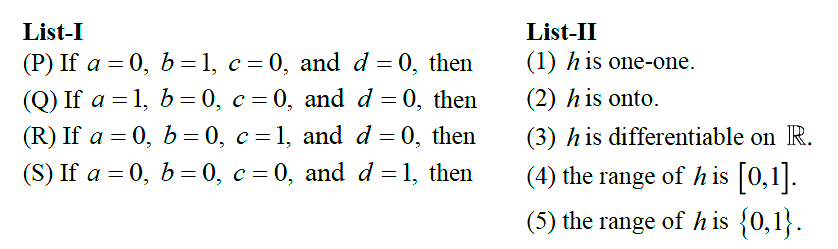
The correct option is :
- A \((\mathrm{P}) \rightarrow(4) \quad(\mathrm{Q}) \rightarrow(3) \quad(\mathrm{R}) \rightarrow(1) \quad(\mathrm{S}) \rightarrow(2)\)
- B \((\mathrm{P}) \rightarrow(5) \quad(\mathrm{Q}) \rightarrow(2) \quad(\mathrm{R}) \rightarrow(4) \quad(\mathrm{S}) \rightarrow(3)\)
- C \((\mathrm{P}) \rightarrow(5) \quad(\mathrm{Q}) \rightarrow(3) \quad(\mathrm{R}) \rightarrow(2) \quad(\mathrm{S}) \rightarrow(4)\)
- D \((\mathrm{P}) \rightarrow(4) \quad(\mathrm{Q}) \rightarrow(2) \quad(\mathrm{R}) \rightarrow(1) \quad(\mathrm{S}) \rightarrow(3)\)
Answer & Solution
Correct Answer
(C) \((\mathrm{P}) \rightarrow(5) \quad(\mathrm{Q}) \rightarrow(3) \quad(\mathrm{R}) \rightarrow(2) \quad(\mathrm{S}) \rightarrow(4)\)
Step-by-step Solution
Detailed explanation
\(f(x)=\left\{\begin{array}{ccc}x|x| \sin \frac{1}{x} & ; & x \neq 0 \\ 0 & ; & x=0\end{array} \quad g(x)=\left\{\begin{array}{ccc}1-2 x & ; & 0 \leq x \leq \frac{1}{2} \\ 0 & ; & \text { otherwise }\end{array}\right.\right.\)
\(g\left(\frac{1}{2}-x\right)=\left\{\begin{array}{ccc}2 x & ; & 0 \leq \frac{1}{2}-x \leq \frac{1}{2} \\ 0 & ; & \text { otherwise }\end{array}=\left\{\begin{array}{ccc}2 x & ; & 0 \leq x \leq \frac{1}{2} \\ 0 & ; & \text { otherwise }\end{array}\right\}\right.\)
\(g(x)+g\left(\frac{1}{2}-x\right)=\left\{\begin{array}{lll}1 & ; & 0 \leq x \leq \frac{1}{2} \\ 0 & ; & \text { otherwise }\end{array}\right\}\)
(P)
Now \(\mathrm{a}=0, \mathrm{~b}=1, \mathrm{c}=0, \mathrm{~d}=0\)
\(\because \mathrm{h}(\mathrm{x})=\mathrm{g}(\mathrm{x})+\mathrm{g}\left(\frac{1}{2}-\mathrm{x}\right)=\left\{\begin{array}{lll}1 & ; & 0 \leq \mathrm{x} \leq \frac{1}{2} \\ 0 & ; & \text { otherwise }\end{array}\right.\)
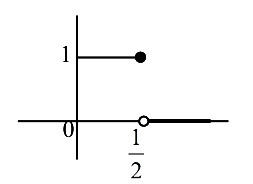
Hence Range of \(\mathrm{h}(\mathrm{x})\) is \(\{0,1\}\)
(Q)
\(\begin{aligned} & \mathrm{a}=1, \mathrm{~b}=0, \mathrm{c}=0, \mathrm{~d}=0 \\ & \mathrm{~h}(\mathrm{x})=\mathrm{f}(\mathrm{x})=\left\{\begin{array}{cll}\mathrm{x}|\mathrm{x}| \sin \frac{1}{x} & ; & x \neq 0 \\ 0 & ; & x=0\end{array}\right. \\ & \text { RHD }=\lim _{x \rightarrow 0} \frac{x^2 \sin \frac{1}{x}-0}{x}=0 \\ & \text { LHD }=\lim _{x \rightarrow 0} \frac{-x^2 \sin \frac{1}{x}-0}{x}=0\end{aligned}\)
Hence \(\mathrm{h}(\mathrm{x})\) is differentiable on \(\mathrm{R}\)
(R)
\(\begin{aligned} & \mathrm{a}=0, \mathrm{~b}=0, \mathrm{c}=1, \mathrm{~d}=0 \\ & h(x)=x-g(x)=\left\{\begin{array}{ccc}3 \mathrm{x}-1 & ; & 0 \leq x \leq \frac{1}{2} \\ 0 & ; & \text { otherwise }\end{array}\right.\end{aligned}\)
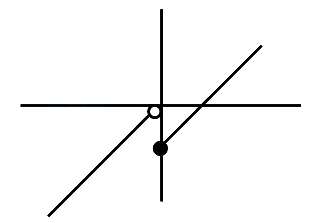
\(\therefore \mathrm{h}(\mathrm{x})\) is ONTO
(S)
\(\begin{aligned} & \mathrm{a}=0, \mathrm{~b}=0, \mathrm{c}=0, \mathrm{~d}=1 \\ & \mathrm{~h}(\mathrm{x})=\mathrm{g}(\mathrm{x})=\left\{\begin{array}{ccl}1-2 \mathrm{x} & ; & 0 \leq \mathrm{x} \leq \frac{1}{2} \\ 0 & ; & \text { otherwise }\end{array}\right.\end{aligned}\)
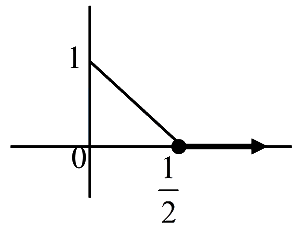
Range of \(h(x)\) is \([0,1]\)
\(g\left(\frac{1}{2}-x\right)=\left\{\begin{array}{ccc}2 x & ; & 0 \leq \frac{1}{2}-x \leq \frac{1}{2} \\ 0 & ; & \text { otherwise }\end{array}=\left\{\begin{array}{ccc}2 x & ; & 0 \leq x \leq \frac{1}{2} \\ 0 & ; & \text { otherwise }\end{array}\right\}\right.\)
\(g(x)+g\left(\frac{1}{2}-x\right)=\left\{\begin{array}{lll}1 & ; & 0 \leq x \leq \frac{1}{2} \\ 0 & ; & \text { otherwise }\end{array}\right\}\)
(P)
Now \(\mathrm{a}=0, \mathrm{~b}=1, \mathrm{c}=0, \mathrm{~d}=0\)
\(\because \mathrm{h}(\mathrm{x})=\mathrm{g}(\mathrm{x})+\mathrm{g}\left(\frac{1}{2}-\mathrm{x}\right)=\left\{\begin{array}{lll}1 & ; & 0 \leq \mathrm{x} \leq \frac{1}{2} \\ 0 & ; & \text { otherwise }\end{array}\right.\)
Hence Range of \(\mathrm{h}(\mathrm{x})\) is \(\{0,1\}\)
(Q)
\(\begin{aligned} & \mathrm{a}=1, \mathrm{~b}=0, \mathrm{c}=0, \mathrm{~d}=0 \\ & \mathrm{~h}(\mathrm{x})=\mathrm{f}(\mathrm{x})=\left\{\begin{array}{cll}\mathrm{x}|\mathrm{x}| \sin \frac{1}{x} & ; & x \neq 0 \\ 0 & ; & x=0\end{array}\right. \\ & \text { RHD }=\lim _{x \rightarrow 0} \frac{x^2 \sin \frac{1}{x}-0}{x}=0 \\ & \text { LHD }=\lim _{x \rightarrow 0} \frac{-x^2 \sin \frac{1}{x}-0}{x}=0\end{aligned}\)
Hence \(\mathrm{h}(\mathrm{x})\) is differentiable on \(\mathrm{R}\)
(R)
\(\begin{aligned} & \mathrm{a}=0, \mathrm{~b}=0, \mathrm{c}=1, \mathrm{~d}=0 \\ & h(x)=x-g(x)=\left\{\begin{array}{ccc}3 \mathrm{x}-1 & ; & 0 \leq x \leq \frac{1}{2} \\ 0 & ; & \text { otherwise }\end{array}\right.\end{aligned}\)
\(\therefore \mathrm{h}(\mathrm{x})\) is ONTO
(S)
\(\begin{aligned} & \mathrm{a}=0, \mathrm{~b}=0, \mathrm{c}=0, \mathrm{~d}=1 \\ & \mathrm{~h}(\mathrm{x})=\mathrm{g}(\mathrm{x})=\left\{\begin{array}{ccl}1-2 \mathrm{x} & ; & 0 \leq \mathrm{x} \leq \frac{1}{2} \\ 0 & ; & \text { otherwise }\end{array}\right.\end{aligned}\)
Range of \(h(x)\) is \([0,1]\)
See the Complete Solution
Get step-by-step explanations for this and 2.5 Lakh+ more JEE, NEET & CET questions.
- Unlock all solutions
- Practice the full chapter
- Track accuracy across PYQs
4.8 rated on Google Play · 14,000+ reviews
More questions from Mathematics
- Let be the number of red and black balls, respectively, in box I. Let be the number of red and black balls, respectively, in box II.
A ball is drawn at random from box I and transferred to box II. If the probability of drawing a red ball from box I, after this transfer, is , then the correct options(s) with the possible values of is(are)JEE Advanced 2015 Medium - If \(|z|=1\) and \(z \neq \pm 1\), then all the values of \(\frac{z}{1-z^2}\) lie onJEE Advanced 2007 Medium
- Let and be non zero real numbers such that . Then which of the following is/are true?JEE Advanced 2017 Medium
- Let \(\mathbb{R}\) denote the set of all real numbers. Let \(a_{\mathrm{i}}, b_{\mathrm{i}} \in \mathbb{R}\) for \(\mathrm{i} \in\{1,2,3\}\).
Define the functions \(f: \mathbb{R} \rightarrow \mathbb{R}, g: \mathbb{R} \rightarrow \mathbb{R}\), and \(h: \mathbb{R} \rightarrow \mathbb{R}\) by
\(\begin{aligned} & f(x)=a_1+10 x+a_2 x^2+a_3 x^3+x^4, \\ & g(x)=b_1+3 x+b_2 x^2+b_3 x^3+x^4, \\ & h(x)=f(x+1)-g(x+2) .\end{aligned}\)
If \(f(x) \neq g(x)\) for every \(x \in \mathbb{R}\), then the coefficient of \(x^3\) in \(h(x)\) isJEE Advanced 2025 Easy - Let denote the complex conjugate of a complex number . If is a non-zero complex number for which both real and imaginary parts of are integers, then which of the following is/are possible value(s) of ?JEE Advanced 2022 Hard
- Three lines
and
are given. For which point(s) and can we find a point on and a point on so that and are collinear?JEE Advanced 2019 Medium
More PYQs from JEE Advanced
- For any real number \(x\), let \([x]\) denotes the largest integer less than or equal to \(x\). Let \(f\) be a real valued function defined on the interval \([-10,10]\) by \(f(x)=\left\{\begin{array}{cc}x-[x] & \text { if }[x] \text { is odd } \\ 1+[x]-x & \text { if }[x] \text { is even }\end{array}\right.\).
Then the value of \(\frac{\pi^2}{10} \int_{-10}^{10} f(x) \cos \pi x d x\) isJEE Advanced 2010 Hard - The electrostatic energy of Z protons uniformly distributed throughout a spherical nucleus of radius R is given by The measured masses of the neutron, are 1.008665 u, 1.007825 u, 15.000109 u and 15.003065 u respectively. Given that the radii of both the nuclei are same, 1u = 931.5 Me V/ (c is the speed of light) and Assuming that the difference between the binding energies of is purely due to the electrostatic energy, the radius of either of the nuclei isJEE Advanced 2016 Hard
- Let \(L_1\) be the line of intersection of the planes given by the equation- \(2 x+3 y+z=4 \text { and } x+2 y+z=5 .\)
Let \(L_2\) be the line passing through the point \(P(2,-1,3)\) and parallel to \(L_1\). Let \(M\) denote the plane given by the equation- \(2 x+y-2 z=6\)
Suppose that the line \(L_2\) meets the plane \(M\) at the point \(Q\). Let \(R\) be the foot of the perpendicular drawn from \(P\) to the plane \(M\).
Then which of the following statements is (are) TRUE?JEE Advanced 2025 Hard - A small object is placed 50 cm to the left of thin convex lens of focal length 30 cm. A convex spherical mirror of radius of curvature 100 cm is placed to the right of the lens at a distance of 50 cm. The mirror is tilted such that the axis of the mirror is at an angle to the axis of the lens, as shown in the figure. If the origin of the coordinate system is taken to be at the centre of the lens, the coordinates (in cm) of the point (x, y) at which the image is formed are:
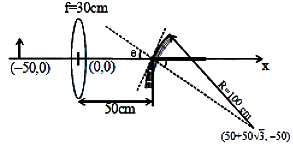 JEE Advanced 2016 Hard
 - A decapeptide (molecular weight 796) on complete hydrolysis gives glycine (molecular weight 75), alanine and phenylalanine. Glycine contributes \(47.0 \%\) to the total weight of the hydrolysed products. The number of glycine units present in the decapeptide isJEE Advanced 2011 Hard
- In a neutral or faintly alkaline solution, moles of permanganate anion quantitatively oxidize thiosulphate anions to produce moles of a sulphur containing product. The magnitude of is:JEE Advanced 2016 Medium