


JEE Advanced · Mathematics · 30. Vector Algebra
Let \(\mathbf{a}=-\hat{\mathbf{i}}-\hat{\mathbf{k}}, \mathbf{b}=-\hat{\mathbf{i}}+\hat{\mathbf{j}}\) and \(\mathbf{c}=\hat{\mathbf{i}}+2 \hat{\mathbf{j}}+3 \hat{\mathbf{k}}\) be three given vectors. If \(\mathbf{r}\) is a vector such that \(\mathbf{r} \times \mathbf{b}=\mathbf{c} \times \mathbf{b}\) and \(\mathbf{r} \cdot \mathbf{a}=0\), then the value of \(\mathbf{r} \cdot \mathbf{b}\) is
- A 9
- B 1
- C 3
- D 10
Answer & Solution
Correct Answer
(A) 9
Step-by-step Solution
Detailed explanation
\[
\begin{aligned}
& \mathbf{r} \times \mathbf{b}=\mathbf{c} \times \mathbf{b} \\
& \Rightarrow \quad(\mathbf{r}-\mathbf{c}) \times \mathbf{b}=0 \Rightarrow \mathbf{r}-\mathbf{c}+\lambda \mathbf{b} \\
& \text { or } \quad \mathbf{r}=\mathbf{c}+\lambda \mathbf{b} \\
&
\end{aligned}
\]
Given, \(\mathbf{r} \cdot \mathbf{a}=0\), taking dot product with a for Eq. (i).
Now, \(\mathbf{r} \cdot \mathbf{a}=\mathbf{a} \cdot \mathbf{c}+\lambda \mathbf{a} \cdot \mathbf{b}\)
\(\therefore \quad \lambda=\frac{-\vec{a} \cdot \vec{c}}{\vec{a} \cdot \vec{b}} \quad[\because \vec{r} \cdot \vec{a}=0] \ldots\) (i)
From Eqs. (i) and (ii), we get
\[
\mathbf{r}=\mathbf{c}-\frac{\mathbf{a} \cdot \mathbf{c}}{\mathbf{a} \cdot \mathbf{b}} \mathbf{b}
\]
Taking dot with \(\mathbf{b}\), we get
\[
\mathbf{r} \cdot \mathbf{b}=\mathbf{c} \cdot \mathbf{b}-\frac{\mathbf{a} \cdot \mathbf{c}}{\mathbf{a} \cdot \mathbf{b}}(\mathbf{b} \cdot \mathbf{b})
\]
where, \(\left[\begin{array}{l}\mathbf{a}=-\hat{\mathbf{i}}-\hat{\mathbf{k}} \\ \mathbf{b}=-\hat{\mathbf{i}}+\hat{\mathbf{j}} \\ \mathbf{c}=\hat{\mathbf{i}}+2 \hat{\mathbf{j}}+3 \hat{\mathbf{k}}\end{array}\right]\)
\[
=(-1+2)-\frac{(-1-3)}{(1)}(1+1)=1+8=9
\]
\begin{aligned}
& \mathbf{r} \times \mathbf{b}=\mathbf{c} \times \mathbf{b} \\
& \Rightarrow \quad(\mathbf{r}-\mathbf{c}) \times \mathbf{b}=0 \Rightarrow \mathbf{r}-\mathbf{c}+\lambda \mathbf{b} \\
& \text { or } \quad \mathbf{r}=\mathbf{c}+\lambda \mathbf{b} \\
&
\end{aligned}
\]
Given, \(\mathbf{r} \cdot \mathbf{a}=0\), taking dot product with a for Eq. (i).
Now, \(\mathbf{r} \cdot \mathbf{a}=\mathbf{a} \cdot \mathbf{c}+\lambda \mathbf{a} \cdot \mathbf{b}\)
\(\therefore \quad \lambda=\frac{-\vec{a} \cdot \vec{c}}{\vec{a} \cdot \vec{b}} \quad[\because \vec{r} \cdot \vec{a}=0] \ldots\) (i)
From Eqs. (i) and (ii), we get
\[
\mathbf{r}=\mathbf{c}-\frac{\mathbf{a} \cdot \mathbf{c}}{\mathbf{a} \cdot \mathbf{b}} \mathbf{b}
\]
Taking dot with \(\mathbf{b}\), we get
\[
\mathbf{r} \cdot \mathbf{b}=\mathbf{c} \cdot \mathbf{b}-\frac{\mathbf{a} \cdot \mathbf{c}}{\mathbf{a} \cdot \mathbf{b}}(\mathbf{b} \cdot \mathbf{b})
\]
where, \(\left[\begin{array}{l}\mathbf{a}=-\hat{\mathbf{i}}-\hat{\mathbf{k}} \\ \mathbf{b}=-\hat{\mathbf{i}}+\hat{\mathbf{j}} \\ \mathbf{c}=\hat{\mathbf{i}}+2 \hat{\mathbf{j}}+3 \hat{\mathbf{k}}\end{array}\right]\)
\[
=(-1+2)-\frac{(-1-3)}{(1)}(1+1)=1+8=9
\]
See the Complete Solution
Get step-by-step explanations for this and 2.5 Lakh+ more JEE, NEET & CET questions.
- Unlock all solutions
- Practice the full chapter
- Track accuracy across PYQs
4.8 rated on Google Play · 14,000+ reviews
More questions from Mathematics
- Consider a triangle having sides of lengths and opposite to the angles and , respectively. Then which of the following statements is (are) TRUE?JEE Advanced 2021 Hard
- Let denote the digit number where the first and the last digits are and the remaining digits are . Consider the sum . If , where and are natural numbers less than , then the value of isJEE Advanced 2023 Hard
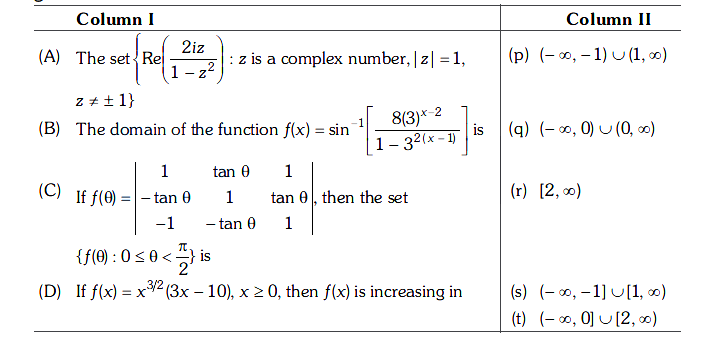
- Match the statements given in Column I with the intervals/union of intervals given in Column II.
 JEE Advanced 2011 Medium
 - For all \(x>0\), let \(y_1(x), y_2(x)\), and \(y_3(x)\) be the functions satisfying
\(\begin{aligned} & \frac{d y_1}{d x}-(\sin x)^2 y_1=0, y_1(1)=5 \\ & \frac{d y_2}{d x}-(\cos x)^2 y_2=0, y_2(1)=\frac{1}{3} \\ & \frac{d y_3}{d x}-\left(\frac{2-x^3}{x^3}\right) y_3=0, y_3(1)=\frac{3}{5 e}\end{aligned}\)
respectively. Then \(\lim _{x \rightarrow 0^{+}} \frac{y_1(x) y_2(x) y_3(x)+2 x}{e^{3 x} \sin x}\) is equal to _____JEE Advanced 2025 Hard - \[
\text { Let } M \text { be a } 3 \times 3 \text { matrix satisfying }
\]
\[
M\left[\begin{array}{l}
0 \\
1 \\
0
\end{array}\right]=\left[\begin{array}{c}
-1 \\
2 \\
3
\end{array}\right], M\left[\begin{array}{c}
1 \\
-1 \\
0
\end{array}\right]=\left[\begin{array}{c}
1 \\
1 \\
-1
\end{array}\right] \text { and } M\left[\begin{array}{l}
1 \\
1 \\
1
\end{array}\right]=\left[\begin{array}{c}
0 \\
0 \\
12
\end{array}\right]
\]
Then, the sum of the diagonal entries of \(M\) isJEE Advanced 2011 Easy - Let be the of all column matrices such that and the system of equations (in real variables)
has at least one solution. Then, which of the following system(s) (in real variables) has (have) at least one solution of each ?JEE Advanced 2018 Hard
More PYQs from JEE Advanced
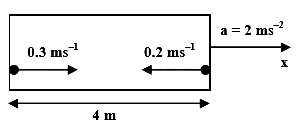
- A rocket is moving in a gravity free space with a constant acceleration of along + x direction (see figure). The length of a chamber inside the rocket is 4 m. A ball is thrown from the left end of the chamber in + x direction with a speed of relative to the rocket. At the same time, another ball is thrown in - x direction with a speed of from its right end relative to the rocket. The time in seconds when the two balls hit each other for the first time is
 JEE Advanced 2014 Medium
 - Paragraph :
The capacitor of capacitance \(C\) can be charged (with the help of a resistance \(R\) ) by a voltage source \(V\), by closing switch \(S_1\) while keeping switch \(S_2\) open. The capacitor can be connected in series with an inductor \(L\) by closing switch \(S_2\) and opening \(S_1\).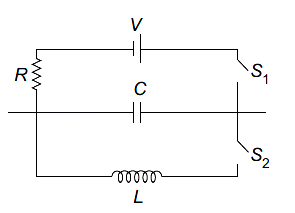
Question :
Initially, the capacitor was uncharged. Now, switch \(S_1\) is closed and \(S_2\) is kept open. If time constant of this circuit is \(\tau\), thenJEE Advanced 2006 Medium - The freezing point (in \({ }^{\circ} \mathrm{C}\) ) of solution containing \(0.1 \mathrm{~g}\) of \(\mathrm{K}_3\left[\mathrm{Fe}(\mathrm{CN})_6\right]\) (molecular weight 329\()\) in \(100 \mathrm{~g}\) of water \(\left(K_f=1.86 \mathrm{~K} \mathrm{~kg} \mathrm{~mol}^{-1}\right)\) isJEE Advanced 2011 Easy
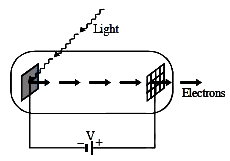
- Light of wavelength falls on a cathode plate inside a vacuum tube as shown in the figure. The work function of the cathode surface is and the anode is a wire mesh of conducting material kept at a distance d from the cathode. A potential difference V is maintained between the electrodes. If the minimum de Broglie wavelength of the electrons passing through the anode is which of the following statement(s) is(are) true ?
 JEE Advanced 2016 Medium
 - Paragraph :
\(\mathbf{P}_{17 \text { - } 19}\) : Paragraph for Questions Nos. 17 to 19 Two discs \(A\) and \(B\) are mounted coaxially on a vertical axle. The discs have moments of inertia I and 2I, respectively about the common axis. Disc \(A\) is imparted an initial angular velocity \(2 \omega\) using the entire potential energy of a spring compressed by a distance \(x_1\). Disc \(B\) is imparted an angular velocity \(\omega\) by a spring having the same spring constant and compressed by a distance \(x_2\). Both the discs rotate in the clockwise direction.
Question :
When disc \(B\) is brought in contact with disc \(A\), they acquire a common angular velocity in time \(t\). The average frictional torque on one disc by the other during this period isJEE Advanced 2007 Medium - The sum of the number of lone pairs of electrons on each central atom in the following species is \(\left[ TeBr _6\right]^{2-},\left[ Br F _2\right]^{+}, S N F_3\) and \(\left[ XeF _3\right]^{-}\)[Atomic number : \(N=7, F=9, S =16, B r=35,\) \(T e=52, X e=54]\)JEE Advanced 2017 Medium