


JEE Advanced · Mathematics · 29. Differential Eqns
For all \(x>0\), let \(y_1(x), y_2(x)\), and \(y_3(x)\) be the functions satisfying
\(\begin{aligned} & \frac{d y_1}{d x}-(\sin x)^2 y_1=0, y_1(1)=5 \\ & \frac{d y_2}{d x}-(\cos x)^2 y_2=0, y_2(1)=\frac{1}{3} \\ & \frac{d y_3}{d x}-\left(\frac{2-x^3}{x^3}\right) y_3=0, y_3(1)=\frac{3}{5 e}\end{aligned}\)
respectively. Then \(\lim _{x \rightarrow 0^{+}} \frac{y_1(x) y_2(x) y_3(x)+2 x}{e^{3 x} \sin x}\) is equal to _____
- A 4
- B 5
- C 2
- D 3
Answer & Solution
Correct Answer
(C) 2
Step-by-step Solution
Detailed explanation
\(\begin{aligned} & \frac{d y_1}{y_1}+\frac{d y_2}{y_2}+\frac{d y_3}{y_3}=\left(\sin ^2 x+\cos ^2 x+\frac{2-x^3}{x^3}\right) d x \\ & \ln \left(y_1 y_2 y_3\right)=\frac{-1}{x^2}+C \\ & \ln \left(y_1(x) y_2(x) y_3(x)\right)=\frac{-1}{x^2}+C \\ & \ln \left(5 \cdot \frac{1}{3} \cdot \frac{3}{5 e}\right)=\frac{-1}{x^2}+C \\ & \therefore C=0\end{aligned}\)
\(\begin{aligned} & y_1(x) y_2(x) y_3(x)=e^{\frac{-1}{x^2}} \\ & \lim _{x \rightarrow 0} \frac{e^{\frac{-1}{x^2}}+2 x}{e^{3 x} \sin x} \\ & \lim _{x \rightarrow 0} \frac{1}{e^{3 x+\frac{1}{x^2}} \sin x}+\lim _{x \rightarrow 0} \frac{2 x}{e^{3 x} \sin x}\end{aligned}\)
\(\lim _{x \rightarrow 0} \frac{1}{e^{3 x} \cdot \frac{\sin x}{x} \cdot \frac{e^{\frac{1}{x^2}}}{\frac{1}{x}}}+2\)
\(=0+2 \quad\left\{\lim _{\mathrm{y} \rightarrow \infty} \frac{\mathrm{e}^{\mathrm{y}^2}}{\mathrm{y}}=\frac{\mathrm{e}^{\mathrm{y}^2} \cdot 2 \mathrm{y}}{1}=\infty\right\}\)
\(=2\)
\(\begin{aligned} & y_1(x) y_2(x) y_3(x)=e^{\frac{-1}{x^2}} \\ & \lim _{x \rightarrow 0} \frac{e^{\frac{-1}{x^2}}+2 x}{e^{3 x} \sin x} \\ & \lim _{x \rightarrow 0} \frac{1}{e^{3 x+\frac{1}{x^2}} \sin x}+\lim _{x \rightarrow 0} \frac{2 x}{e^{3 x} \sin x}\end{aligned}\)
\(\lim _{x \rightarrow 0} \frac{1}{e^{3 x} \cdot \frac{\sin x}{x} \cdot \frac{e^{\frac{1}{x^2}}}{\frac{1}{x}}}+2\)
\(=0+2 \quad\left\{\lim _{\mathrm{y} \rightarrow \infty} \frac{\mathrm{e}^{\mathrm{y}^2}}{\mathrm{y}}=\frac{\mathrm{e}^{\mathrm{y}^2} \cdot 2 \mathrm{y}}{1}=\infty\right\}\)
\(=2\)
See the Complete Solution
Get step-by-step explanations for this and 2.5 Lakh+ more JEE, NEET & CET questions.
- Unlock all solutions
- Practice the full chapter
- Track accuracy across PYQs
4.8 rated on Google Play · 14,000+ reviews
More questions from Mathematics
- If is a twice differentiable function such that for all and thenJEE Advanced 2017 Easy
- Let \(p(x)\) be a polynomial of degree 4 having extremum at \(x=1,2\) and \(\lim _{x \rightarrow 0}\left[1+\frac{p(x)}{x^2}\right]=2\). Then, the value of \(p(2)\) isJEE Advanced 2009 Medium
- For 3 x 3 matrices M and N, which of the following statement(s) is (are) not correct?JEE Advanced 2013 Medium
- The value of
\(\sec ^{-1}\left(\frac{1}{4} \sum_{k=0}^{10} \sec (\frac{7 \pi}{12}+\frac{k \pi}{2}\right) \sec (\frac{7 \pi}{12}\) \(+\frac{(k+1) \pi}{2}))\) in the interval \(\left[-\frac{\pi}{4}, \frac{3 \pi}{4}\right]\) equalsJEE Advanced 2019 Medium - Let \(f: \mathbb{R} \rightarrow \mathbb{R}\) be a function defined by \(f(x)=\left\{\begin{array}{cc}x^2 \sin \left(\frac{\pi}{x^2}\right), & \text { if } x \neq 0 \\ 0, & \text { if } x=0\end{array}\right.\) Then which of the following statements is TRUE?JEE Advanced 2024 Hard
- One Indian and four American men and their wives are to be seated randomly around a circular table. Then, the conditional probability that the Indian man is seated adjacent to his wife given that each American man is seated adjacent to his wife, isJEE Advanced 2007 Hard
More PYQs from JEE Advanced
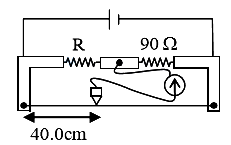
- During an experiment with a metre bridge, the galvanometer shows a null point when the jockey is pressed at using a standard resistance of ,as shown in the figure. The least count of the scale used in the metre bridge is . The unknown resistance is
 JEE Advanced 2014 Easy
 - According to kinetic theory of gasesJEE Advanced 2011 Hard
- A thin and uniform rod of mass and length is held vertical on a floor with large friction. The rod is released from rest so that it falls by rotating about its contact-point with the floor without slipping. Which of the following statement(s) is/are correct, when the rod makes an angle with vertical?
[ is the acceleration due to gravity]JEE Advanced 2019 Medium - Let be positive valued angles (in radian) such that . Define the complex numbers for , where . Consider the statements and given below:
\(P:\left|z_2-z_1\right|+\left|z_3-z_2\right|+\cdots+\left|z_{10}-z_9\right|\) \(+\left|z_1-z_{10}\right| \leq 2 \pi \)
\( Q:\left|z_2^2-z_1^2\right|+\left|z_3^2-z_2^2\right|+\cdots+\left|z_{10}^2-z_9^2\right|\) \(+\left|z_1^2-z_{10}^2\right| \leq 4 \pi\)JEE Advanced 2021 Medium - A particle of mass moves in circular orbits with potential energy , where is a positive constant and is its distance from the origin. Its energies are calculated using the Bohr model. If the radius of the particle's orbit is denoted by and its speed and energy are denoted by and respectively, then for the orbit (here is the Planck's constant)JEE Advanced 2020 Medium
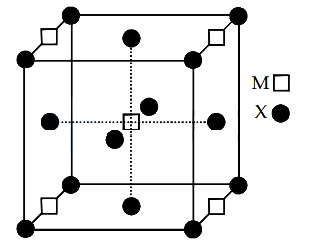
- A compound \(\mathrm{M}_{\mathrm{p}} \mathrm{X}_{\mathrm{q}}\) has cubic close packing (ccp) arrangement of \(\mathrm{X}\). Its unit cell structure is shown below. The empirical formula of the compound is
 JEE Advanced 2012 Hard