


JEE Advanced · Mathematics · 19. Determinants
Let be the of all column matrices such that and the system of equations (in real variables)
has at least one solution. Then, which of the following system(s) (in real variables) has (have) at least one solution of each ?
- A and
- B and
- C and
- D and
Answer & Solution
Correct Answer
(D) and
Step-by-step Solution
Detailed explanation
We find & since no pair of planes are parallel, so there are an infinite number of solutions. So, the infinite solutions shall lie on a common line of intersection of these planes. Hence, we can write any plane as a linear combination of other two planes:
(by comparing coefficients of )
(a) unique solution for any
(b) but
(c) Also as they are parallel planes, they will have at least one solution only if they are all coincident, so that
So each of that satisfy , they don't always need to satisfy . Hence option is wrong.
(by comparing coefficients of )
(a) unique solution for any
(b) but
(c) Also as they are parallel planes, they will have at least one solution only if they are all coincident, so that
So each of that satisfy , they don't always need to satisfy . Hence option is wrong.
See the Complete Solution
Get step-by-step explanations for this and 2.5 Lakh+ more JEE, NEET & CET questions.
- Unlock all solutions
- Practice the full chapter
- Track accuracy across PYQs
4.8 rated on Google Play · 14,000+ reviews
More questions from Mathematics
- If the adjoint of a \(3 \times 3\) matrix \(P\) is \(\left[\begin{array}{lll}1 & 4 & 4 \\ 2 & 1 & 7 \\ 1 & 1 & 3\end{array}\right]\), then the possible value(s) of the determinant of \(P\) is (are)JEE Advanced 2012 Easy
- Columns 1, 2 and 3 contain conics, equations of tangents to the conics and points of contact, respectively.
If a tangent to a suitable conic (Column 1) is found to be and its point of contact is , then which of the following options is the only Correct combination?Column 1 Column 2 Column 3 (I) (i) (P) (II) (ii) (Q) (III) (iii) (R) (IV) (iv) (S) JEE Advanced 2017 Hard - Let \(a_{n}\) denote the number of all \(n\)-digit positive integers formed by the digits 0,1 or both such that no consecutive digits in them are 0 . Let \(b_{n}=\) the number of such \(n\)-digit integers ending with digit 1 and \(c_{n}=\) the number of such \(n\)-digit integers ending with digit 0 .
Question:
Which of the following is correct?JEE Advanced 2012 Hard - Let be positive valued angles (in radian) such that . Define the complex numbers for , where . Consider the statements and given below:
\(P:\left|z_2-z_1\right|+\left|z_3-z_2\right|+\cdots+\left|z_{10}-z_9\right|\) \(+\left|z_1-z_{10}\right| \leq 2 \pi \)
\( Q:\left|z_2^2-z_1^2\right|+\left|z_3^2-z_2^2\right|+\cdots+\left|z_{10}^2-z_9^2\right|\) \(+\left|z_1^2-z_{10}^2\right| \leq 4 \pi\)JEE Advanced 2021 Medium - A normal with slope \(\frac{1}{\sqrt{6}}\) is drawn from the point \((0,-\alpha)\) to the parabola \(x^2=-4 a y\), where \(a>0\). Let \(L\) be the line passing through \((0,-\alpha)\) and parallel to the directrix of the parabola. Suppose that \(L\) intersects the parabola at two points \(A\) and \(B\). Let \(r\) denote the length of the latus rectum and \(s\) denote the square of the length of the line segment \(A B\). If \(r: s=1: 16\), then the value of 24ais ________.JEE Advanced 2024 Medium
- Let the straight line \(\mathrm{y}=2 \mathrm{x}\) touch a circle with center \((0, \alpha), \alpha>0\), and radius \(\mathrm{r}\) at a point \(\mathrm{A}_1\). Let \(\mathrm{B}_1\) be the point on the circle such that the line segment \(A_1 B_1\) is a diameter of the circle. Let \(\alpha+r=5+\sqrt{5}\).
Match each entry in List-I to the correct entry in List-II.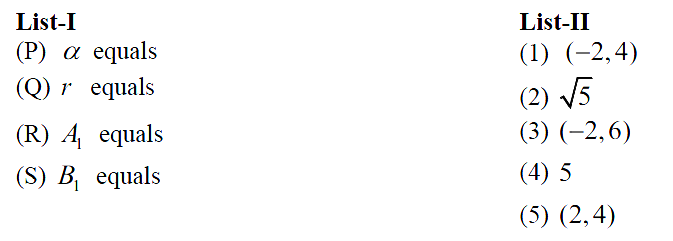
The correct option isJEE Advanced 2024 Easy
More PYQs from JEE Advanced
- For , a transition takes place from the orbit of radius to the orbit of radius . The wavelength (in ) of the emitted photon during the transition is
Bohr radius,
Rydberg constant,
Planck's constant,
Speed of light, ]JEE Advanced 2023 Easy - For any positive integer , let be defined by
where for any and . Then which of the following statements is (are) TRUE ?JEE Advanced 2021 Medium - Let and be the identity matrix of order . If is a matrix such that then the value of is equal toJEE Advanced 2016 Medium
- You are given many resistances, capacitors and inductors. These are connected to a variable DC voltage source (the first two circuits) or an AC voltage source of \(50 \mathrm{~Hz}\) frequency (the next three circuits) in different ways as shown in Column II. When a current \(I\) (steady state for DC or rms for \(A C\) ) flows through the circuit, the corresponding voltage \(V_1\) and \(V_2\) (indicated in circuits) are related as shown in Column I. Match the two
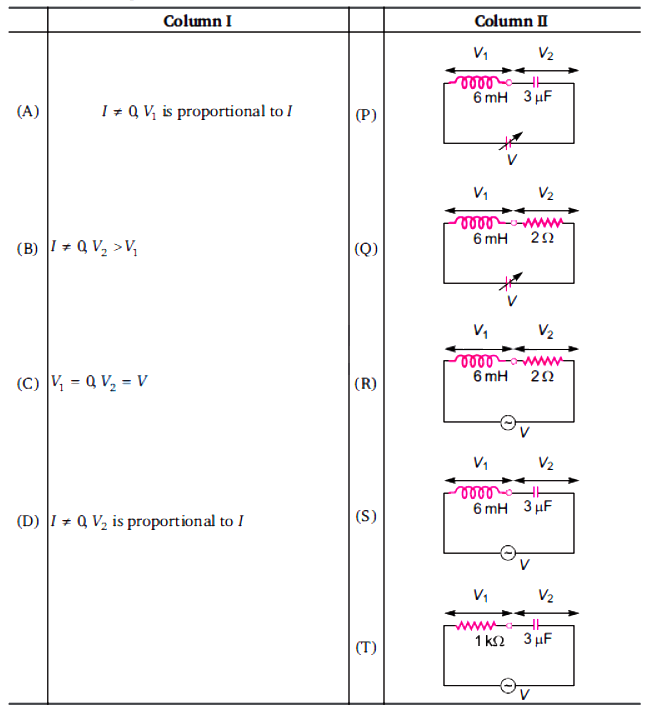 JEE Advanced 2010 Hard
 - Concentration of and in a solution is and , respectively. Molar solubility of in the same solution is (expressed in scientific notation). The value of is
[Given: Solubility product of . For is very large and ]
If the numerical value has more than two decimal places, truncate/round-off the value to TWO decimal places.JEE Advanced 2022 Hard - In the options given below, let \(E\) denote the rest mass energy of a nucleus and \(n\) a neutron. The correct option isJEE Advanced 2007 Hard