


JEE Advanced · Chemistry · 4. Chemical Bonding
The sum of the number of lone pairs of electrons on each central atom in the following species is \(\left[ TeBr _6\right]^{2-},\left[ Br F _2\right]^{+}, S N F_3\) and \(\left[ XeF _3\right]^{-}\)[Atomic number : \(N=7, F=9, S =16, B r=35,\) \(T e=52, X e=54]\)
- A 6
- B 12
- C 5
- D 10
Answer & Solution
Correct Answer
(A) 6
Step-by-step Solution
Detailed explanation
| Number of -bonds formed by central metal atom/ ion | Number of lone pairs on central metal atom/ ion | |
| (i) | 6 | 1 |
| (ii) | 2 | 2 |
| (iii) | 4 | 0 |
| (iv) | 3 | 3 |
See the Complete Solution
Get step-by-step explanations for this and 2.5 Lakh+ more JEE, NEET & CET questions.
- Unlock all solutions
- Practice the full chapter
- Track accuracy across PYQs
4.8 rated on Google Play · 14,000+ reviews
More questions from Chemistry
- Match the compounds in LIST- with the observations in LIST-, and choose the correct option.
LIST- LIST- Aniline Sodium fusion extract of the compound on boiling with , followed by acidification with conc. , gives Prussian blue color. Cresol Sodium fusion extract of the compound on treatment with sodium nitroprusside gives blood red color. Cysteine Addition of the compound to a saturated solution of results in effervescence. Caprolactam The compound reacts with bromine water to give a white precipitate. Treating the compound with neutral solution produces violet color. JEE Advanced 2022 Hard - Which of the following liberates upon hydrolysis?JEE Advanced 2020 Medium
- Among the following, the correct statement(s) about polymers is(are)JEE Advanced 2022 Easy
- Paragraph:
The hydrogen-like species \(\mathrm{Li}^{2+}\) is in a spherically symmetric state \(S_1\) with one radial node. Upon absorbing light the ion undergoes transition to a state \(S_2\). The state \(S_2\) has one radial node and its energy is equal to the ground state energy of the hydrogen atom.
Question:
The orbtial angular momentum quantum number of the state \(S_2\) isJEE Advanced 2010 Medium - Consider the following volume-temperature \((\mathrm{V}-\mathrm{T})\) diagram for the expansion of 5 moles of an ideal monoatomic gas.
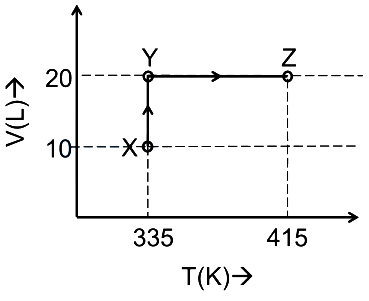
Considering only P-V work is involved, the total change in enthalpy (in Joule) for the transformation of state in the sequence \(\mathbf{X} \rightarrow \mathbf{Y} \rightarrow \mathbf{Z}\) is ________.
[Use the given data: Molar heat capacity of the gas for the given temperature range, \(\mathrm{C}_{\mathrm{V}, \mathrm{m}}=12 \mathrm{~J} \mathrm{~K}^{-1}\) \(\mathrm{mol}^{-1}\) and gas constant, \(\left.\mathrm{R}=8.3 \mathrm{~J} \mathrm{~K}^{-1} \mathrm{~mol}^{-1}\right]\)JEE Advanced 2024 Medium - Based on VSEPR model, match the xenon compounds given in List-I with the corresponding geometries and the number of lone pairs on xenon given in List-II and choose the correct option.
List - I List - II (P) \(XeF _2\) (1) Trigonal bipyramidal and two lone pair of electrons (Q) \(XeF _4\) (2) Tetrahedral and one lone pair of electrons (R) \(XeO _3\) (3) Octahedral and two lone pair of electrons (S) \(XeO _3 F_2\) (4) Trigonal bipyramidal and no lone pair of electrons (5) Trigonal bipyramidal and three lone pair of electrons JEE Advanced 2024 Medium
More PYQs from JEE Advanced
- A particle of mass is projected from the ground with an initial speed at an angle with the horizontal. At the highest point of its trajectory, it makes a completely inelastic collision with another identical particle, which was thrown vertically upward from the ground with the same initial speed . The angle that the composite system makes with the horizontal immediately after the collision isJEE Advanced 2013 Medium
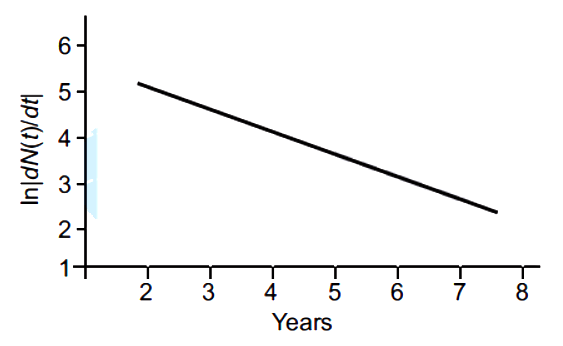
- To determine the half-life of a radioactive element, a student plots a graph of \(\ln \left|\frac{d N(t)}{d t}\right|\) versust. Here \(\frac{d N(t)}{d t}\) is the rate of radioactive decay at time \(t\). If the number of radioactive nuclei of this element decreases by a factor of \(p\) after \(4.16 \mathrm{yr}\), the value of \(p\) is
 JEE Advanced 2010 Hard
 - Let thenJEE Advanced 2017 Easy
- Answer the following by appropriately matching the lists based on the information given in the paragraph.
In a thermodynamics process on an ideal monatomic gas, the infinitesimal heat absorbed by the gas is given by where is temperature of the system and is the infinitesimal change in a thermodynamic quantity of the system. For a mole of monatomic ideal gas Here, is gas constant, is volume of gas, and are constants.
The List-I below gives some quantities involved in a process and List-II gives some possible values of these quantities.Work done by the system in process Change in internal energy in process Heat absorbed by the system in process Heat absorbed by the system in process
If the process carried out on one mole of monatomic ideal gas is as shown in figure in the - -diagram with the correct match is,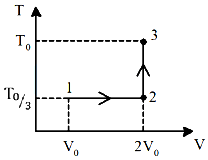 JEE Advanced 2019 Medium
 - The correct option(s) related to adsorption processes is(are)JEE Advanced 2022 Easy
- Let \(z=\cos \theta+i \sin \theta\). Then, the value of \(\sum_{m=1}^{15} \operatorname{Im}\left(z^{2 m-1}\right)\) at \(\theta=2^{\circ}\) isJEE Advanced 2009 Medium