


JEE Advanced · Mathematics · 22. Functions
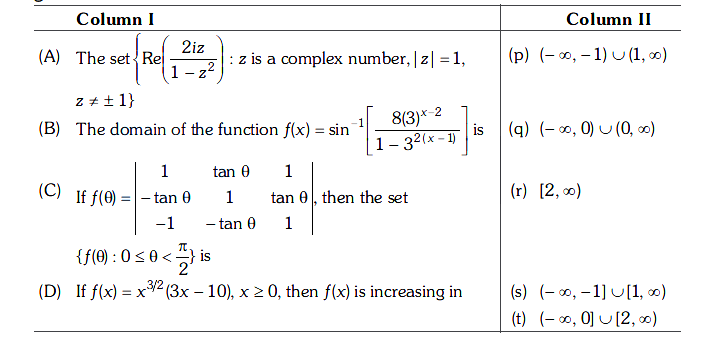
Match the statements given in Column I with the intervals/union of intervals given in Column II.
- A
(A) q, (B) r, (C) s, (D) t
- B
(A) s, (B) t, (C) r, (D) q
- C
(A) q, (B) r, (C) s, (D) r
- D
(A) s, (B) t, (C) r, (D) r
Answer & Solution
Correct Answer
(D)
(A) s, (B) t, (C) r, (D) r
Step-by-step Solution
Detailed explanation
(A) Given, \(|z|=1 \Rightarrow z \cdot \bar{z}=1\)
\[
\therefore \quad \frac{2 i z}{1-z^2}=\frac{2 i z}{z \cdot \bar{z}-z^2}=\frac{2 i}{\bar{z}-z} \text {, }
\]
Let \(\quad z=x+i y\)
\[
\therefore z-\bar{z}=2 i y=\frac{2 i}{-2 i y}=-\frac{1}{y}
\]
where, \(y=\sqrt{1-x^2}\)
\(\therefore \quad-1 \leq y \leq 1 \Rightarrow-1 \leq y\)
and \(y \leq 1 \Rightarrow-1 \geq \frac{1}{y}\) and \(\frac{1}{y} \geq 1\)
\(\Rightarrow \operatorname{Re}\left(\frac{2 i z}{1-z^2}\right) \in(-\infty,-1] \cup[1, \infty)\)
(B) \(f(x)=\sin ^{-1}\left(\frac{8\left(3^{x-2}\right)}{1-3^{2(x-1)}}\right)\),
\[
\begin{aligned}
& \text { For domain, }-1 \leq \frac{8\left(3^{x-2}\right)}{1-3^{2(x-1)}} \leq 1 \\
& \Rightarrow \quad-1 \leq \frac{9 \cdot\left(3^{x-2}\right)-\left(3^{x-2}\right)}{1-3^{2(x-1)}} \leq 1 \\
& \therefore \quad-1 \leq \frac{3^x-3^{x-2}}{1-3^x \cdot 3^{(x-2)}} \leq 1 \\
& \frac{3^x-3^{x-2}}{1-3^x \cdot 3^{x-2}} \geq-1 \\
& \Rightarrow \frac{\left(3^x-1\right)\left(3^{x-2}-1\right)}{\left(3^{x-1}+1\right)\left(3^{x-1}-1\right)} \geq 0 \\
& \Rightarrow \quad x \in(-\infty, 0] \cup(1, \infty) \\
& \text { and } \frac{3^x-3^{x-2}}{1-3^x \cdot 3^{x-2}} \leq 1 \\
& \Rightarrow \frac{\left(3^{x-2}-1\right)\left(3^x+1\right)}{\left(3^{x-1}+1\right)\left(3^{x-1}-1\right)} \geq 0 \\
&
\end{aligned}
\]

and \(x \in(-\infty, 1) \cup[2, \infty)\)
\(\therefore \quad x \in(-\infty, 0] \cup[2, \infty)\)
(C) \(f(\theta)=\left|\begin{array}{ccc}1 & \tan \theta & 1 \\ -\tan \theta & 1 & \tan \theta \\ -1 & -\tan \theta & 1\end{array}\right|\)
\[
\begin{aligned}
R_1 & \rightarrow R_1+R_3, \\
f(\theta) & =\left|\begin{array}{ccc}
0 & 0 & 2 \\
-\tan \theta & 1 & \tan \theta \\
-1 & -\tan \theta & 1
\end{array}\right| \\
& =2\left(\tan ^2 \theta+1\right)=2 \sec ^2 \theta \geq 2 \\
f(\theta) & \in[2, \infty)
\end{aligned}
\]
\[
\text { (D) } \begin{aligned}
f(x) & =x^{3 / 2}(3 x-10) ; x \geq 0 \\
f^{\prime}(x) & =x^{3 / 2} \cdot 3+\frac{3}{2} \cdot x^{1 / 2}(3 x-10) \\
& =3 x^{1 / 2}\left\{x+\frac{1}{2}(3 x-10)\right\}
\end{aligned}
\]
\[
\begin{aligned}
& =\frac{3}{2} x^{1 / 2}\{2 x+3 x-10\} \\
& =\frac{15}{2} x^{1 / 2}(x-2) \\
& \\
\therefore \quad & x \geq 2
\end{aligned}
\]
\[
\therefore \quad \frac{2 i z}{1-z^2}=\frac{2 i z}{z \cdot \bar{z}-z^2}=\frac{2 i}{\bar{z}-z} \text {, }
\]
Let \(\quad z=x+i y\)
\[
\therefore z-\bar{z}=2 i y=\frac{2 i}{-2 i y}=-\frac{1}{y}
\]
where, \(y=\sqrt{1-x^2}\)
\(\therefore \quad-1 \leq y \leq 1 \Rightarrow-1 \leq y\)
and \(y \leq 1 \Rightarrow-1 \geq \frac{1}{y}\) and \(\frac{1}{y} \geq 1\)
\(\Rightarrow \operatorname{Re}\left(\frac{2 i z}{1-z^2}\right) \in(-\infty,-1] \cup[1, \infty)\)
(B) \(f(x)=\sin ^{-1}\left(\frac{8\left(3^{x-2}\right)}{1-3^{2(x-1)}}\right)\),
\[
\begin{aligned}
& \text { For domain, }-1 \leq \frac{8\left(3^{x-2}\right)}{1-3^{2(x-1)}} \leq 1 \\
& \Rightarrow \quad-1 \leq \frac{9 \cdot\left(3^{x-2}\right)-\left(3^{x-2}\right)}{1-3^{2(x-1)}} \leq 1 \\
& \therefore \quad-1 \leq \frac{3^x-3^{x-2}}{1-3^x \cdot 3^{(x-2)}} \leq 1 \\
& \frac{3^x-3^{x-2}}{1-3^x \cdot 3^{x-2}} \geq-1 \\
& \Rightarrow \frac{\left(3^x-1\right)\left(3^{x-2}-1\right)}{\left(3^{x-1}+1\right)\left(3^{x-1}-1\right)} \geq 0 \\
& \Rightarrow \quad x \in(-\infty, 0] \cup(1, \infty) \\
& \text { and } \frac{3^x-3^{x-2}}{1-3^x \cdot 3^{x-2}} \leq 1 \\
& \Rightarrow \frac{\left(3^{x-2}-1\right)\left(3^x+1\right)}{\left(3^{x-1}+1\right)\left(3^{x-1}-1\right)} \geq 0 \\
&
\end{aligned}
\]
and \(x \in(-\infty, 1) \cup[2, \infty)\)
\(\therefore \quad x \in(-\infty, 0] \cup[2, \infty)\)
(C) \(f(\theta)=\left|\begin{array}{ccc}1 & \tan \theta & 1 \\ -\tan \theta & 1 & \tan \theta \\ -1 & -\tan \theta & 1\end{array}\right|\)
\[
\begin{aligned}
R_1 & \rightarrow R_1+R_3, \\
f(\theta) & =\left|\begin{array}{ccc}
0 & 0 & 2 \\
-\tan \theta & 1 & \tan \theta \\
-1 & -\tan \theta & 1
\end{array}\right| \\
& =2\left(\tan ^2 \theta+1\right)=2 \sec ^2 \theta \geq 2 \\
f(\theta) & \in[2, \infty)
\end{aligned}
\]
\[
\text { (D) } \begin{aligned}
f(x) & =x^{3 / 2}(3 x-10) ; x \geq 0 \\
f^{\prime}(x) & =x^{3 / 2} \cdot 3+\frac{3}{2} \cdot x^{1 / 2}(3 x-10) \\
& =3 x^{1 / 2}\left\{x+\frac{1}{2}(3 x-10)\right\}
\end{aligned}
\]
\[
\begin{aligned}
& =\frac{3}{2} x^{1 / 2}\{2 x+3 x-10\} \\
& =\frac{15}{2} x^{1 / 2}(x-2) \\
& \\
\therefore \quad & x \geq 2
\end{aligned}
\]
See the Complete Solution
Get step-by-step explanations for this and 2.5 Lakh+ more JEE, NEET & CET questions.
- Unlock all solutions
- Practice the full chapter
- Track accuracy across PYQs
4.8 rated on Google Play · 14,000+ reviews
More questions from Mathematics
- Paragraph:
Let \(a\), b and \(c\) be three real numbers satisfying \(\left[\begin{array}{lll}a & b & c\end{array}\right]\left[\begin{array}{lll}1 & 9 & 7 \\ 8 & 2 & 7 \\ 7 & 3 & 7\end{array}\right]=\left[\begin{array}{lll}0 & 0 & 0\end{array}\right]\)Question:
Let \(b=6\), with \(a\) and \(c\) satisfying Eq. (E). If \(\alpha\) and \(\beta\) are the roots of the quadratic equation \(a x^2+b x+c=0\), then \(\sum_{n=0}^{\infty}\left(\frac{1}{\alpha}+\frac{1}{\beta}\right)^n\) isJEE Advanced 2011 Easy - Match the following.
List – I List – II (A) Let Then equals (P) 1 (B) Let be the vertices of a regular polygon of n sides with its centre at the origin. Let be the position vector of the point If , then the minimum value of n is (Q) 2 (C) If the normal from the point on the ellipse is perpendicular to the line then the value of h is (R) 8 (D) Number of positive solutions satisfying the equation is (S) 9 JEE Advanced 2014 Hard - Two fair dice, each with faces numbered and , are rolled together and the sum of the numbers on the faces is observed. This process is repeated till the sum is either a prime number or a perfect square. Suppose the sum turns out to be a perfect square before it turns out to be a prime number. If is the probability that this perfect square is an odd number, then the value of is_____JEE Advanced 2020 Medium
- \(\frac{d^2 x}{d y^2}\) equalsJEE Advanced 2007 Medium
- Let be a twice differentiable function such that for all . If , then which of the following statement(s) is (are) TRUE ?JEE Advanced 2018 Medium
- The value of is equal toJEE Advanced 2016 Medium
More PYQs from JEE Advanced
- Based on VSEPR model, match the xenon compounds given in List-I with the corresponding geometries and the number of lone pairs on xenon given in List-II and choose the correct option.
List - I List - II (P) \(XeF _2\) (1) Trigonal bipyramidal and two lone pair of electrons (Q) \(XeF _4\) (2) Tetrahedral and one lone pair of electrons (R) \(XeO _3\) (3) Octahedral and two lone pair of electrons (S) \(XeO _3 F_2\) (4) Trigonal bipyramidal and no lone pair of electrons (5) Trigonal bipyramidal and three lone pair of electrons JEE Advanced 2024 Medium - Reaction of iso-propylbenzene with \(\mathrm{O}_2\) followed by the treatment with \(\mathrm{H}_3 \mathrm{O}^{+}\)forms phenol and a by-product \(\mathbf{P}\). Reaction of \(\mathbf{P}\) with 3 equivalents of \(\mathrm{Cl}_2\) gives compound \(\mathbf{Q}\). Treatment of \(\mathbf{Q}\) with \(\mathrm{Ca}(\mathrm{OH})_2\) produces compound \(\mathbf{R}\) and calcium salt \(\mathbf{S}\).
The correct statement(s) regarding \(\mathbf{P}, \mathbf{Q}, \mathbf{R}\) and \(\mathbf{S}\) is(are)JEE Advanced 2024 Hard - \[
\text { Let } M \text { be a } 3 \times 3 \text { matrix satisfying }
\]
\[
M\left[\begin{array}{l}
0 \\
1 \\
0
\end{array}\right]=\left[\begin{array}{c}
-1 \\
2 \\
3
\end{array}\right], M\left[\begin{array}{c}
1 \\
-1 \\
0
\end{array}\right]=\left[\begin{array}{c}
1 \\
1 \\
-1
\end{array}\right] \text { and } M\left[\begin{array}{l}
1 \\
1 \\
1
\end{array}\right]=\left[\begin{array}{c}
0 \\
0 \\
12
\end{array}\right]
\]
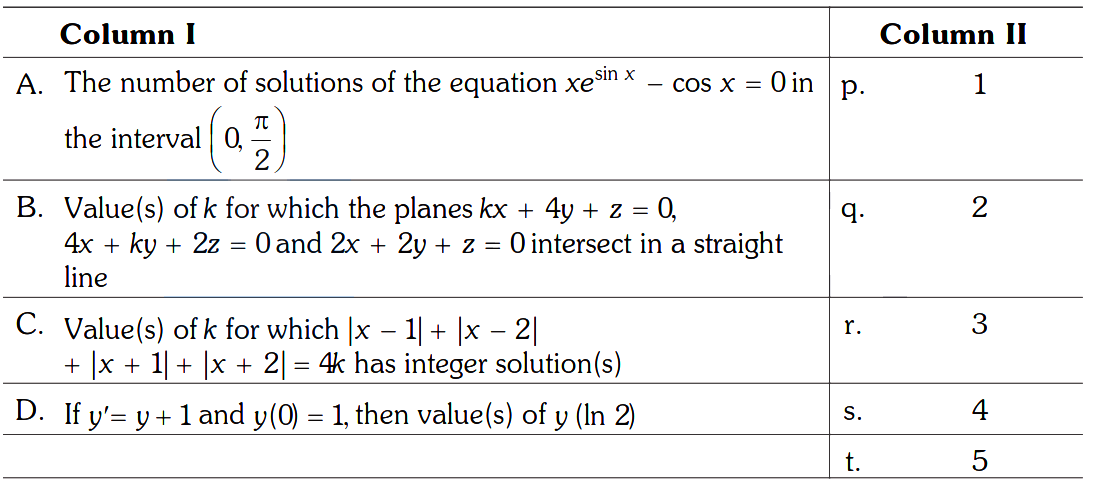
Then, the sum of the diagonal entries of \(M\) isJEE Advanced 2011 Easy - Match the statements/expressions given in Column I with the values given in Column II.
 JEE Advanced 2009 Easy
 - Let and be differentiable functions such that and , for all Then,
JEE Advanced 2016 Hard - The difference in the oxidation numbers of the two types of sulphur atoms in \(\mathrm{Na}_2 \mathrm{~S}_4 \mathrm{O}_6\) isJEE Advanced 2011 Medium