


JEE Advanced · Physics · 8. Rotational Motion
Paragraph :
\(\mathbf{P}_{17 \text { - } 19}\) : Paragraph for Questions Nos. 17 to 19 Two discs \(A\) and \(B\) are mounted coaxially on a vertical axle. The discs have moments of inertia I and 2I, respectively about the common axis. Disc \(A\) is imparted an initial angular velocity \(2 \omega\) using the entire potential energy of a spring compressed by a distance \(x_1\). Disc \(B\) is imparted an angular velocity \(\omega\) by a spring having the same spring constant and compressed by a distance \(x_2\). Both the discs rotate in the clockwise direction.
Question :
When disc \(B\) is brought in contact with disc \(A\), they acquire a common angular velocity in time \(t\). The average frictional torque on one disc by the other during this period is
- A \(\frac{2 I \omega}{3 t}\)
- B \(\frac{9 I \omega}{2 t}\)
- C \(\frac{91 \omega}{4 t}\)
- D \(\frac{3 I \omega}{2 t}\)
Answer & Solution
Correct Answer
(A) \(\frac{2 I \omega}{3 t}\)
Step-by-step Solution
Detailed explanation
Let \(\omega^{\prime}\) be the common velocity. Then from conservation of angular momentum, we have
\(
\begin{aligned}
(i+2 I) \omega^{\prime} & =I(2 \omega)+2 I(\omega) \\
\omega^{\prime} & =\frac{4}{3} \omega
\end{aligned}
\)
From the equation,
Angular impulse = change in angular momentum for any of the disc, we have
\(
\begin{aligned}
\tau t & =I(2 \omega)-I\left(\frac{4}{3} \omega\right)=\frac{2 I \omega}{3} \\
\tau & =\frac{2 I \omega}{3 t}
\end{aligned}
\)
\(\therefore\) Option (a) is correct.
\(
\begin{aligned}
(i+2 I) \omega^{\prime} & =I(2 \omega)+2 I(\omega) \\
\omega^{\prime} & =\frac{4}{3} \omega
\end{aligned}
\)
From the equation,
Angular impulse = change in angular momentum for any of the disc, we have
\(
\begin{aligned}
\tau t & =I(2 \omega)-I\left(\frac{4}{3} \omega\right)=\frac{2 I \omega}{3} \\
\tau & =\frac{2 I \omega}{3 t}
\end{aligned}
\)
\(\therefore\) Option (a) is correct.
See the Complete Solution
Get step-by-step explanations for this and 2.5 Lakh+ more JEE, NEET & CET questions.
- Unlock all solutions
- Practice the full chapter
- Track accuracy across PYQs
4.8 rated on Google Play · 14,000+ reviews
More questions from Physics
- A rocket is launched normal to the surface of the Earth, away from the Sun, along the line joining the Sun and the Earth. The Sun is times heavier than the Earth and is at a distance times larger than the radius of the Earth. The escape velocity from Earth's gravitational field is . The minimum initial velocity required for the rocket to be able to leave the Sun-Earth system is closest to
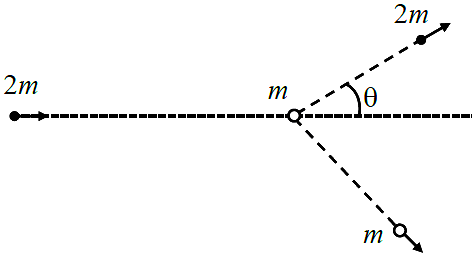
(Ignore the rotation and revolution of the Earth and the presence of any other planet)JEE Advanced 2017 Medium - In a scattering experiment, a particle of mass \(2 m\) collides with another particle of mass \(m\), which is initially at rest. Assuming the collision to be perfectly elastic, the maximum angular deviation \(\theta\) of the heavier particle, as shown in the figure, in radians is:
 JEE Advanced 2025 Hard
 - Paragraph:
The figure shows a circular loop of radius \(a\) with two long parallel wires (numbered \(1\) and \(2\) ) all in the plane of the paper. The distance of each wire from the centre of the loop is \(d\). The loop and the wires are carrying the same current \(I\). The current in the loop is in the counterclockwise direction if seen from above.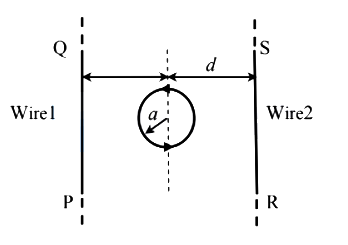
Question:
When \(d \approx a\) but wires are not touching the loop, it is found that the net magnetic field on the axis of the loop is zero at a height \(h\) above the loop. In that caseJEE Advanced 2014 Medium - A train with cross-sectional area is moving with speed inside a long tunnel of cross-sectional area . Assume that almost all the air (density ) in front of the train flows back between its sides and the walls of the tunnel. Also, the airflow with respect to the train is steady and laminar. Take the ambient pressure and that inside the train to be . If the pressure in the region between the sides of the train and the tunnel walls is , then The value of is _______.JEE Advanced 2020 Medium
- Let and be the respective electric fields at a distance r from a point charge Q, an infinitely long wire with constant linear charge density , and an infinite plane with uniform surface charge density . If at a given distance , thenJEE Advanced 2014 Medium
- One mole of a monatomic ideal gas undergoes the cyclic process \(\mathrm{J} \rightarrow \mathrm{K} \rightarrow \mathrm{L} \rightarrow \mathrm{M} \rightarrow \mathrm{J}\), as shown in the P-T diagram.
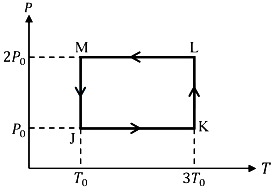
Match the quantities mentioned in List-I with their values in List-II and choose the correct option.
[\(\mathcal{R}\) is the gas constant.]List-I List-II (P) Work done in the complete cyclic process (1) \(R T_0-4 R T_0 \ln 2\) (Q) Change in the internal energy of the gas in the process JK (2) \(0\) (R) Heat given to the gas in the process KL (3) \(3 K T_0\) (S) Change in the internal energy of the gas in the process MJ (4) \(-2 R T_0 \ln 2\) \((5)-3 R T_0 \ln 2\) JEE Advanced 2024 Medium
More PYQs from JEE Advanced
- A mixture of two salts is used to prepare a solution

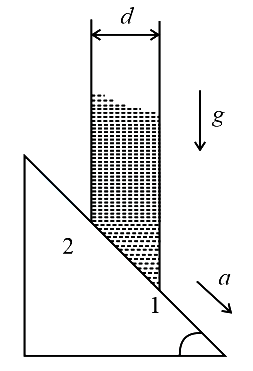
The correct option (s) for the salt mixture is(are)JEE Advanced 2021 Medium - A cylindrical tube, with its base as shown in the figure., is filled with water. It is moving down with a constant acceleration along a fixed inclined plane with angle . and are pressures at point and , respectively, located at the base of the tube. Let , where is density of water, is the inner diameter of the tube and is the acceleration due to gravity. Which of the following statement(s) is (are) correct?
 JEE Advanced 2021 Hard
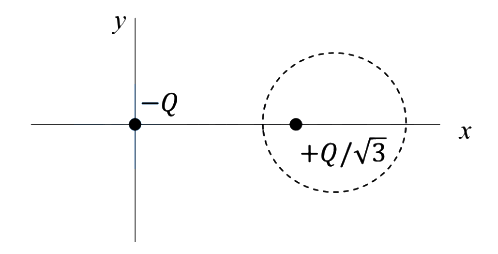
 - Two point charges \(-Q\) and \(+Q / \sqrt{3}\) are placed in the \(x y\)-plane at the origin \((0,0)\) and a point \((2,0)\), respectively, as shown in the figure. This results in an equipotential circle of radius \(R\) and potential \(V=0\) in the \(x y\)-plane with its center at \((b, 0)\). All lengths are measured in meters.
The value of is ________ meter.JEE Advanced 2021 Medium - Let and be real numbers. Consider the following system of linear equations Match each entry in List-I to the correct entries in List-II.
The correct option is:List-I List-II If and then the system has a unique solution If and , then the system has no solution If where and , then the system has infinitely many solutions If where and , then the system has and as a solution and as a solution JEE Advanced 2023 Medium - Let be a continuous function such that and Then which of the following statements is (are) TRUE?JEE Advanced 2021 Medium
- A trinitro compound, -tris-(-nitrophenyl) benzene, on complete reaction with an excess of gives a major product, which on treatment with an excess of at provides as the product. , upon treatment with excess of at room temperature, gives the product . Bromination of in aqueous medium furnishes the product . The compound upon treatment with an excess of phenol under basic conditions gives the product . The molar mass difference between compounds and is and between compounds and is .
The total number of carbon atoms and heteroatoms present in one molecule of \(S\) is
[Use: Molar mass (in \(\text{gmol} ^{-1}\) ): \(\text H =1,\text C =12,\text N=14,\text O =16,\) \(\text{Br} =80, \text{Cl} =35.5\) Atoms other than C and H are considered as heteroatoms]JEE Advanced 2023 Easy