


JEE Advanced · Physics · 4. Motion in 2D
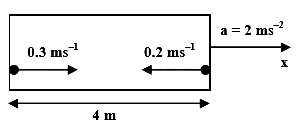
A rocket is moving in a gravity free space with a constant acceleration of along + x direction (see figure). The length of a chamber inside the rocket is 4 m. A ball is thrown from the left end of the chamber in + x direction with a speed of relative to the rocket. At the same time, another ball is thrown in - x direction with a speed of from its right end relative to the rocket. The time in seconds when the two balls hit each other for the first time is
- A 1
- B 2
- C 3
- D 4
Answer & Solution
Correct Answer
(B) 2
Step-by-step Solution
Detailed explanation
Consider motion of two balls with respect to rocket.
\(\frac{u^2}{2 a}=\frac{0.3 \times 0.3}{2 \times 2}=\frac{0.09}{4}=0.02 m\)
So, collision of two bals will take place very near to left wall.
\(\begin{aligned}
& \text { for } B S=u t+\frac{1}{2} a t^2 \\
& -4=-0.2 t\left(\frac{1}{2}\right) 2 t^2 \Rightarrow t^2+0.2 t \\
& -4=0 \\
& \Rightarrow f t=\frac{-0.2 \pm \sqrt{0.04+16}}{2}=1.9
\end{aligned}\)
nearest integer \(=2 \mathrm{~s}\)
\(\frac{u^2}{2 a}=\frac{0.3 \times 0.3}{2 \times 2}=\frac{0.09}{4}=0.02 m\)
So, collision of two bals will take place very near to left wall.
\(\begin{aligned}
& \text { for } B S=u t+\frac{1}{2} a t^2 \\
& -4=-0.2 t\left(\frac{1}{2}\right) 2 t^2 \Rightarrow t^2+0.2 t \\
& -4=0 \\
& \Rightarrow f t=\frac{-0.2 \pm \sqrt{0.04+16}}{2}=1.9
\end{aligned}\)
nearest integer \(=2 \mathrm{~s}\)
See the Complete Solution
Get step-by-step explanations for this and 2.5 Lakh+ more JEE, NEET & CET questions.
- Unlock all solutions
- Practice the full chapter
- Track accuracy across PYQs
4.8 rated on Google Play · 14,000+ reviews
More questions from Physics
- The general motion of a rigid body can be considered to be a combination of (i) a motion of its centre of mass about an axis, and (ii) its motion about an instantaneous axis passing through the centre of mass.
These axes need not be stationary. Consider, for example, a thin uniform disc welded (rigidly fixed) horizontally at its rim to a massless, stick, as shown in the figure. When the disc-stick system is rotated about the origin on a horizontal frictionless plane with angular speed \(\omega\), the motion at any instant can be taken as a combination of (i) a rotation of the centre of mass of the disc about the \(z\)-axis and (ii) a rotation of the disc through an instantaneous vertical axis passing through its centre of mass (as is seen from the changed orientation of points \(P\) and \(Q\) ). Both these motions have the same angular speed \(\omega\) in this case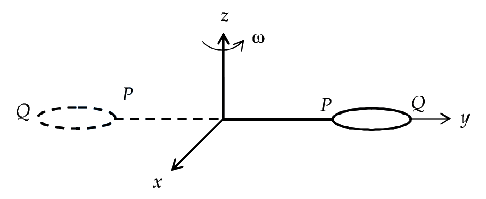
Now consider two similar systems as shown in the figure: Case
(a) the disc with its face vertical and parallel to \(x-z\) plane; Case
(b) the disc with its face making an angle of
\(45^{\circ}\) with \(x-y\) plane and its horizontal diameter parallel to \(x\)-axis. In both the cascs, the disc is welded at point \(\mathrm{P}\), and the systems are rotated with constant angular speed \(\omega\) about the \(z\) axis.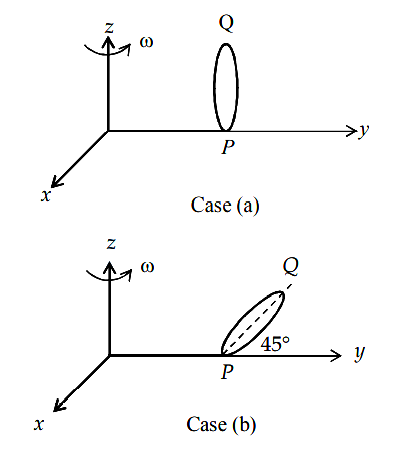
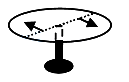
Question : Which of the following statements about the instantaneous axis (passing through the centre of mass) is correct?JEE Advanced 2012 Medium - A horizontal circular platform of radius 0.5 m and mass 0.45 kg is free to rotate about its axis. Two massless spring toy-guns, each carrying a steel ball of mass 0.05 kg are attached to the platform at a distance 0.25 m from the centre on its either sides along its diameter (see figure). Each gun simultaneously fires the balls horizontally and perpendicular to the diameter in opposite directions. After leaving the platform, the balls have horizontal speed of 9 with respect to the ground. The rotational speed of the platform in rad after the balls leave the platform is
 JEE Advanced 2014 Medium
 - Paragraph:
Scientists are working hard to develop nuclear fusion reactor. Nuclei of heavy hydrogen, \({ }_1^2 \mathrm{H}\) known as deuteron and denoted by \(D\) can be thought of as a candidate for fusion reactor. The \(D\) - \(D\) reaction is \({ }_1^2 \mathrm{H}+{ }_1^2 \mathrm{H} \rightarrow{ }_2^3 \mathrm{He}+n+\) energy. In the core of fusion reactor. A gas of heavy hydrogen is fully ionized into deuteron nuclei and electrons. This collection of \({ }_1^4 \mathrm{H}\) nuclei and electrons is known as plasma. The nuclei move randomly in the reactor core and occasionally come close enough for nuclear fusion to take place. Usually, the temperatures in the reactor core are too high and no material wall can be used to confine the plasma. Special techniques are used which confine the plasma for a time \(t_0\) before the particles fly away from the core. If n is the density (number/volume) of deutrons, the product t \(_0\) is called Lawson number. In one of the criteria, \(a\) reactor is termed successful if Lawson number is greater than \(5 \times 10^{14} \mathrm{scm}^{-3}\).
It may be helpful to use the following : Boltzmann constant \(k=8.6 \times 10^{-5} \mathrm{eV} / \mathrm{K}\); \(\frac{e^2}{4 \pi \varepsilon_0}=1.44 \times 10^{-9} \mathrm{eVm}\)
Question:
Assume that two deuteron nuclei in the core of fusion reactor at temperature \(T\) are moving towards each other, each with kinetic energy \(1.5 \mathrm{kT}\), when the separation between them is large enough to neglect Coulomb potential energy. Also neglect any interaction from other particles in the core. The minimum temperature \(T\) required for them to reach a separation of \(4 \times 10^{-15} \mathrm{~m}\) is in the rangeJEE Advanced 2009 Medium - Three objects \(A, B\) and \(C\) are kept in a straight line on a frictionless horizontal surface. These have masses \(m, 2 m\) and \(m\), respectively. The object \(A\) moves towards \(B\) with a speed \(9 \mathrm{~ms}^{-1}\) and makes an elastic collision with it. Thereafter, \(B\) makes completely inelastic collision with \(C\). All motions occur on the same straight line. Find the final speed (in \(\mathrm{ms}^{-1}\) ) of the object \(C\).
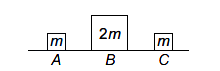 JEE Advanced 2009 Medium
 - Two spherical bodies \(A\) (radius \(6 \mathrm{~cm}\) ) and \(B\) (radius \(18 \mathrm{~cm}\) ) are at temperatures \(T_1\) and \(T_2\), respectively. The maximum intensity in the emission spectrum of \(A\) is at \(500 \mathrm{~nm}\) and in that of \(B\) is at \(1500 \mathrm{~nm}\). Considering them to be black bodies, what will be the ratio of the rate of total energy radiated by \(A\) to that of \(B\) ?JEE Advanced 2010 Hard
- Consider a disc rotating in the horizontal plane with a constant angular speed \(\omega\) about its centre \(\mathrm{O}\). The disc has a shaded region on one side of the diameter and an unshaded region on the other side as shown in the figure. When the disc is in the orientation as shown, two pebbles \(P\) and \(Q\) are simultaneously projected at an angle towards \(R\). The velocity of projection is in the \(y\) - \(z\) plane and is same for both pebbles with respect to the disc. Assume that (i) they land back on the disc before the disc has completed \(1 / 8\) rotation, (ii) their range is less than half the disc radius, and (iii) \(\omega\) remains constant throughout. Then
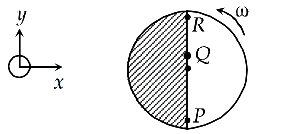 JEE Advanced 2012 Medium
More PYQs from JEE Advanced
- Amongst the following, the total number of compounds whose aqueous solution turns red litmus paper blue is
\(\begin{array}{llll}
\mathrm{KCN} & \mathrm{K}_2 \mathrm{SO}_4 & \left(\mathrm{NH}_4\right)_2 \mathrm{C}_2 \mathrm{O}_4 & \mathrm{NaCl} \\
\mathrm{Zn}\left(\mathrm{NO}_3\right)_2 & \mathrm{FeCl}_3 & \mathrm{~K}_2 \mathrm{CO}_3 & \mathrm{NH}_4 \mathrm{NO}_3 \\
\mathrm{LiCN} & & &
\end{array}\)JEE Advanced 2010 Hard - The number of matrices with entries from , such that the sum of the diagonal elements of is , areJEE Advanced 2017 Hard
- A biconvex lens of focal length \(15 \mathrm{~cm}\) is in front of a plane mirror. The distance between the lens and the mirror is 10 \(\mathrm{cm}\). A small object is kept at a distance of \(30 \mathrm{~cm}\) from the lens. The final image isJEE Advanced 2010 Medium
- On decreasing the from to , the solubility of a sparingly soluble salt of a weak acid increased from to . The of isJEE Advanced 2023 Easy
- The number of \(3 \times 3\) matrices \(A\) whose entries are either 0 or 1 and for which the system \(A\left[\begin{array}{l}x \\ y \\ z\end{array}\right]=\left[\begin{array}{l}1 \\ 0 \\ 0\end{array}\right]\) has exactly two distinct solutions, isJEE Advanced 2010 Medium
- Lines \(L_1: y-x=0\) and \(L_2: 2 x+y=0\) intersect the line \(L_3: y+2=0\) at \(P\) and \(Q\), respectively. The bisector of the acute angle between \(L_1\) and \(L_2\) intersects \(L_3\) at \(R\).
Statement I The ratio \(P R: R Q\) equals \(2 \sqrt{2}: \sqrt{5}\).
Statement II In any triangle, bisector of an angle divides the triangle into two similar triangles.JEE Advanced 2007 Medium