


JEE Advanced · Mathematics · 32. Probability
A ship is fitted with three engines \(E_{1}, E_{2}\) and \(E_{3}\). The engines function independently of each other with respective probabilities \(\frac{1}{2}, \frac{1}{4}\) and \(\frac{1}{4}\). For the ship to be operational at least two of its engines must function. Let \(X\) denote the event that the ship is operational and let \(X_{1}, X_{2}\) and \(X_{3}\) denote respectively the events that the engines \(E_{1}, E_{2}\) and \(E_{3}\) are functioning. Which of the following is(are) true?
- A \(P\left[X_{1}^{c} \mid X\right]=\frac{3}{16}\)
- B \(P\) [Exactly two engines of the ship are functioning \([X]=\frac{7}{8}\)
- C \(P\left[X \mid X_{2}\right]=\frac{5}{16}\)
- D \(P\left[X \mid X_{1}\right]=\frac{7}{16}\)
Answer & Solution
Correct Answer
(D) \(P\left[X \mid X_{1}\right]=\frac{7}{16}\)
Step-by-step Solution
Detailed explanation
Given that \(P\left(X_{1}\right)=\frac{1}{2}, \mathrm{P}\left(X_{2}\right)=\frac{1}{4}, \mathrm{P}\left(X_{3}\right)=\frac{1}{4}\) \(P(X)=P\) (at least 2 engines are functioning)
\(\begin{aligned}=P\left(X_{1} \cap X_{2}\right.&\left.\cap X_{3}^{C}\right)+P\left(X_{1} \cap X_{2}^{C} \cap X_{3}\right) \\ &+P\left(X_{1}^{C} \cap X_{2} \cap X_{3}\right)+P\left(X_{1} \cap X_{2} \cap X_{3}\right) \end{aligned}\)
\(=\frac{1}{2} \times \frac{1}{4} \times \frac{3}{4}+\frac{1}{2} \times \frac{3}{4} \times \frac{1}{4}+\frac{1}{2} \times \frac{1}{4} \times \frac{1}{4}+\frac{1}{2} \times \frac{1}{4} \times \frac{1}{4}=\frac{1}{4}\)
(a) \(P\left(X_{1}^{C} / X\right)=\frac{P\left(X_{1}^{C} \cap X\right)}{P(X)}=\frac{P\left(X_{1}^{C} \cap X_{2} \cap X_{3}\right)}{P(X)}\)
\(=\frac{\frac{1}{2} \times \frac{1}{4} \times \frac{1}{4}}{\frac{1}{4}}=\frac{1}{8}\)
\(\therefore\) (a) is not true.
(b) \(P\) [Exactly two engines are functioning \(/ X]\)
\(=\frac{P[(\text { Exactly two engines are functioning }) \cap X]}{P(X)}\)
\(=\frac{P\left(X_{1}^{C} \cap X_{2} \cap X_{3}\right)+P\left(X_{1} \cap X_{2}^{C} \cap X_{3}\right)+P\left(X_{1} \cap X_{2} \cap X_{3}^{C}\right)}{P(X)}\)
\(=\frac{\frac{1}{2} \times \frac{1}{4} \times \frac{1}{4}+\frac{1}{2} \times \frac{3}{4} \times \frac{1}{4}+\frac{1}{2} \times \frac{1}{4} \times \frac{3}{4}}{\frac{1}{4}}=\frac{7}{8}\)
\(\therefore\) (b) is true.
(c) \(P\left(X / X_{2}\right)=\frac{P\left(X \cap X_{2}\right)}{P\left(X_{2}\right)}\)
\(=\frac{P\left(X_{1} \cap X_{2} \cap X_{3}\right)+P\left(X_{1}^{C} \cap X_{2} \cap X_{3}\right)+P\left(X_{1} \cap X_{2} \cap X_{3}^{C}\right)}{P\left(X_{2}\right)}\)
\(=\frac{\frac{1}{2} \times \frac{1}{4} \times \frac{1}{4}+\frac{1}{2} \times \frac{1}{4} \times \frac{1}{4}+\frac{1}{2} \times \frac{1}{4} \times \frac{3}{4}}{\frac{1}{4}}=\frac{5}{8}\)
\(\therefore\) (c) is not true.
(d) \(P\left(X / X_{1}\right)=\frac{P\left(X \cap X_{1}\right)}{P\left(X_{1}\right)}\)
\(=\frac{P\left(X_{1} \cap X_{2} \cap X_{3}\right)+P\left(X_{1} \cap X_{2}^{C} \cap X_{3}\right)+P\left(X_{1} \cap X_{2} \cap X_{3}^{C}\right)}{P\left(X_{1}\right)}\)
\(=\frac{\frac{1}{2} \times \frac{1}{4} \times \frac{1}{4}+\frac{1}{2} \times \frac{3}{4} \times \frac{1}{4}+\frac{1}{2} \times \frac{1}{4} \times \frac{3}{4}}{\frac{1}{2}}=\frac{7}{16}\)
\(\therefore\) (d) is true.
\(\begin{aligned}=P\left(X_{1} \cap X_{2}\right.&\left.\cap X_{3}^{C}\right)+P\left(X_{1} \cap X_{2}^{C} \cap X_{3}\right) \\ &+P\left(X_{1}^{C} \cap X_{2} \cap X_{3}\right)+P\left(X_{1} \cap X_{2} \cap X_{3}\right) \end{aligned}\)
\(=\frac{1}{2} \times \frac{1}{4} \times \frac{3}{4}+\frac{1}{2} \times \frac{3}{4} \times \frac{1}{4}+\frac{1}{2} \times \frac{1}{4} \times \frac{1}{4}+\frac{1}{2} \times \frac{1}{4} \times \frac{1}{4}=\frac{1}{4}\)
(a) \(P\left(X_{1}^{C} / X\right)=\frac{P\left(X_{1}^{C} \cap X\right)}{P(X)}=\frac{P\left(X_{1}^{C} \cap X_{2} \cap X_{3}\right)}{P(X)}\)
\(=\frac{\frac{1}{2} \times \frac{1}{4} \times \frac{1}{4}}{\frac{1}{4}}=\frac{1}{8}\)
\(\therefore\) (a) is not true.
(b) \(P\) [Exactly two engines are functioning \(/ X]\)
\(=\frac{P[(\text { Exactly two engines are functioning }) \cap X]}{P(X)}\)
\(=\frac{P\left(X_{1}^{C} \cap X_{2} \cap X_{3}\right)+P\left(X_{1} \cap X_{2}^{C} \cap X_{3}\right)+P\left(X_{1} \cap X_{2} \cap X_{3}^{C}\right)}{P(X)}\)
\(=\frac{\frac{1}{2} \times \frac{1}{4} \times \frac{1}{4}+\frac{1}{2} \times \frac{3}{4} \times \frac{1}{4}+\frac{1}{2} \times \frac{1}{4} \times \frac{3}{4}}{\frac{1}{4}}=\frac{7}{8}\)
\(\therefore\) (b) is true.
(c) \(P\left(X / X_{2}\right)=\frac{P\left(X \cap X_{2}\right)}{P\left(X_{2}\right)}\)
\(=\frac{P\left(X_{1} \cap X_{2} \cap X_{3}\right)+P\left(X_{1}^{C} \cap X_{2} \cap X_{3}\right)+P\left(X_{1} \cap X_{2} \cap X_{3}^{C}\right)}{P\left(X_{2}\right)}\)
\(=\frac{\frac{1}{2} \times \frac{1}{4} \times \frac{1}{4}+\frac{1}{2} \times \frac{1}{4} \times \frac{1}{4}+\frac{1}{2} \times \frac{1}{4} \times \frac{3}{4}}{\frac{1}{4}}=\frac{5}{8}\)
\(\therefore\) (c) is not true.
(d) \(P\left(X / X_{1}\right)=\frac{P\left(X \cap X_{1}\right)}{P\left(X_{1}\right)}\)
\(=\frac{P\left(X_{1} \cap X_{2} \cap X_{3}\right)+P\left(X_{1} \cap X_{2}^{C} \cap X_{3}\right)+P\left(X_{1} \cap X_{2} \cap X_{3}^{C}\right)}{P\left(X_{1}\right)}\)
\(=\frac{\frac{1}{2} \times \frac{1}{4} \times \frac{1}{4}+\frac{1}{2} \times \frac{3}{4} \times \frac{1}{4}+\frac{1}{2} \times \frac{1}{4} \times \frac{3}{4}}{\frac{1}{2}}=\frac{7}{16}\)
\(\therefore\) (d) is true.
See the Complete Solution
Get step-by-step explanations for this and 2.5 Lakh+ more JEE, NEET & CET questions.
- Unlock all solutions
- Practice the full chapter
- Track accuracy across PYQs
4.8 rated on Google Play · 14,000+ reviews
More questions from Mathematics
- Let the vectors \(\mathbf{P Q}, \mathbf{Q R}, \mathbf{R S}, \mathbf{S T}, \mathbf{T U}\) and UP represent the sides of a regular hexagon.
Statement I PQ \(\times(\mathbf{R S}+\mathbf{S T}) \neq \mathbf{0}\)
Statement II \(\mathbf{P Q} \times \mathbf{R S}=\mathbf{0}\) and \(\mathbf{P Q} \times \mathbf{S Q} \neq \mathbf{0}\)JEE Advanced 2007 Medium - Let \(\mathbb{R}\) denote the set of all real numbers. For a real number \(x\), let \([x]\) denote the greatest integer less than or equal to \(x\). Let \(n\) denote a natural number.
Match each entry in List-I to the correct entry in List-II and choose the correct option.
LIST - I LIST - II (P) The minimum value of \(n\) for which the function \(f(x)=\left[\frac{10 x^3-45 x^2+60 x+35}{n}\right]\) is continuous on the interval \([1,2]\),is (1) 8 (Q) The minimum value of \(n\) for which \(g(x)=\left(2 n^2-13 n-15\right)\left(x^3+3 x\right),x \in \mathbb{R}\),is an increasing function on \(\mathbb{R}\),is (2) 9 (R) The smallest natural number \(n\) which is greater than 5,such that \(x=3\) is a point of local minima of \(h(x)=\left(x^2-9\right)^{\mathrm{n}}\left(x^2+2 x+3\right)\),is (3) 5 (S) Number of \(x_0 \in \mathbb{R}\) such that \(l(x)=\sum_{k=0}^4\left(\sin |x-k|+\cos \left|x-k+\frac{1}{2}\right|\right),x \in \mathbb{R}\),is NOT differentiable at \(x_0\),is (4) 6 (5) 10 JEE Advanced 2025 Hard - Let \(a_1, a_2, a_3, \ldots, a_{11}\) be real numbers satisfying \(a_1=15,27-2 a_2>0\) and \(a_k=2 a_{k-1}-a_{k-2}\) for \(k=3,4, \ldots, 11\).
If \(\frac{a_1^2+a_2^2+\ldots+a_{11}^2}{11}=90\), then the value of \(\frac{a_1+a_2+\ldots+a_{11}}{11}\) is equal toJEE Advanced 2010 Medium - Let \(f(x)=\frac{x}{\left(1+x^n\right)^{1 / n}}\) for \(n \geq 2\) and \(g(x)=\underbrace{(f \circ f o \ldots o f)}_{f \text { occurs } n \text { times }}(x)\). Then, \(\int x^{n-2} g(x) d x\) equalsJEE Advanced 2007 Hard
- Let the function be defined by . Suppose the function has a local minimum at precisely when where Then the value of is_______JEE Advanced 2020 Easy
- Let be the origin and let be an arbitrary triangle. The point is such that then triangle has as itsJEE Advanced 2017 Medium
More PYQs from JEE Advanced
- \(75.2 \mathrm{~g}\) of \(\mathrm{C}_6 \mathrm{H}_5 \mathrm{OH}\) (phenol) is dissolved in a solvent of \(K_f=14\). If the depression in freezing point is \(7 \mathrm{~K}\), then find the \(\%\) of phenol that dimerises.JEE Advanced 2006 Medium
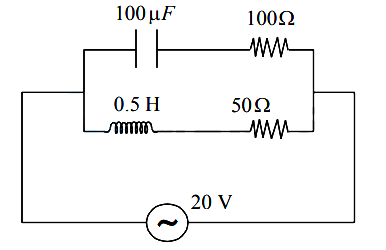
- In the given circuit, the \(\mathrm{AC}\) source has \(\omega=100 \mathrm{rad} / \mathrm{s}\). Considering the inductor and capacitor to be ideal, the correct choice(s) is (are)
 JEE Advanced 2012 Hard
 - The electrochemical cell shown below is a concentration cell. \(\mathrm{M} \mid \mathrm{M}^{2+}\) (saturated solution of a sparingly soluble salt, \(\left.\mathrm{MX}_{2}\right) \| \mathrm{M}^{2 \perp}\left(0.001 \mathrm{~mol} \mathrm{dm}^{-3}\right) \mid \mathrm{M}\).
The emf of the cell depends on the difference in concentrations of \(\mathrm{M}^{2+}\) ions at the two electrodes. The emf of the cell at \(298 \mathrm{~K}\) is \(0.059 \mathrm{~V}\).
Question:
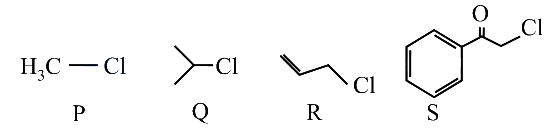
The solubility product \(\left(\mathrm{K}_{s p} ; \mathrm{mol}^{3} \mathrm{dm}^{-9}\right)\) of \(\mathrm{MX}_{2}\) at \(298 \mathrm{~K}\) based on the information available for the given concentration cell is (take \(2.303 \times \mathrm{R} \times 298 / \mathrm{F}=0.059 \mathrm{~V}\) )JEE Advanced 2012 Medium - KI in acetone, undergoes SN2 reaction with each of P, Q, R and S. The rates of the reaction vary as
 JEE Advanced 2013 Medium
 - Paragraph:
Consider a simple \(R C\) circuit as shown in Figure \(1\).
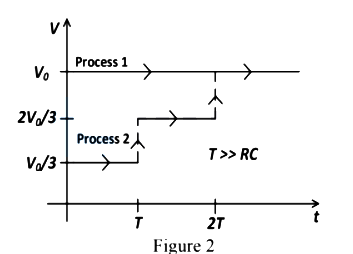
Process 1: In the circuit the switch \(S\) is closed at \(t=0\) and the capacitor is fully charged to voltage \(V_{0}\) (i.e., charging continues for time \(T>>R C\) ). In the process some dissipation \(\left(E_{D}\right)\) occurs across the resistance \(R\). The amount of energy finally stored in the fully charged capacitor is \(E_{C}\).
Process 2: In a different process the voltage is first set to \(\frac{V_{0}}{3}\) and maintained for a charging time \(T>>R C\). Then the voltage is raised to \(\frac{2 V_{0}}{3}\) without discharging the capacitor and again maintained for a time \(T>>R C\). The process is repeated one more time by raising the voltage to \(V_{0}\) and the capacitor is charged to the same final voltage \(V_{0}\) as in Process 1.
These two processes are depicted in Figure \(2 .\)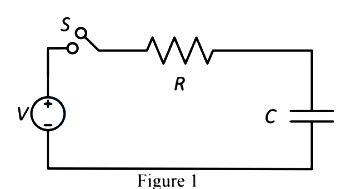
Question:
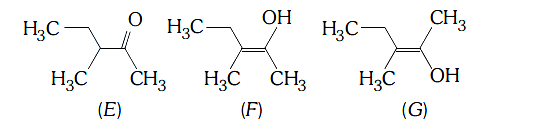
In Process 1 , the energy stored in the capacitor \(E_{C}\) and heat dissipated across resistance \(E_{D}\) are related by:JEE Advanced 2017 Medium - The correct statement(s) concerning the structures E, F and G is are
 JEE Advanced 2008 Easy