


JEE Advanced · Chemistry · 16. Solutions
\(75.2 \mathrm{~g}\) of \(\mathrm{C}_6 \mathrm{H}_5 \mathrm{OH}\) (phenol) is dissolved in a solvent of \(K_f=14\). If the depression in freezing point is \(7 \mathrm{~K}\), then find the \(\%\) of phenol that dimerises.
- A 25
- B 35
- C 45
- D 55
Answer & Solution
Correct Answer
(B) 35
Step-by-step Solution
Detailed explanation
Phenol is dimerised as follows
At \(t=0\)
\(2 \mathrm{C}_6 \mathrm{H}_5 \mathrm{OH} \rightleftharpoons\left(\mathrm{C}_6 \mathrm{H}_5 \mathrm{OH}\right)_2\)
At equilibrium
\((1-\alpha) \quad \alpha / 2\)
Total moles after dimerisation \(=1-\alpha+\alpha / 2=1-\alpha / 2\)
\(\text {Van't Hoff factor (i)} =\) \(\frac{\text {Normal molecular wt. of phenol}}{\text {Abnormal molecular wt. of phenol}}\)\(=\frac{94}{m_{a b}} \)
\(m_{a b} =\frac{1000 \times K_f \times w}{\Delta T_f \times W}\)
Given that
\(K_f=14 \)
\(w=72.5 \mathrm{gm} \)
\(W=1000 \mathrm{gm} \)
\(\therefore m_{a b}=\frac{1000 \times 14 \times 72.5}{7 \times 1000}=145\)
\(\therefore \quad i=\frac{94}{145}\)
\(\text {(i)}=\frac{\text {No. of particles after dimerisation}}{\text {No. of particles before dimerisation}}\)\(=\frac{1-\alpha / 2}{1}\)
From eq. (i) and (ii)
\(1-\alpha / 2 =\frac{94}{145}=0.65 \)
\(\frac{\alpha}{2} =1-0.65=0.35\)
Hence, \(35 \%\) phenol is present in dimeric form.
At \(t=0\)
\(2 \mathrm{C}_6 \mathrm{H}_5 \mathrm{OH} \rightleftharpoons\left(\mathrm{C}_6 \mathrm{H}_5 \mathrm{OH}\right)_2\)
At equilibrium
\((1-\alpha) \quad \alpha / 2\)
Total moles after dimerisation \(=1-\alpha+\alpha / 2=1-\alpha / 2\)
\(\text {Van't Hoff factor (i)} =\) \(\frac{\text {Normal molecular wt. of phenol}}{\text {Abnormal molecular wt. of phenol}}\)\(=\frac{94}{m_{a b}} \)
\(m_{a b} =\frac{1000 \times K_f \times w}{\Delta T_f \times W}\)
Given that
\(K_f=14 \)
\(w=72.5 \mathrm{gm} \)
\(W=1000 \mathrm{gm} \)
\(\therefore m_{a b}=\frac{1000 \times 14 \times 72.5}{7 \times 1000}=145\)
\(\therefore \quad i=\frac{94}{145}\)
\(\text {(i)}=\frac{\text {No. of particles after dimerisation}}{\text {No. of particles before dimerisation}}\)\(=\frac{1-\alpha / 2}{1}\)
From eq. (i) and (ii)
\(1-\alpha / 2 =\frac{94}{145}=0.65 \)
\(\frac{\alpha}{2} =1-0.65=0.35\)
Hence, \(35 \%\) phenol is present in dimeric form.
See the Complete Solution
Get step-by-step explanations for this and 2.5 Lakh+ more JEE, NEET & CET questions.
- Unlock all solutions
- Practice the full chapter
- Track accuracy across PYQs
4.8 rated on Google Play · 14,000+ reviews
More questions from Chemistry
- Among \(\left[ Ni ( CO )_4\right],\left[ NiCl _4\right]^{2-},\left[ Co \left( NH _3\right)_4 Cl _2\right] Cl , Na _3\) \(\left[ CoF _6\right], Na _2 O _2\) and \(CsO _2\), the total number of paramagnetic compounds isJEE Advanced 2016 Medium
- The reaction of white phosphorus with aqueous \(\mathrm{NaOH}\) gives phosphine along with another phosphorus containing compound. The reaction type; the oxidation states of phosphorus in phosphine and the other product are respectivelyJEE Advanced 2012 Easy
- Match the following
Column I Column II (A) \(CH _3- CHBr - CD _3\) on treatment with alc. KOH gives \(CH _2= CH - CD _3\) as a major product. (P) E1 reaction (B) \(Ph - CHBr - CH _3\) reacts faster than \(Ph - CHBr - CD _3\) (Q) E2 reaction (C) \(Ph - CH _2- CH _2 Br\) on treatment with \(C _2 H _5 OD / C _2 H _5 O ^{-}\)gives \(Ph - CD = CH _2\) as the major product (R) El cb reaction (D) \(PhCH _2 CH _2 Br\) and \(PhCH _2 CH _2 Br\) react with same rate (S) First order reaction JEE Advanced 2006 Medium - A sample \((5.6 \mathrm{~g})\) containing iron is completely dissolved in cold dilute \(\mathrm{HCl}\) to prepare a \(250 \mathrm{~mL}\) of solution. Titration of \(25.0 \mathrm{~mL}\) of this solution requires \(12.5 \mathrm{~mL}\) of \(0.03 \mathrm{M} \mathrm{KMnO}_{4}\) solution to reach the end point. Number of moles of \(\mathrm{Fe}^{2+}\) present in \(250 \mathrm{~mL}\) solution is \(\mathbf{x} \times 10^{-2}\) (consider complete dissolution of \(\mathrm{FeCl}_{2}\) ). The amount of iron present in the sample is \(\mathbf{y} \%\) by weight.
(Assume: \(\mathrm{KMnO}_{4}\) reacts only with \(\mathrm{Fe}^{2+}\) in the solution Use: Molar mass of iron as \(56 \mathrm{~g} \mathrm{~mol}^{-1}\) )
The value of is________ .JEE Advanced 2021 Medium - Among the following, intensive property is (properties are)JEE Advanced 2010 Medium
- The number of aldol reaction(s) that occurs in the given transformation is :
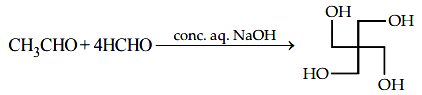 JEE Advanced 2012 Medium
More PYQs from JEE Advanced
- Mixture(s) showing positive deviation from Raoult's law at is (are)JEE Advanced 2016 Easy
- A charged particle is introduced at the origin with a given initial velocity . A uniform electric field and a uniform magnetic field exist everywhere. The velocity , electric field and a uniform magnetic field are given in the columns below
In which case will the particle describe a helical path with axis along positive z direction?Column 1 Column 2 Column 3 1. Electron with (i) (P) 2. Electron with (ii) (Q) 3.Proton with =0 (iii) (R) 4. Proton with (iv) (S) JEE Advanced 2017 Medium - Column I showns four systems, each of the same length \(L\), for producing standing waves. The lowest possible natural frequency of a system is called its fundamental frequency, whose wavelength is denoted as \(\lambda_f\). Match each system with statements given in Column II describing the nature and wave length of the standing waves.
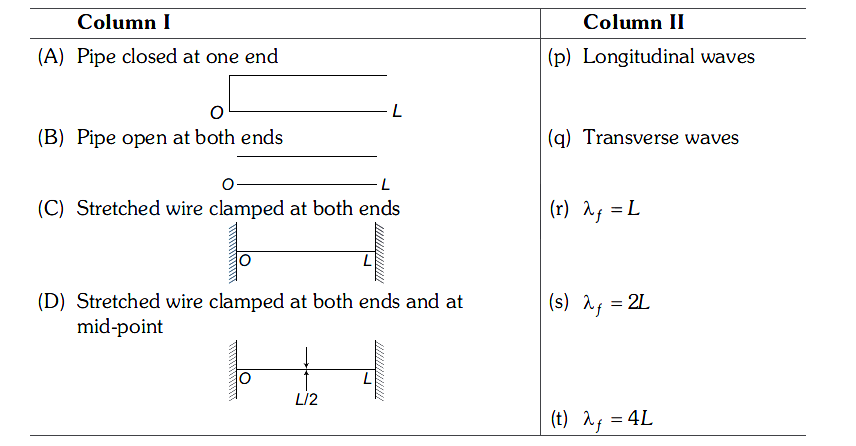 JEE Advanced 2011 Hard
 - Consider the functions defined by and
If is the area of the region , then the value of is _____ .JEE Advanced 2022 Hard - A student skates up a ramp that makes an angle with the horizontal. He/she starts (as shown in the figure) at the bottom of the ramp with speed and wants to turn around over a semicircular path of radius during which he/she reaches a maximum height (at point ) from the ground as shown in the figure. Assume that the energy loss is negligible and the force required for this turn at the highest point is provided by his/her weight only. Then ( is the acceleration due to gravity)
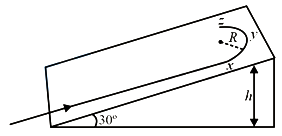 JEE Advanced 2020 Medium
 - Paragraph :
When liquid medicine of density \(\rho\) is to be put in the eye, it is done with the help of a dropper. As the bulb on the top of the dropper is pressed, a drop forms at the opening of the dropper. We wish to estimate the size of the drop.
We first assume that the drop formed at the opening is spherical because that requires a minimum increase in its surface energy. To determine the size, we calculate the net vertical force due to the surface tension \(T\) when the radius of the drop is \(R\). When this force becomes smaller than the weight of the drop, the drop gets detached from the dropper.
Question :
If the radius of the opening of the dropper is \(r\), the vertical force due to the surface tension on the drop of radius \(R\) (assuming \(r< < R\) ) isJEE Advanced 2010 Medium