


JEE Advanced · Mathematics · 30. Vector Algebra
Let the vectors \(\mathbf{P Q}, \mathbf{Q R}, \mathbf{R S}, \mathbf{S T}, \mathbf{T U}\) and UP represent the sides of a regular hexagon.
Statement I PQ \(\times(\mathbf{R S}+\mathbf{S T}) \neq \mathbf{0}\)
Statement II \(\mathbf{P Q} \times \mathbf{R S}=\mathbf{0}\) and \(\mathbf{P Q} \times \mathbf{S Q} \neq \mathbf{0}\)
- A Statement I is true, Statement II is true; Statement II is a correct explanation for Statement I
- B Statement I is true, Statement II is true; Statement II is not a correct explanation for Statement I
- C Statement I is true, Statement II is false
- D Statement I is false, Statement II is true
Answer & Solution
Correct Answer
(C) Statement I is true, Statement II is false
Step-by-step Solution
Detailed explanation
Since, \(\mathbf{P Q}\) is not parallel to \(\mathbf{T R}\)
\(\because\) TR is resultant of \(\mathbf{S R}\) and \(\mathbf{S T}\) vectors.
\(\Rightarrow \quad \mathbf{P Q} \times(\mathbf{R S}+\mathbf{S T}) \neq \mathbf{0}\)
But for Statement II, we have \(\mathbf{P Q} \times \mathbf{R S}=\mathbf{0}\)
which is not possible as \(\mathbf{P Q}\) not parallel to \(\mathbf{R S}\).
Hence, Statement I is true and Statement II is false.
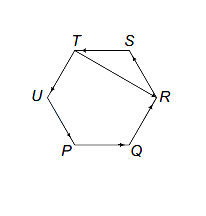
\(\because\) TR is resultant of \(\mathbf{S R}\) and \(\mathbf{S T}\) vectors.
\(\Rightarrow \quad \mathbf{P Q} \times(\mathbf{R S}+\mathbf{S T}) \neq \mathbf{0}\)
But for Statement II, we have \(\mathbf{P Q} \times \mathbf{R S}=\mathbf{0}\)
which is not possible as \(\mathbf{P Q}\) not parallel to \(\mathbf{R S}\).
Hence, Statement I is true and Statement II is false.
See the Complete Solution
Get step-by-step explanations for this and 2.5 Lakh+ more JEE, NEET & CET questions.
- Unlock all solutions
- Practice the full chapter
- Track accuracy across PYQs
4.8 rated on Google Play · 14,000+ reviews
More questions from Mathematics
- If , then which of the following matrices is equal to ?JEE Advanced 2022 Easy
- Paragraph:
Let \(A, B, C\) be three sets of complex numbers as defined below.
\(A=\{z ; \operatorname{lm} z \geq 1\} ; B=\{z:|z-2-i|=3\} ;\) \(C=\{z: \operatorname{Re}((1-i) z)=\sqrt{2}\}\).
Question:
Let \(z\) be any point in \(A \cap B \cap C\). The \(|z+1-i|^2+|z-5-i|^2\) lies betweenJEE Advanced 2008 Easy - Let be the minimum possible value of , where are real numbers for which . Let be the maximum possible value of , where are positive real numbers for which . Then the value of isJEE Advanced 2020 Medium
- Let \(\mathbb{R}^3\) denote the three-dimensional space. Take two points \(P=(1,2,3)\) and \(Q=(4,2,7)\). Let \(\operatorname{dist}(X, Y)\) denote the distance between two points \(X\) and \(Y\) in \(\mathbb{R}^3\). Let
\(\begin{gathered}S=\left\{X \in \mathbb{R}^3:(\operatorname{dist}(X, P))^2-(\operatorname{dist}(X, Q))^2=50\right\} \text { and } \\T=\left\{Y \in \mathbb{R}^3:(\operatorname{dist}(Y, Q))^2-(\operatorname{dist}(Y, P))^2=50\right\} .\end{gathered}\)
Then which of the following statements is (are) TRUE?JEE Advanced 2024 Medium - A normal with slope \(\frac{1}{\sqrt{6}}\) is drawn from the point \((0,-\alpha)\) to the parabola \(x^2=-4 a y\), where \(a>0\). Let \(L\) be the line passing through \((0,-\alpha)\) and parallel to the directrix of the parabola. Suppose that \(L\) intersects the parabola at two points \(A\) and \(B\). Let \(r\) denote the length of the latus rectum and \(s\) denote the square of the length of the line segment \(A B\). If \(r: s=1: 16\), then the value of 24ais ________.JEE Advanced 2024 Medium
- The number of distinct solutions of the equation in the interval isJEE Advanced 2015 Medium
More PYQs from JEE Advanced
- Two bodies, each of mass , are kept fixed with a separation of . A particle of mass is projected from the midpoint of the line joining their centers, perpendicular to the line. The gravitational constant is . The correct statement (s) is (are) :JEE Advanced 2013 Medium
- Let the set of all relations \(R\) on the set \(\{a, b, c, d, e, f\}\), such that \(R\) is reflexive and symmetric, and \(R\) contains exactly 10 elements, be denoted by \(S\). Then the number of elements in \(S\) is ______JEE Advanced 2025 Hard
- of molal urea solution (density at ) is mixed with of a solution containing of urea. Both the solutions were prepared in the same solvent. The osmotic pressure (in torr) of the resulting at is
[Use : Molar mass of urea ; gas constant, ;
Assume,JEE Advanced 2023 Easy - A proton is fired from very far away towards a nucleus with charge \(Q=120 e\), where \(e\) is the electronic charge. It makes a closest approach of \(10 \mathrm{fm}\) to the nucleus. The de Broglie wavelength (in units of \(\mathrm{fm}\) ) of the proton at its start is: (take the proton mass, \(m_{p}=(5 / 3) \times 10^{-27} \mathrm{~kg} ; h / e=4.2 \times\) \(10^{-15} \mathrm{~J} . \mathrm{S} / \mathrm{C}\);
\(\frac{1}{4 \pi \varepsilon_{0}}=9 \times 10^{9} \mathrm{~m} / \mathrm{F} ; 1 \mathrm{fm}=10^{-15} \mathrm{~m}\)JEE Advanced 2012 Medium - A charged shell of radius carries a total charge Given as the flux of electric field through a closed cylindrical surface of height radius and with its center same as that of the shell. Here, center of the cylinder is a point on the axis of the cylinder which is equidistant from its top and bottom surfaces. Which of the following option(s) is/are correct? [ is the permittivity of free space]JEE Advanced 2019 Medium
- Let , for . Then the number of real solutions of the equation in the set is equal toJEE Advanced 2023 Easy