


JEE Advanced · Chemistry · 17. Electrochemistry
The electrochemical cell shown below is a concentration cell. \(\mathrm{M} \mid \mathrm{M}^{2+}\) (saturated solution of a sparingly soluble salt, \(\left.\mathrm{MX}_{2}\right) \| \mathrm{M}^{2 \perp}\left(0.001 \mathrm{~mol} \mathrm{dm}^{-3}\right) \mid \mathrm{M}\).
The emf of the cell depends on the difference in concentrations of \(\mathrm{M}^{2+}\) ions at the two electrodes. The emf of the cell at \(298 \mathrm{~K}\) is \(0.059 \mathrm{~V}\).
Question:
The solubility product \(\left(\mathrm{K}_{s p} ; \mathrm{mol}^{3} \mathrm{dm}^{-9}\right)\) of \(\mathrm{MX}_{2}\) at \(298 \mathrm{~K}\) based on the information available for the given concentration cell is (take \(2.303 \times \mathrm{R} \times 298 / \mathrm{F}=0.059 \mathrm{~V}\) )
- A \(1 \times 10^{-15}\)
- B \(4 \times 10^{-15}\)
- C \(1 \times 10^{-12}\)
- D \(4 \times 10^{-12}\)
Answer & Solution
Correct Answer
(B) \(4 \times 10^{-15}\)
Step-by-step Solution
Detailed explanation
\(M \mid M^{2+}\) (aq) \(\| M^{2+}\) (aq) \(\mid M\)
\(0.001 \mathrm{M}\)
Anode : \(M \longrightarrow M^{2+}(\mathrm{aq})+2 e^{-}\)
Cathode : \(M^{2+}(\mathrm{aq})+2 e^{-} \longrightarrow M\)
\(M^{2+}(\mathrm{aq})_{c} \rightleftharpoons M^{2+}(\mathrm{aq})_{a}\)
\(E_{\text {cell }}=0-\frac{0.059}{2} \log \left\{\frac{M^{2+}(\mathrm{aq})_{a}}{10^{-3}}\right\} \)
\( \Rightarrow 0.059=-\frac{0.059}{2} \log \left\{\frac{M^{2+}(\mathrm{aq})_{a}}{10^{-3}}\right\} \)
\( -2=\log \left\{\frac{M^{2+}(\mathrm{aq})_{a}}{10^{-3}}\right\}\)
\(\Rightarrow 10^{-2} \times 10^{-3}=\mathrm{M}^{2+}(\mathrm{aq})_{a}=\) solubility \(=s\)
\(M X_{2} \rightleftharpoons M^{2+}+2 X^{-}\)
\(K_{s p}=S .(2 S)^{2} 2 S\)
\(\Rightarrow K_{s p}=4 s^{3}=4 \times\left(10^{-5}\right)^{3}=4 \times 10^{-15}\)
\(0.001 \mathrm{M}\)
Anode : \(M \longrightarrow M^{2+}(\mathrm{aq})+2 e^{-}\)
Cathode : \(M^{2+}(\mathrm{aq})+2 e^{-} \longrightarrow M\)
\(M^{2+}(\mathrm{aq})_{c} \rightleftharpoons M^{2+}(\mathrm{aq})_{a}\)
\(E_{\text {cell }}=0-\frac{0.059}{2} \log \left\{\frac{M^{2+}(\mathrm{aq})_{a}}{10^{-3}}\right\} \)
\( \Rightarrow 0.059=-\frac{0.059}{2} \log \left\{\frac{M^{2+}(\mathrm{aq})_{a}}{10^{-3}}\right\} \)
\( -2=\log \left\{\frac{M^{2+}(\mathrm{aq})_{a}}{10^{-3}}\right\}\)
\(\Rightarrow 10^{-2} \times 10^{-3}=\mathrm{M}^{2+}(\mathrm{aq})_{a}=\) solubility \(=s\)
\(M X_{2} \rightleftharpoons M^{2+}+2 X^{-}\)
\(K_{s p}=S .(2 S)^{2} 2 S\)
\(\Rightarrow K_{s p}=4 s^{3}=4 \times\left(10^{-5}\right)^{3}=4 \times 10^{-15}\)
See the Complete Solution
Get step-by-step explanations for this and 2.5 Lakh+ more JEE, NEET & CET questions.
- Unlock all solutions
- Practice the full chapter
- Track accuracy across PYQs
4.8 rated on Google Play · 14,000+ reviews
More questions from Chemistry
- Statement I Molecules that are not superimposable on their mirror images are chiral.
Statement II All chiral molecules have chiral centres.JEE Advanced 2007 Easy - The correct stability order for the following species is
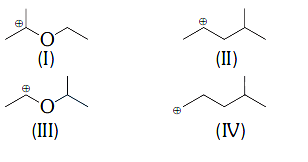 JEE Advanced 2008 Medium
 - Paragraph:
p-amino-N, N-dimethylaniline is added to a strongly acidic solution of \(X\). The resulting solution is treated with a few drops of aqueous solution of \(Y\) to yield blue colouration due to the formation of methylene blue. Treatment of the aqueous solution of \(Y\) with the reagent potassium hexacyanoferrate(II) leads to the formation of an intense blue precipitate. The precipitate dissolves an excess addition of the reagent. Similarly, treatment of the solution of \(Y\) with the solution of potassium hexacyanoferrate(III) leads to a brown colouration due to the formation of \(Z\).
Question:
The compound \(Y\), isJEE Advanced 2009 Medium - Paragraph:
An aqueous solution of metal ion \(\mathbf{M} 1\) reacts separately with reagents \(\mathbf{Q}\) and \(\mathbf{R}\) in excess to give tetrahedral and square planar complexes, respectively. An aqueous solution of another metal ion M2 always forms tetrahedral complexes with these reagents. Aqueous solution of \(\mathbf{M} 2\) on reaction with reagent \(\mathbf{S}\) gives white precipitate which dissolves in excess of \(\mathbf{S}\). The reactions are summarized in the scheme given below: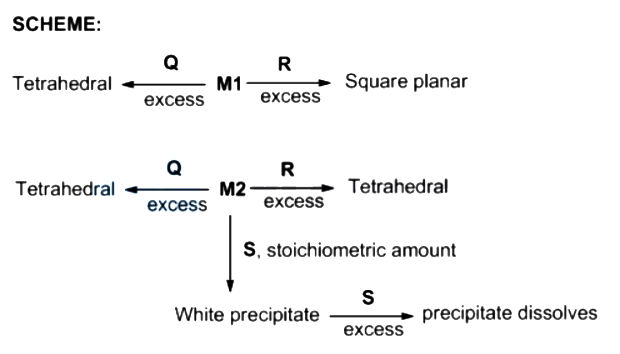
Question:
Reagent \(\mathbf{S}\) isJEE Advanced 2014 Medium - The work function ( \(\Phi\) ) of some metals is listed below. The number of metals which will show photoelectric effect when light of \(300 \mathrm{~nm}\) wavelength falls on the metal is
 JEE Advanced 2011 Easy
 - The dilution processes of different aqueous solutions with water are given in LIST-I. The effects of dilution of the solutions on are given in LIST-II.
(Note: The degree of dissociation of a weak acid and a weak base is the degree of hydrolysis of salt is represents the concentration of ions)List - I List - II A) 10 mL of \(0.1\text{ M NaOH} +20\text{ mL}\) of 0.1 M acetic acid diluted to 60 mL . P) The value of \(\left[\text H ^{+}\right]\)does not change on dilution. B) 20 mL of \(0.1\text{ M NaOH} +20\text{ mL}\) of 0.1 M acetic acid diluted to 80 mL . Q) The value of \(\left[\text H ^{+}\right]\)changes to half of its initial value on dilution. C) 20 mL of \(0.1\text{ M HCl} +20\text{ mL}\) of 0.1 M ammonia solution diluted to 80 mL . R) The value of \(\left[\text H ^{+}\right]\)changes to two times its initial value on dilution. D) 10 mL saturated solution of \(\text{Ni} (\text{OH})_2\) in equilibrium with excess of solid \(\text{Ni} (\text{OH})_2\) is diluted to 20 mL (solid \(\text{Ni} (\text{OH})_2\) is still present after dilution). S) The value of \(\left[\text H ^{+}\right]\)changes to \(\sqrt{ }\) times its initial value on dilution. T) The value of \(\left[\text H ^{+}\right]\)changes to \(\sqrt{2}\) times its initial value on dilution.
Match each process given in LIST-I with one or more effect(s) in LIST-II. The correct option isJEE Advanced 2018 Hard
More PYQs from JEE Advanced
- Let M and N be two matrices such that MN = NM. Further, if and , thenJEE Advanced 2014 Medium
- For a reaction taking place in a container in equilibrium with its surroundings, the effect of temperature on its equilibrium constant in terms of change in entropy is described by:JEE Advanced 2017 Medium
- A circular disc of radius carries surface charge density , where is a constant and is the distance from the center of the disc. Electric flux through a large spherical surface that encloses the charged disc completely is . Electric flux through another spherical surface of radius and concentric with the disc is . Then the ratio isJEE Advanced 2020 Hard
- Two adjacent sides of a parallelogram \(A B C D\) are given by \(\overrightarrow{\mathbf{A B}}=2 \hat{\mathbf{i}}+10 \hat{\mathbf{j}}+11 \hat{\mathbf{k}}\) and \(\overrightarrow{\mathbf{A D}}=-\hat{\mathbf{i}}+2 \hat{\mathbf{j}}+2 \hat{\mathbf{k}}\). The side \(A D\) is rotated by an acute angle \(\alpha\) in the plane of the parallelogram so that \(A D\) becomes \(A D^{\prime}\). If \(A D^{\prime}\) makes a right angle with the side \(A B\), then the cosine of the angle \(\alpha\) is given byJEE Advanced 2010 Easy
- In a high school, a committee has to be formed from a group of boys
and girls .
(i) Let be the total number of ways in which the committee can be formed such that the committee has members, having exactly boys and girls.
(ii) Let be the total number of ways in which the committee can be formed such that the committee has at least members, and having an equal number of boys and girls.
(iii) Let be the total number of ways in which the committee can be formed such that the committee has members, at least of them being girls.
(iv) Let be the total number of ways in which the committee can be formed such that the committee has members, having at least girls and such that both and are NOT in the committee together.
The correct option is:LIST-I LIST-II A. The value of is P. B. The value of is Q. C. The value of is R. D. The value of is S. T. U. JEE Advanced 2018 Medium - The value of
\(6+\log _{\frac{3}{2}}\)\(\left(\frac{1}{3 \sqrt{2}} \sqrt{4-\frac{1}{3 \sqrt{2}} \sqrt{4-\frac{1}{3 \sqrt{2}} \sqrt{4-\frac{1}{3 \sqrt{2}}} \cdots}}\right)\) isJEE Advanced 2012 Medium