


JEE Advanced · Mathematics · 25. AOD
Let \(\mathbb{R}\) denote the set of all real numbers. For a real number \(x\), let \([x]\) denote the greatest integer less than or equal to \(x\). Let \(n\) denote a natural number.
Match each entry in List-I to the correct entry in List-II and choose the correct option.
| LIST - I | LIST - II | ||
|---|---|---|---|
| (P) | The minimum value of \(n\) for which the function \(f(x)=\left[\frac{10 x^3-45 x^2+60 x+35}{n}\right]\) is continuous on the interval \([1,2]\),is | (1) | 8 |
| (Q) | The minimum value of \(n\) for which \(g(x)=\left(2 n^2-13 n-15\right)\left(x^3+3 x\right),x \in \mathbb{R}\),is an increasing function on \(\mathbb{R}\),is | (2) | 9 |
| (R) | The smallest natural number \(n\) which is greater than 5,such that \(x=3\) is a point of local minima of \(h(x)=\left(x^2-9\right)^{\mathrm{n}}\left(x^2+2 x+3\right)\),is | (3) | 5 |
| (S) | Number of \(x_0 \in \mathbb{R}\) such that \(l(x)=\sum_{k=0}^4\left(\sin |x-k|+\cos \left|x-k+\frac{1}{2}\right|\right),x \in \mathbb{R}\),is NOT differentiable at \(x_0\),is | (4) | 6 |
| (5) | 10 |
- A \((\mathrm{P}) \rightarrow(1),(\mathrm{Q}) \rightarrow(3),(\mathrm{R}) \rightarrow(2),(\mathrm{S}) \rightarrow(5)\)
- B \((\mathrm{P}) \rightarrow(2),(\mathrm{Q}) \rightarrow(1),(\mathrm{R}) \rightarrow(4),(\mathrm{S}) \rightarrow(3)\)
- C \((\mathrm{P}) \rightarrow(5),(\mathrm{Q}) \rightarrow(1),(\mathrm{R}) \rightarrow(4),(\mathrm{S}) \rightarrow(3)\)
- D \((\mathrm{P}) \rightarrow(2),(\mathrm{Q}) \rightarrow(3),(\mathrm{R}) \rightarrow(1),(\mathrm{S}) \rightarrow(5)\)
Answer & Solution
Correct Answer
(B) \((\mathrm{P}) \rightarrow(2),(\mathrm{Q}) \rightarrow(1),(\mathrm{R}) \rightarrow(4),(\mathrm{S}) \rightarrow(3)\)
Step-by-step Solution
Detailed explanation
\(\begin{aligned}
& P(x)=10 x^3-45 x^2+60 x+35 \\
& P^{\prime}(x)=30(x-1)(x-2)
\end{aligned}\)
\(\mathrm{P}(\mathrm{x})\) decreases in \([1,2]\)
\(\Rightarrow\) Range of \(\mathrm{P}(\mathrm{x})=[55,60]\)
\(f(\mathrm{x})=\left[\frac{\mathrm{P}(\mathrm{x})}{\mathrm{n}}\right] \min\) value of \(\mathrm{n}=9\)
(Q) For \(g(x)\) to be increasing
\(2 n^2-13 n-15 \geq 0\)
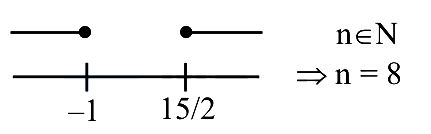
(R) \(\begin{aligned} & h(x)=\left(x^2-9\right)^n\left(x^2+2 x+3\right) \\ & h^{\prime}(x)=\left(x^2-9\right)^n(2 x+2)+\left(x^2+2 x+3\right) n\left(x^2-9\right)^{n-1} \cdot 2 x \\ & =\left(x^2-9\right)^{n-1}\left[2\left(x^2-9\right)(x+1)+2 n x\left(x^2+2 x+3\right)\right] \\ & =(x+3)^{n-1}(x-3)^{n-1} \cdot q(x)\end{aligned}\)
Derivative must change sign at \(x=3\)
\(\begin{aligned}
& \because \mathrm{n}-1=\text { odd } \\
& \mathrm{n}=\text { even } \\
& \mathrm{n}=6
\end{aligned}\)
(S) \(\cos \left|\mathrm{x}-\mathrm{k}+\frac{1}{2}\right|\) is differentiable everywhere
\(\Rightarrow \sin |\mathrm{x}-\mathrm{k}|\) is NOT diff. at \(\mathrm{k}=0,1,2,3,4\)
& P(x)=10 x^3-45 x^2+60 x+35 \\
& P^{\prime}(x)=30(x-1)(x-2)
\end{aligned}\)
\(\mathrm{P}(\mathrm{x})\) decreases in \([1,2]\)
\(\Rightarrow\) Range of \(\mathrm{P}(\mathrm{x})=[55,60]\)
\(f(\mathrm{x})=\left[\frac{\mathrm{P}(\mathrm{x})}{\mathrm{n}}\right] \min\) value of \(\mathrm{n}=9\)
(Q) For \(g(x)\) to be increasing
\(2 n^2-13 n-15 \geq 0\)
(R) \(\begin{aligned} & h(x)=\left(x^2-9\right)^n\left(x^2+2 x+3\right) \\ & h^{\prime}(x)=\left(x^2-9\right)^n(2 x+2)+\left(x^2+2 x+3\right) n\left(x^2-9\right)^{n-1} \cdot 2 x \\ & =\left(x^2-9\right)^{n-1}\left[2\left(x^2-9\right)(x+1)+2 n x\left(x^2+2 x+3\right)\right] \\ & =(x+3)^{n-1}(x-3)^{n-1} \cdot q(x)\end{aligned}\)
Derivative must change sign at \(x=3\)
\(\begin{aligned}
& \because \mathrm{n}-1=\text { odd } \\
& \mathrm{n}=\text { even } \\
& \mathrm{n}=6
\end{aligned}\)
(S) \(\cos \left|\mathrm{x}-\mathrm{k}+\frac{1}{2}\right|\) is differentiable everywhere
\(\Rightarrow \sin |\mathrm{x}-\mathrm{k}|\) is NOT diff. at \(\mathrm{k}=0,1,2,3,4\)
See the Complete Solution
Get step-by-step explanations for this and 2.5 Lakh+ more JEE, NEET & CET questions.
- Unlock all solutions
- Practice the full chapter
- Track accuracy across PYQs
4.8 rated on Google Play · 14,000+ reviews
More questions from Mathematics
- Let be the origin and let be an arbitrary triangle. The point is such that then triangle has as itsJEE Advanced 2017 Medium
- A bag contains \(N\) balls out of which 3 balls are white, 6 balls are green, and the remaining balls are blue. Assume that the balls are identical otherwise. Three balls are drawn randomly one after the other without replacement. For \(i=1,2,3\), let \(W_i, G_i\), and \(B_i\) denote the events that the ball drawn in the \(i^{\text {th }}\) draw is a white ball, green ball, and blue ball, respectively. If the probability \(P\left(W_1 \cap G_2 \cap B_3\right)=\frac{2}{5 N}\) and the conditional probability \(P\left(B_3 \mid W_1 \cap G_2\right)=\frac{2}{9}\), then \(N\) equals ________.JEE Advanced 2024 Medium
- Consider three sets and . Two elements are chosen at random, without replacement, from the set , and let denote the set of these chosen elements. Let and . Now two elements are chosen at random, without replacement, from the set and let denote the set of these chosen elements. Let . Finally, two elements are chosen at random, without replacement, from the set and let denote the set of these chosen elements.
Let . Given that , let be the conditional probability of the event . Then the value of isJEE Advanced 2021 Medium - If \(w=\alpha+i \beta\), where \(\beta \neq 0\) and \(z \neq 1\) satisfies the condition that \(\left(\frac{w-\bar{w} z}{1-z}\right)\) is purely real, then the set of values of \(z\) isJEE Advanced 2006 Easy
- Let , where Suppose is a matrix such that, where and is the identity matrix of order 3. If and thenJEE Advanced 2016 Hard
- Let be a real number. Consider the matrix . If is a singular matrix, then the value of is _____ .JEE Advanced 2022 Medium
More PYQs from JEE Advanced
- If the wavelength of the \(n^{\text {th }}\) line of Lyman series is equal to the de-Broglie wavelength of electron in initial orbit of a hydrogen like element \((Z=11)\). Find the value of \(n\).JEE Advanced 2006 Medium
- The number of distinct solutions of the equation in the interval isJEE Advanced 2015 Medium
- A point object is placed at distance of \(20 \mathrm{~cm}\) from a thin planoconvex lens of focal length \(15 \mathrm{~cm}\). The plane surface of the lens is now silvered. The image created by the system is at
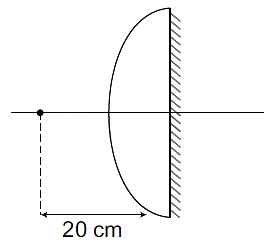 JEE Advanced 2006 Medium
 - Let be a continuous function such that for all Then, which of the following statement(s) is (are) TRUE?JEE Advanced 2018 Hard
- A crystalline solid of a pure substance has a face-centred cubic structure with a cell edge of . If the density of the substance in the crystal is then the number of atoms present in of the crystal . The value of isJEE Advanced 2017 Medium
- Let \(z\) be a complex number such that the imaginary part of \(z\) is non-zero and \(a=z^{2}+z+1\) is real. Then a cannot take the valueJEE Advanced 2012 Hard