


JEE Advanced · Mathematics · 23. C&D
Let \(f\) be a real-valued function defined on the interval \((0, \infty)\), by \(f(x)=\ln x+\int_0^x \sqrt{1+\sin t} d t\). Then which of the following statement(s) is (are) true ?
- A
\(f^{\prime \prime}(x)\) exists for all \(x \in(0, \infty)\)
- B
\(f^{\prime}(x)\) exists for all \(x \in(0, \infty)\) and \(f^{\prime}\) is continuous on \((0, \infty)\), but not differentiable on \((0, \infty)\)
- C
there exists \(\alpha>1\) such that \(\left|f^{\prime}(x)\right| < |f(x)|\) for all \(x \in(\alpha, \infty)\) - D
there exists \(\beta>0\) such that \(|f(x)|+\left|f^{\prime}(x)\right| \leq \beta \quad\) from all \(x \in(0, \infty)\)
Answer & Solution
Correct Answer
(C)
there exists \(\alpha>1\) such that \(\left|f^{\prime}(x)\right| < |f(x)|\) for all \(x \in(\alpha, \infty)\)
Step-by-step Solution
Detailed explanation
Here, \(f^{\prime}(x)=\frac{1}{x}+\sqrt{1+\sin x}, x>0\) but \(f(x)\) is not differentiable in \((0, \infty)\) as \(\sin x\) may be \(-1\) and then \(f^{\prime \prime}(x)=-\frac{1}{x^2}+\frac{\cos x}{2 \sqrt{1+\sin x}}\) will not exists.
\(\Rightarrow f^{\prime}(x)\) is continuous for all \(x \in(0, \infty)\) but \(f^{\prime}(x)\) is not differentiable on \((0, \infty)\).
\(\therefore\) Option (b) is true.
Also, \(\quad f^{\prime}(x) \leq 3\), if \(x>1\) and \(\quad f(x)>3\), if \(x>e^3\)
\(\therefore\) Let \(\alpha=e^3\)
\(\Rightarrow\) Option (c) is true.
(d) is not possible as \(f(x) \rightarrow \infty\) when \(x \rightarrow \infty\).
Hence, (b, c) is the correct option.
\(\Rightarrow f^{\prime}(x)\) is continuous for all \(x \in(0, \infty)\) but \(f^{\prime}(x)\) is not differentiable on \((0, \infty)\).
\(\therefore\) Option (b) is true.
Also, \(\quad f^{\prime}(x) \leq 3\), if \(x>1\) and \(\quad f(x)>3\), if \(x>e^3\)
\(\therefore\) Let \(\alpha=e^3\)
\(\Rightarrow\) Option (c) is true.
(d) is not possible as \(f(x) \rightarrow \infty\) when \(x \rightarrow \infty\).
Hence, (b, c) is the correct option.
See the Complete Solution
Get step-by-step explanations for this and 2.5 Lakh+ more JEE, NEET & CET questions.
- Unlock all solutions
- Practice the full chapter
- Track accuracy across PYQs
4.8 rated on Google Play · 14,000+ reviews
More questions from Mathematics
- Consider the lines \(L_{1}\) and \(L_{2}\) defined by
\[
L_{1}: x \sqrt{2}+y-1=0 \text { and } L_{2}: x \sqrt{2}-y+1=0
\]
For a fixed constant \(\lambda\), let \(C\) be the locus of a point \(P\) such that the product of the distance of \(P\) from \(L_{1}\) and the distance of \(P\) from \(L_{2}\) is \(\lambda^{2}\). The line \(y=2 x+1\) meets \(C\) at two points \(R\) and \(S\), where the distance between \(R\) and \(S\) is \(\sqrt{270}\).
Let the perpendicular bisector of \(R S\) meet \(C\) at two distinct points \(R^{\prime}\) and \(S^{\prime}\). Let \(D\) be the square of the distance between \(R^{\prime}\) and \(S^{\prime}\).
The value of isJEE Advanced 2021 Hard - Paragraph:
Let \(F_{1}\left(x_{1}, 0\right)\) and \(F_{2}\left(x_{2}, 0\right)\), for \(x_{1}<0\) and \(x_{2}>0\), be the foci of the ellipse \(\frac{x^{2}}{9}+\frac{y^{2}}{8}=1 .\) Suppose a parabola having vertex at the origin and focus at \(F_{2}\) intersects the ellipse at point \(M\) in the first quadrant and at point \(N\) in the fourth quadrant.
Question:
If the tangents to the ellipse at \(M\) and \(N\) meet at \(R\) and the normal to the parabola at \(M\) meets the \(x\)-axis at \(Q\), then the ratio of area of the triangle \(M Q R\) to area of the quadrilateral \(M F_{1} N F_{2}\) isJEE Advanced 2016 Medium - The integral \(\int \frac{\sec ^{2} x}{(\sec x+\tan x)^{\frac{9}{2}}} d x\) equals (for some arbitrary constant \(\mathrm{K}\) )JEE Advanced 2012 Hard
- Three lines
and
are given. For which point(s) and can we find a point on and a point on so that and are collinear?JEE Advanced 2019 Medium - Paragraph:
Consider the function \(f:(-\infty, \infty) \rightarrow(-\infty, \infty)\) defined by \(f(x)=\frac{x^2-a x+1}{x^2+a x+1} ; 0 < a < 2\)Question:
Which of the following is true?JEE Advanced 2008 Easy - Let \(a\) and \(b\) be two nonzero real numbers. If the coefficient of \(x^5\) in the expansion of \(\left(a x^2+\frac{70}{27 b x}\right)^4\) is equal to the coefficient of \(x^{-5}\) in the expansion of \(\left(a x-\frac{1}{b x^2}\right)^7\), then the value of \(2 b\) isJEE Advanced 2023 Easy
More PYQs from JEE Advanced
- A circular disc of radius carries surface charge density , where is a constant and is the distance from the center of the disc. Electric flux through a large spherical surface that encloses the charged disc completely is . Electric flux through another spherical surface of radius and concentric with the disc is . Then the ratio isJEE Advanced 2020 Hard
- For a reaction taking place in a container in equilibrium with its surroundings, the effect of temperature on its equilibrium constant in terms of change in entropy is described by:JEE Advanced 2017 Medium
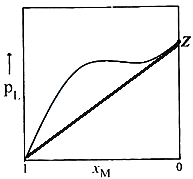
- For a solution formed by mixing liquids and , the vapour pressure of plotted against the mole fraction of in solution is shown in the following figure, Here, and represent mole fractions of and , respectively, in the solution. The correct statement(s) applicable to this system is(are) -
 JEE Advanced 2017 Medium
 - One mole of an ideal gas expands adiabatically from an initial state to final state . Another mole of the same gas expands isothermally from a different initial state to the same final state . The ratio of the specific heats at constant pressure and constant volume of this ideal gas is . What is the ratio ?JEE Advanced 2023 Easy
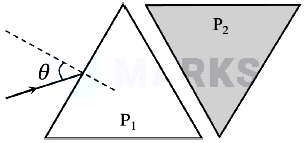
- Two equilateral-triangular prisms \(\mathrm{P}_1\) and \(\mathrm{P}_2\) are kept with their sides parallel to each other, in vacuum, as shown in the figure. A light ray enters prism \(P_1\) at an angle of incidence \(\theta\) such that the outgoing ray undergoes minimum deviation in prism \(P_2\). If the respective refractive indices of \(\mathrm{P}_1\) and \(\mathrm{P}_2\) are \(\sqrt{\frac{3}{2}}\) and \(\sqrt{3}\), then \(\theta=\sin ^{-1}\left[\sqrt{\frac{3}{2}} \sin \left(\frac{\pi}{\beta}\right)\right]\), where the value of \(\beta\) is _______ .
 JEE Advanced 2024 Medium
 - Let be a differentiable function with and Let and for all Let denote denote .Then which of the following is (are) true?JEE Advanced 2015 Hard