


JEE Advanced · Chemistry · 23. Coordination Compounds
The correct order of the wavelength maxima of the absorption band in the ultraviolet-visible region for the given complexes is
- A \(\left[\mathrm{Co}(\mathrm{CN})_6\right]^{3-} <\left[\mathrm{Co}\left(\mathrm{NH}_3\right)_6\right]^{3+} <[\mathrm{Co}\left(\mathrm{NH}_3\right)_5\)\(\left(\mathrm{H}_2 \mathrm{O}\right)]^{3+} <\left[\mathrm{Co}\left(\mathrm{NH}_3\right)_5(\mathrm{Cl})\right]^{2+}\)
- B \(\left[\mathrm{Co}\left(\mathrm{NH}_3\right)_5(\mathrm{Cl})\right]^{2+} <\left[\mathrm{Co}\left(\mathrm{NH}_3\right)_5\left(\mathrm{H}_2 \mathrm{O}\right)\right]^{3+}\)\(<\left[\mathrm{Co}\left(\mathrm{NH}_3\right)_6\right]^{3+} <\left[\mathrm{Co}(\mathrm{CN})_6\right]^{3-}\)
- C \(\left[\mathrm{Co}(\mathrm{CN})_6\right]^{3-} <\left[\mathrm{Co}\left(\mathrm{NH}_3\right)_5(\mathrm{Cl})\right]^{2+}\)\(<\left[\mathrm{Co}\left(\mathrm{NH}_3\right)_5\left(\mathrm{H}_2 \mathrm{O}\right)\right]^{3+} <\left[\mathrm{Co}\left(\mathrm{NH}_3\right)_6\right]^{3+}\)
- D \(\left[\mathrm{Co}\left(\mathrm{NH}_3\right)_6\right]^{3+} <\left[\mathrm{Co}(\mathrm{CN})_6\right]^{3-}\)\(<\left[\mathrm{Co}\left(\mathrm{NH}_3\right)_5(\mathrm{Cl})\right]^{2+} <\left[\mathrm{Co}\left(\mathrm{NH}_3\right)_5\left(\mathrm{H}_2 \mathrm{O}\right)\right]^{3+}\)
Answer & Solution
Correct Answer
(A) \(\left[\mathrm{Co}(\mathrm{CN})_6\right]^{3-} <\left[\mathrm{Co}\left(\mathrm{NH}_3\right)_6\right]^{3+} <[\mathrm{Co}\left(\mathrm{NH}_3\right)_5\)\(\left(\mathrm{H}_2 \mathrm{O}\right)]^{3+} <\left[\mathrm{Co}\left(\mathrm{NH}_3\right)_5(\mathrm{Cl})\right]^{2+}\)
Step-by-step Solution
Detailed explanation
\(\Delta_{\mathrm{O}} \propto \frac{1}{\lambda}\)
The absorb wave length order is
\(\left[\mathrm{Co}(\mathrm{CN})_6\right]^{3-} <\left[\mathrm{Co}\left(\mathrm{NH}_3\right)_6\right]^{3+}\)\(<\left[\mathrm{Co}\left(\mathrm{NH}_3\right)_5 \mathrm{H}_2 \mathrm{O}\right]^{3+} <\left[\mathrm{Co}\left(\mathrm{NH}_3\right)_5 \mathrm{Cl}\right]^{2+}\)
The absorb wave length order is
\(\left[\mathrm{Co}(\mathrm{CN})_6\right]^{3-} <\left[\mathrm{Co}\left(\mathrm{NH}_3\right)_6\right]^{3+}\)\(<\left[\mathrm{Co}\left(\mathrm{NH}_3\right)_5 \mathrm{H}_2 \mathrm{O}\right]^{3+} <\left[\mathrm{Co}\left(\mathrm{NH}_3\right)_5 \mathrm{Cl}\right]^{2+}\)
See the Complete Solution
Get step-by-step explanations for this and 2.5 Lakh+ more JEE, NEET & CET questions.
- Unlock all solutions
- Practice the full chapter
- Track accuracy across PYQs
4.8 rated on Google Play · 14,000+ reviews
More questions from Chemistry
- The concentration of \(R\) in the reaction \(R \longrightarrow P\) was measured as a function of time and the following data is obtained :
\(\begin{array}{lllll}{[R] \text { (molar) }} & 1.0 & 0.75 & 0.40 & 0.10 \\ t \text { (min) } & 0.0 & 0.05 & 0.12 & 0.18\end{array}\)
The order of the reaction isJEE Advanced 2010 Easy - In the following carbocation, \(\mathrm{H} / \mathrm{CH}_3\) that is most likely to migrate to the positively charged carbon is
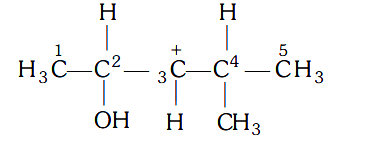 JEE Advanced 2009 Hard
 - The total number of chiral molecules formed from one molecule of on complete ozonolysis is _____
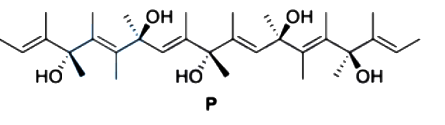 JEE Advanced 2022 Easy
 - A reversible cyclic process for an ideal gas is shown below. Here, are pressure, volume and temperature, respectively. The thermodynamic parameters are heat, work, enthalpy and internal energy, respectively.
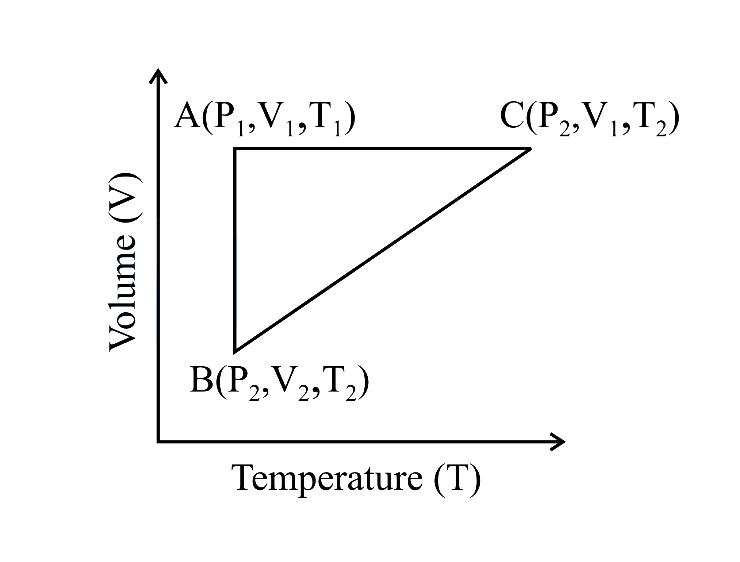
The correct option(s) is (are)JEE Advanced 2018 Medium - A sample \((5.6 \mathrm{~g})\) containing iron is completely dissolved in cold dilute \(\mathrm{HCl}\) to prepare a \(250 \mathrm{~mL}\) of solution. Titration of \(25.0 \mathrm{~mL}\) of this solution requires \(12.5 \mathrm{~mL}\) of \(0.03 \mathrm{M} \mathrm{KMnO}_{4}\) solution to reach the end point. Number of moles of \(\mathrm{Fe}^{2+}\) present in \(250 \mathrm{~mL}\) solution is \(\mathbf{x} \times 10^{-2}\) (consider complete dissolution of \(\mathrm{FeCl}_{2}\) ). The amount of iron present in the sample is \(\mathbf{y} \%\) by weight.
(Assume: \(\mathrm{KMnO}_{4}\) reacts only with \(\mathrm{Fe}^{2+}\) in the solution Use: Molar mass of iron as \(56 \mathrm{~g} \mathrm{~mol}^{-1}\) )
The value of is________ .JEE Advanced 2021 Medium - Paragraph:
Carbon-14 is used to determine the age of organic material. The procedure is based on the formation of \({ }^{14} \mathrm{C}\) by neutron capture in the upper atmosphere.
\(
{ }_7^{14} \mathrm{~N}+{ }_0^1 n \longrightarrow{ }_6^{14} \mathrm{C}+{ }_1 n^1
\)
\({ }^{14} \mathrm{C}\) is absorbed by living organisms during photosynthesis. The \({ }^{14} \mathrm{C}\) content is constant in living organism once the plant or animal dies, the uptake of carbon dioxide by it ceases and the level of \({ }^{14} \mathrm{C}\) in the dead being, falls to the decay which \({ }^{14} \mathrm{C}\) undergoes.
\(
{ }_6^{14} \mathrm{C} \longrightarrow{ }_7^{14} \mathrm{~N}+\beta^{-}
\)
The half life period of \({ }^{14} \mathrm{C}\) is 5770 years. The decay constant \((\lambda)\) can be calculated by using the following formula \(\lambda=\frac{0.693}{t_{1 / 2}}\).
The comparison of the \(\beta^{-}\)activity of the dead matter with that of the carbon still in circulation enables measurement of the period of the isolation of the material from the living cycle. The method however, ceases to be accurate over periods longer than 30,000 years. The proportion of \({ }^{14} \mathrm{C}\) to \({ }^{12} \mathrm{C}\) in living matter is \(1: 10^{12}\).
Question:
A nuclear explosion has taken place leading to increase in concentration of \(C^{14}\) in nearby areas. \(\mathrm{C}^{14}\) concentration is \(C_1\) in nearby areas and \(C_2\) in areas far away. If the age of the fossil is determined to be \(T_1\) and \(T_2\) at the places respectively thenJEE Advanced 2006 Hard
More PYQs from JEE Advanced
- A ball is thrown from the location \(\left(x_0, y_0\right)=(0,0)\) of a horizontal playground with an initial speed \(v_0\) at an angle \(\theta_0\) from the \(+x\)-direction. The ball is to be hit by a stone, which is thrown at the same time from the location \(\left(x_1, y_1\right)=(L, 0)\). The stone is thrown at an angle \(\left(180-\theta_1\right)\) from the \(+x\)-direction with a suitable initial speed. For a fixed \(v_0\), when \(\left(\theta_0, \theta_1\right)=\left(45^{\circ}, 45^{\circ}\right)\), the stone hits the ball after time \(T_1\), and when \(\left(\theta_0, \theta_1\right)=\left(60^{\circ}, 30^{\circ}\right)\), it hits the ball after time \(T_2\). In such a case, \(\left(T_1 / T_2\right)^2\) is _______ .JEE Advanced 2024 Hard
- KI in acetone, undergoes SN2 reaction with each of P, Q, R and S. The rates of the reaction vary as
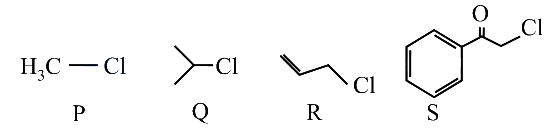 JEE Advanced 2013 Medium
 - At time \(t=0\), a battery of \(10 \mathrm{~V}\) is connected across points \(A\) and \(B\) in the given circuit. If the capacitors have no charge initially, at what time (in second) does the voltage across them become \(4 \mathrm{~V}\) ?
[Take \(: \ln 5=1.6, \ln 3=1.1]\)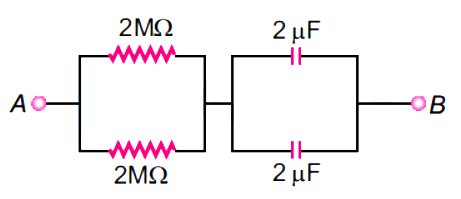 JEE Advanced 2010 Medium
 - One mole of a monatomic ideal gas is taken through a cycle \(A B C D A\) as shown in the \(p\)-V diagram. Column II gives the characteristics involved in the cycle. Match them with each of the processes given in Column I.
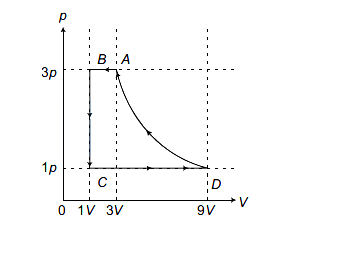
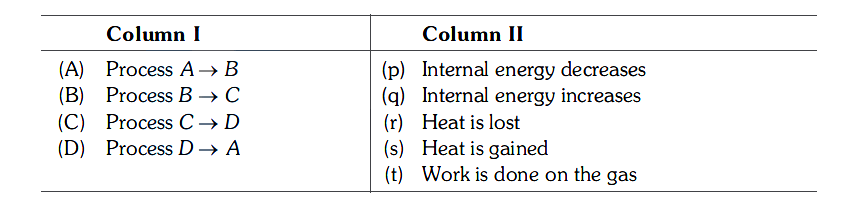 JEE Advanced 2011 Medium
 - Let denote the base of the natural logarithm. The value of the real number for which the right-hand limit is equal to a non-zero real number, isJEE Advanced 2020 Medium
- The straight line \(2 x-3 y=1\) divides the circular region \(x^2+y^2 \leq 6\) into two parts. If \(S=\left\{\left(2, \frac{3}{4}\right),\left(\frac{5}{2}, \frac{3}{4}\right),\left(\frac{1}{4},-\frac{1}{4}\right),\left(\frac{1}{8}, \frac{1}{4}\right)\right\}\), then the number of point(s) in \(S\) lying inside the smaller part isJEE Advanced 2011 Medium