


JEE Advanced · Chemistry · 6. Thermodynamics (C)
A reversible cyclic process for an ideal gas is shown below. Here, are pressure, volume and temperature, respectively. The thermodynamic parameters are heat, work, enthalpy and internal energy, respectively.
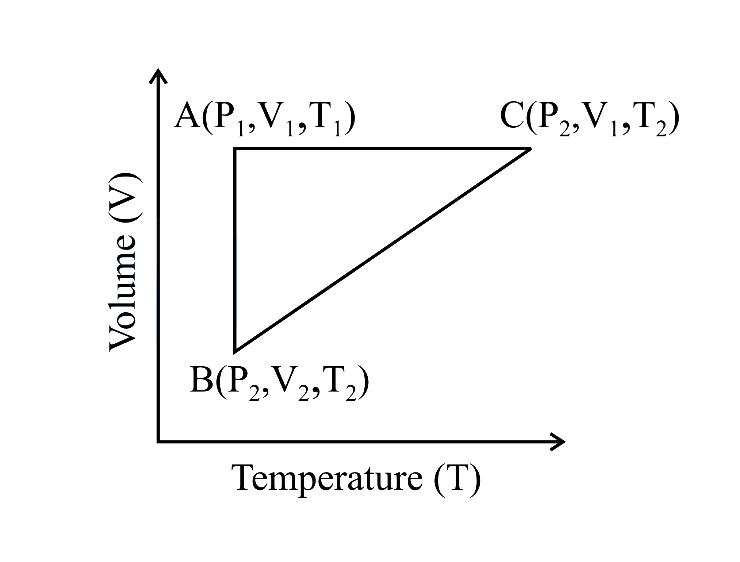
The correct option(s) is (are)
- A
- B
- C
- D
Answer & Solution
Correct Answer
(D)
Step-by-step Solution
Detailed explanation
AC → Isochoric
AB → Isothermal
BC → Isobaric
A (wrong)
B (correct)
C (correct)
(wrong)
AB → Isothermal
BC → Isobaric
A (wrong)
B (correct)
C (correct)
(wrong)
See the Complete Solution
Get step-by-step explanations for this and 2.5 Lakh+ more JEE, NEET & CET questions.
- Unlock all solutions
- Practice the full chapter
- Track accuracy across PYQs
4.8 rated on Google Play · 14,000+ reviews
More questions from Chemistry
- Paragraph I: An organic compound \(\mathbf{P}\) with molecular formula \(\mathrm{C}_9 \mathrm{H}_{18} \mathrm{O}_2\) decolorizes bromine water and also shows positive iodoform test. \(\mathbf{P}\) on ozonolysis followed by treatment with \(\mathrm{H}_2 \mathrm{O}_2\) gives \(\mathbf{Q}\) and \(\mathbf{R}\). While compound \(\mathbf{Q}\) shows positive iodoform test, compound \(\mathbf{R}\) does not give positive iodoform test. \(\mathbf{Q}\) and \(\mathbf{R}\) on oxidation with pyridinium chlorochromate (PCC) followed by heating give \(\mathbf{S}\) and \(\mathbf{T}\), respectively. Both \(\mathbf{S}\) and \(\mathbf{T}\) show positive iodoform test.
Complete copolymerization of 500 moles of \(\mathbf{Q}\) and 500 moles of \(\mathbf{R}\) gives one mole of a single acyclic copolymer \(\mathbf{U}\).
[Given, atomic mass: \(\mathrm{H}=1, \mathrm{C}=12, \mathrm{O}=16\)]
Question: Sum of number of oxygen atoms in \(\mathbf{S}\) and \(\mathbf{T}\) isJEE Advanced 2024 Medium - Paragraph:
The noble gases have closed-shell electronic configuration and are monoatomic gases under normal conditions. The low boiling points of the lighter noble gases are due to weak dispersion forces between the atoms and the absence of other interatomic interactions.
The direct reaction of xenon with fluorine leads to a series of compounds with oxidation numbers \(+2,+4\) and \(+6 . \mathrm{XeF}_4\) reacts violently with water to give \(\mathrm{XeO}_3\). The compounds of xenon exhibit rich stereochemistry and their geometries can be deduced considering the total number of electron pairs in the valence shell.
Question:
\(\mathrm{XeF}_4\) and \(\mathrm{XeF}_6\) are expected to beJEE Advanced 2007 Medium - Paragraph:
The noble gases have closed-shell electronic configuration and are monoatomic gases under normal conditions. The low boiling points of the lighter noble gases are due to weak dispersion forces between the atoms and the absence of other interatomic interactions.
The direct reaction of xenon with fluorine leads to a series of compounds with oxidation numbers \(+2,+4\) and \(+6 . \mathrm{XeF}_4\) reacts violently with water to give \(\mathrm{XeO}_3\). The compounds of xenon exhibit rich stereochemistry and their geometries can be deduced considering the total number of electron pairs in the valence shell.
Question:
Argon is used in are welding because of itsJEE Advanced 2007 Medium - The given graphs/data I, II, III and IV represent general trends observed for different physisorption and chemisorption processes under mild conditions of temperature and presure. Which of the following
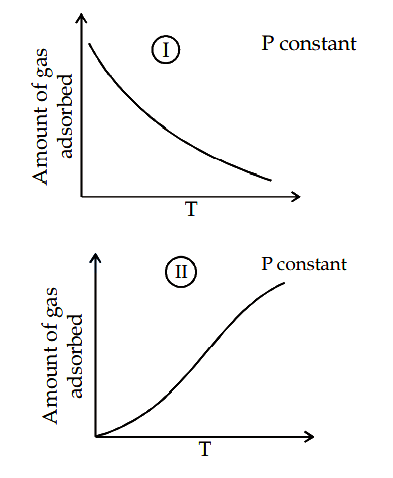
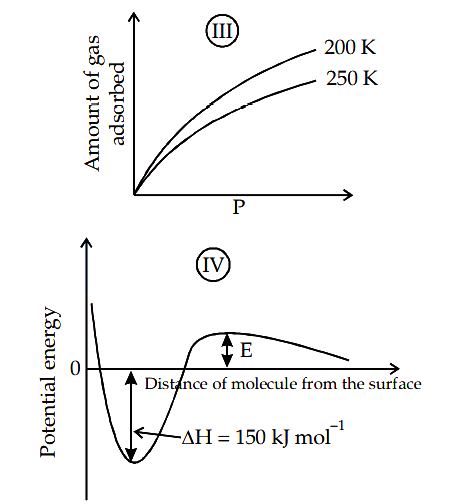 JEE Advanced 2012 Easy
 - Paragraph:
Tollen's reagent is used for the detection of aldehyde when a solution of \(\mathrm{AgNO}_3\) is added to glucose with \(\mathrm{NH}_4 \mathrm{OH}\) then gluconic acid is formed
\(\mathrm{Ag}^{+}+e^{-} \rightarrow \mathrm{Ag} E_{\text {red }}^{\circ}=0.8 \mathrm{~V} \)
\( \mathrm{C}_6 \mathrm{H}_{12} \mathrm{O}_6+\mathrm{H}_2 \mathrm{O} \rightarrow \text { Gluconic acid }\left(\mathrm{C}_6 \mathrm{H}_{12} \mathrm{O}_7\right)\) \(+~2 \mathrm{H}^{+}+2 e^{-} ; -E_{\mathrm{red}}^{\circ}=-0.05 \mathrm{~V} \)
\( \mathrm{Ag}\left(\mathrm{NH}_3\right)_2^{+}+e^{-} \rightarrow \mathrm{Ag}(s)+2 \mathrm{NH}_3 ; E_{\mathrm{red}}^{\circ}\) \(=0.337 \mathrm{~V}\)
[Use \(2.303 \times \frac{R T}{F}=0.0592\) and \(\frac{F}{R T}=38.92\) at \(298 \mathrm{~K}\)]
Question:
\(2 \mathrm{Ag}^{+}+\mathrm{C}_6 \mathrm{H}_{12} \mathrm{O}_6+\mathrm{H}_2 \mathrm{O} \rightarrow 2 \mathrm{Ag}(\mathrm{s})\) \(+~\mathrm{C}_6 \mathrm{H}_{12} \mathrm{O}_4+2 \mathrm{H}^{+}\). Find \(\ln \mathrm{K}\) of this reaction.JEE Advanced 2006 Medium - Paragraph:
Properties such as boiling point, freezing point and vapour pressure of a pure solvent change when solute molecules are added to get homogeneous solution. These are called colligative properties. Applications of colligative properties are very useful in day-to-day life. One of its examples is the use of ethylene glycol and water mixture as anti-freezing liquid in the radiator automobiles.
A solution \(M\) is prepared by mixing ethanol and water. The mole fraction of ethanol in the mixtrue is \(0.9\)
Given Freezing point depression constant of water \(\left(k^{\text {water }}\right)=1.86 \mathrm{~K} \mathrm{~kg} \mathrm{~mol}^{-1}\)
Freezing point depression constant of ethanol \(\left(k_f^{\text {ethanol }}\right)=2.0 \mathrm{Kkg} \mathrm{mol}^{-1}\)
Boiling point elevation constant of water \(\left(k_b^{\text {water }}\right)=0.52 \mathrm{Kkg} \mathrm{mol}^{-1}\)
Boiling point elevation constant of ethanol \(\left(k_b^{\text {ethanol }}\right)=1.2 \mathrm{Kkg} \mathrm{mol}^{-1}\)
Standard freezing point of water \(=273 \mathrm{~K}\)
Standard freezing point of ethanol \(=155.7 \mathrm{~K}\)
Standard boiling point of water \(=373 \mathrm{~K}\)
Standard boiling point of ethanol \(=351.5 \mathrm{~K}\)
Vapour pressure of pure water \(=328 \mathrm{~mm}\) of \(\mathrm{Hg}\)
Vapour pressure of pure ethanol \(=40 \mathrm{~mm}\) of \(\mathrm{Hg}\)
Molecular weight of water \(=18 \mathrm{~g} \mathrm{~mol}^{-1}\)
Molecular weight of ethanol \(=46 \mathrm{~g} \mathrm{~mol}^{-1}\)
In answering the following questions, consider the solutions to be ideal dilute solutions and solutes to be non-volatile and non-dissociative.
Question:
Water is added to the solution \(M\) such that the mole fraction of water in the solution becomes \(0.9\) The boiling point of this solutions isJEE Advanced 2008 Medium
More PYQs from JEE Advanced
- A cylindrical furnace has height and diameter both . It is maintained at temperature . The air getsheated inside the furnace at constant pressureand its temperature becomes . The hot air with density rises up a vertical chimney of diameter and height above the furnace and exits the chimney (seethe figure). As a result, atmospheric air of density,pressure and temperature entersthe furnace. Assume air as an ideal gas, neglect the variations inand inside the chimney and the furnace. Also ignore the viscous effects.
[Given: The acceleration due to gravityand]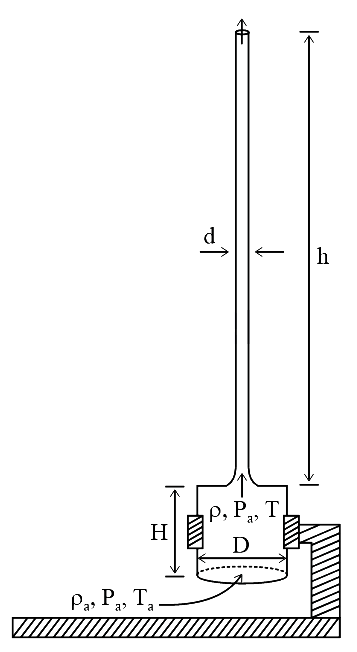
When the chimney is closed using a cap at the top, a pressure difference develops between the top and the bottom surfaces of the cap. If the changes in the temperature and density of the hot air, due to the stoppage of air flow, are negligible then the value of is _____ .JEE Advanced 2023 Medium - Consider the following four compounds I, II, III, and IV.
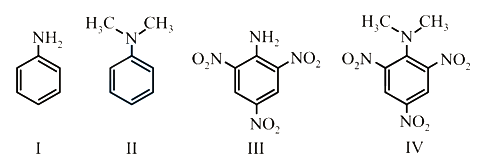
Choose the correct statement(s).JEE Advanced 2020 Medium - Which of the following inequalities is/are TRUE?JEE Advanced 2020 Hard
- is reduced to by usingJEE Advanced 2015 Easy
- Statement 1 Bromobenzene, upon reaction with \(\mathrm{Br}_2 / \mathrm{Fe}\) gives 1, 4-dibromobenzene as the major product.
Statement 2 In bromobenzene, the inductive effect of the bromo group is more dominant than the mesomeric effect in directing the incoming electrophile.JEE Advanced 2008 Medium - The dilution processes of different aqueous solutions with water are given in LIST-I. The effects of dilution of the solutions on are given in LIST-II.
(Note: The degree of dissociation of a weak acid and a weak base is the degree of hydrolysis of salt is represents the concentration of ions)List - I List - II A) 10 mL of \(0.1\text{ M NaOH} +20\text{ mL}\) of 0.1 M acetic acid diluted to 60 mL . P) The value of \(\left[\text H ^{+}\right]\)does not change on dilution. B) 20 mL of \(0.1\text{ M NaOH} +20\text{ mL}\) of 0.1 M acetic acid diluted to 80 mL . Q) The value of \(\left[\text H ^{+}\right]\)changes to half of its initial value on dilution. C) 20 mL of \(0.1\text{ M HCl} +20\text{ mL}\) of 0.1 M ammonia solution diluted to 80 mL . R) The value of \(\left[\text H ^{+}\right]\)changes to two times its initial value on dilution. D) 10 mL saturated solution of \(\text{Ni} (\text{OH})_2\) in equilibrium with excess of solid \(\text{Ni} (\text{OH})_2\) is diluted to 20 mL (solid \(\text{Ni} (\text{OH})_2\) is still present after dilution). S) The value of \(\left[\text H ^{+}\right]\)changes to \(\sqrt{ }\) times its initial value on dilution. T) The value of \(\left[\text H ^{+}\right]\)changes to \(\sqrt{2}\) times its initial value on dilution.
Match each process given in LIST-I with one or more effect(s) in LIST-II. The correct option isJEE Advanced 2018 Hard