


JEE Advanced · Chemistry · 18. Chemical Kinetics
Paragraph:
Carbon-14 is used to determine the age of organic material. The procedure is based on the formation of \({ }^{14} \mathrm{C}\) by neutron capture in the upper atmosphere.
\(
{ }_7^{14} \mathrm{~N}+{ }_0^1 n \longrightarrow{ }_6^{14} \mathrm{C}+{ }_1 n^1
\)
\({ }^{14} \mathrm{C}\) is absorbed by living organisms during photosynthesis. The \({ }^{14} \mathrm{C}\) content is constant in living organism once the plant or animal dies, the uptake of carbon dioxide by it ceases and the level of \({ }^{14} \mathrm{C}\) in the dead being, falls to the decay which \({ }^{14} \mathrm{C}\) undergoes.
\(
{ }_6^{14} \mathrm{C} \longrightarrow{ }_7^{14} \mathrm{~N}+\beta^{-}
\)
The half life period of \({ }^{14} \mathrm{C}\) is 5770 years. The decay constant \((\lambda)\) can be calculated by using the following formula \(\lambda=\frac{0.693}{t_{1 / 2}}\).
The comparison of the \(\beta^{-}\)activity of the dead matter with that of the carbon still in circulation enables measurement of the period of the isolation of the material from the living cycle. The method however, ceases to be accurate over periods longer than 30,000 years. The proportion of \({ }^{14} \mathrm{C}\) to \({ }^{12} \mathrm{C}\) in living matter is \(1: 10^{12}\).
Question:
A nuclear explosion has taken place leading to increase in concentration of \(C^{14}\) in nearby areas. \(\mathrm{C}^{14}\) concentration is \(C_1\) in nearby areas and \(C_2\) in areas far away. If the age of the fossil is determined to be \(T_1\) and \(T_2\) at the places respectively then
- A The age of the fossil will increase at the place where explosion has taken and
\(
T_1-T_2=\frac{1}{\lambda} \ln \frac{C_1}{C_2}
\) - B The age of the fossil will decrease at the place where explosion has taken place and \(T_1-T_2=\frac{1}{\lambda} \ln \frac{C_1}{C_2}\)
- C The age of fossil will be determined to be same
- D \(\frac{T_1}{T_2}=\frac{C_1}{C_2}\)
Answer & Solution
Correct Answer
(A) The age of the fossil will increase at the place where explosion has taken and
\(
T_1-T_2=\frac{1}{\lambda} \ln \frac{C_1}{C_2}
\)
Step-by-step Solution
Detailed explanation
All radioactive decays are the examples of first order kinetics.
So, decay constant \(\lambda=\frac{1}{T_1-T_2} \ln \frac{C_1}{C_2}\)
\(C_1\) is the concentration at \(T_1\) time
\(C_2\) is the concentration at \(T_2\) time
So, \(\quad T_1-T_2=\frac{1}{\lambda} \ln \frac{C_1}{C_2}\)
So, decay constant \(\lambda=\frac{1}{T_1-T_2} \ln \frac{C_1}{C_2}\)
\(C_1\) is the concentration at \(T_1\) time
\(C_2\) is the concentration at \(T_2\) time
So, \(\quad T_1-T_2=\frac{1}{\lambda} \ln \frac{C_1}{C_2}\)
See the Complete Solution
Get step-by-step explanations for this and 2.5 Lakh+ more JEE, NEET & CET questions.
- Unlock all solutions
- Practice the full chapter
- Track accuracy across PYQs
4.8 rated on Google Play · 14,000+ reviews
More questions from Chemistry
- The correct statement related to colloids is(are)JEE Advanced 2021 Easy
- A trinitro compound, -tris-(-nitrophenyl) benzene, on complete reaction with an excess of gives a major product, which on treatment with an excess of at provides as the product. , upon treatment with excess of at room temperature, gives the product . Bromination of in aqueous medium furnishes the product . The compound upon treatment with an excess of phenol under basic conditions gives the product . The molar mass difference between compounds and is and between compounds and is .
The number of heteroatoms present in one molecule of \(R\) is [Use: Molar mass (in \(\text{g mol} -1\) ): \(H =1,\) \(C =12, N=14, O =16,\) \(Br =80, Cl =35.5\) Atoms other than C and H are considered as heteroatoms]JEE Advanced 2023 Medium - Consider a efficient hydrogen-oxygen fuel cell working under standard conditions at bar and . Its cell reaction is The work derived from the cell on the consumption of of is used to compress of a monoatomic ideal gas in a thermally insulated container. What is the change in the temperature (in ) of the ideal gas? The standard reduction potentials for the two half-cells are given below. \(O _2(g)+4 H ^{+}( aq )+4 e ^{-} \rightarrow 2 H _2 O ( l ),\) \(E ^0=1.23 V\) Use .JEE Advanced 2020 Hard
- The number of aldol reaction(s) that occurs in the given transformation is :
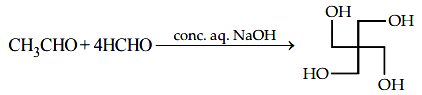 JEE Advanced 2012 Medium
 - A mixture of two salts is used to prepare a solution

The correct option (s) for the salt mixture is(are)JEE Advanced 2021 Medium - For 'invert sugar', the correct statement(s) is (are)
(Given: specific rotations of sucrose, maltose, glucose and fructose in aqueous solution are and , respectively)JEE Advanced 2016 Easy
More PYQs from JEE Advanced
- Paragraph :
A spray gun is shown in the figure where a piston pushes air out of a nozzle. A thin tube of uniform cross section is connected to the nozzle. The other end of the tube is in a small liquid container. As the piston pushes air through the nozzle, the liquid from the container rises into the nozzle and is sprayed out. For the spray gun shown, the radii of the piston and the nozzle are \(20 \mathrm{~mm}\) and \(1 \mathrm{~mm}\), respectively. The upper end of the container is open to the atmosphere.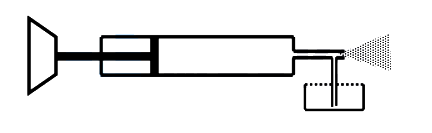
Question :
If the density of air is \(\rho_{a}\) and that of the liquid \(\rho_{\ell}\), then for a given piston speed the rate (volume per unit time) at which the liquid is sprayed will be proportional toJEE Advanced 2014 Easy - Let P be the point on the parabola which is at the shortest distance from the center S of the circle Let Q be the point on the circle dividing the line segment SP internally. Then -JEE Advanced 2016 Medium
- Paragraph: When potassium iodide is added to an aqueous solution of potassium ferricyanide, a reversible reaction is observed in which a complex \(\mathrm{P}\) is formed. In a strong acidic medium, the equilibrium shifts completely towards \(\mathrm{P}\). Addition of zinc chloride to \(\mathrm{P}\) in a slightly acidic medium results in a sparingly soluble complex Q.
Question: The number of moles of potassium iodide required to produce two moles of \(\mathbf{P}\) isJEE Advanced 2024 Medium - A person sitting inside an elevator performs a weighing experiment with an object of mass 50 kg . Suppose that the variation of the height \(y\) (in m ) of the elevator, from the ground, with time \(t\) (in s ) is given by \(y=8\left[1+\sin \left(\frac{2 \pi t}{T}\right)\right]\), where \(T=40 \pi \mathrm{~s}\). Taking acceleration due to gravity, \(g=10 \mathrm{~m} / \mathrm{s}^2\), the maximum variation of the object's weight (in N ) as observed in the experiment is _______ .JEE Advanced 2025 Medium
- Two soap bubbles \(A\) and \(B\) are kept in a closed chamber where the air is maintained at pressure \(8 \mathrm{Nm}^{-2}\). The radii of bubbles \(A\) and \(B\) are \(2 \mathrm{~cm}\), respectively. Surface tension of the soap-water used to make bubbles is \(0.04\) \(\mathrm{Nm}^{-1}\). Find the ratio \(\frac{n_B}{n_A}\), where \(n_A\) and \(n_B\) are the number of moles of air in bubbles \(A\) and \(B\), respectively. [Neglect the effect of gravity]JEE Advanced 2009 Hard
- A parallel plate capacitor \(C\) with plates of unit area and separation \(d\) is filled with a liquid of dielectric constant \(K=2\). The level of liquid is \(\frac{d}{3}\) initially. Suppose the liquid level decreases at a constant speed \(v\), the time constant as a function of time \(t\) is
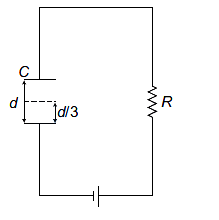 JEE Advanced 2008 Hard