


JEE Advanced · Physics · 13. Thermodynamics
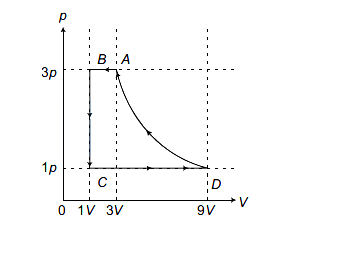
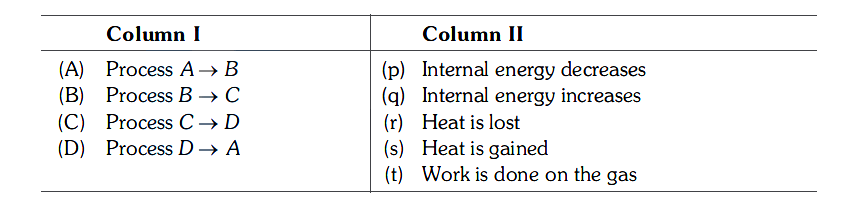
One mole of a monatomic ideal gas is taken through a cycle \(A B C D A\) as shown in the \(p\)-V diagram. Column II gives the characteristics involved in the cycle. Match them with each of the processes given in Column I.
- A (A) p,q,r,t, (B) q,r, (C) q,s, (D) r
- B (A) p,q,t, (B) p,r, (C) q,r, (D) s
- C (A) p,s, (B) q,r, (C) q,s, (D) r
- D (A) p,q,r,t, (B) p,q,r, (C) q,r, (D) s
Answer & Solution
Correct Answer
(B) (A) p,q,t, (B) p,r, (C) q,r, (D) s
Step-by-step Solution
Detailed explanation
Internal energy \(\propto T \propto p V\)
This is because
\(
U=\frac{n f}{2} R T=\frac{f}{2} p V
\)
Here, \(n=\) number of moles
\(f=\) degree of freedom
If the product \(p V\) increases, then internal energy will increase and if product decreases, the internal energy will decrease.
Further, work is done on the gas, if volume of gas decreases. For heat exchange.
\(
Q=W+\Delta U
\)
Work done is area under \(p-V\) graph. If volume increases work done by gas is positive and if volume decreases work done by gas is negative. Further \(\Delta U\) is positive if product of \(p V\) is increasing and \(N U\) is negative, if product of \(p V\) is decreasing. If heat is taken by the gas \(Q\) is positive and if heat is lost by the gas \(Q\) is negative.
Keeping the above points in mind the answer to this question is as under.
(A) \(\rightarrow(\mathrm{p}, \mathrm{r}, \mathrm{t})\)
(B) \(\rightarrow(\mathrm{p}, \mathrm{r})\)
(C) \(\rightarrow\) (q, s)
(D) \(\rightarrow(\mathrm{r}, \mathrm{t})\)
Analysis of Question
(i) Calculation wise, question is slightly lengthy. Otherwise question is theory based and simple.
(ii) In process \(D A\),
\(\begin{array}{rlrl} & & p_A V_A & =p_D V_D \\ \therefore & & T_A & =T_D \\ \text { or } & \Delta U & =0\end{array}\)
Further, volume of gas is decreasing. Therefore, work is done on the gas or work done by gas is negative. Therefore, \(Q\) is negative or heat is lost.
(iii) This question covers almost all the concepts of first law of thermodynamics.
This is because
\(
U=\frac{n f}{2} R T=\frac{f}{2} p V
\)
Here, \(n=\) number of moles
\(f=\) degree of freedom
If the product \(p V\) increases, then internal energy will increase and if product decreases, the internal energy will decrease.
Further, work is done on the gas, if volume of gas decreases. For heat exchange.
\(
Q=W+\Delta U
\)
Work done is area under \(p-V\) graph. If volume increases work done by gas is positive and if volume decreases work done by gas is negative. Further \(\Delta U\) is positive if product of \(p V\) is increasing and \(N U\) is negative, if product of \(p V\) is decreasing. If heat is taken by the gas \(Q\) is positive and if heat is lost by the gas \(Q\) is negative.
Keeping the above points in mind the answer to this question is as under.
(A) \(\rightarrow(\mathrm{p}, \mathrm{r}, \mathrm{t})\)
(B) \(\rightarrow(\mathrm{p}, \mathrm{r})\)
(C) \(\rightarrow\) (q, s)
(D) \(\rightarrow(\mathrm{r}, \mathrm{t})\)
Analysis of Question
(i) Calculation wise, question is slightly lengthy. Otherwise question is theory based and simple.
(ii) In process \(D A\),
\(\begin{array}{rlrl} & & p_A V_A & =p_D V_D \\ \therefore & & T_A & =T_D \\ \text { or } & \Delta U & =0\end{array}\)
Further, volume of gas is decreasing. Therefore, work is done on the gas or work done by gas is negative. Therefore, \(Q\) is negative or heat is lost.
(iii) This question covers almost all the concepts of first law of thermodynamics.
See the Complete Solution
Get step-by-step explanations for this and 2.5 Lakh+ more JEE, NEET & CET questions.
- Unlock all solutions
- Practice the full chapter
- Track accuracy across PYQs
4.8 rated on Google Play · 14,000+ reviews
More questions from Physics
- A nuclear power plant supplying electrical power to a village uses a radioactive material of half life years as the fuel. The amount of fuel at the beginning is such that the total power requirement of the village is 12.5% of the electrical power available from the plant at that time. If the plant is able to meet the total power needs of the village for a maximum period of years, then the value of isJEE Advanced 2015 Easy
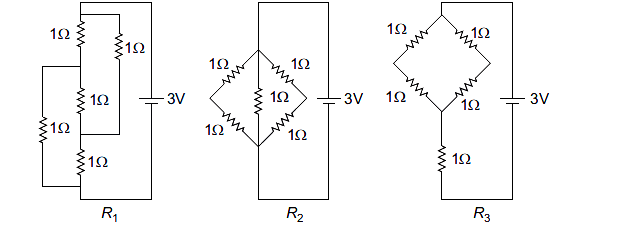
- Figure shows three resistor configurations \(R_1, R_2\) and \(R_3\) connected to \(3 \mathrm{~V}\) battery. If the power dissipated by the configuration \(R_1, R_2\) and \(R_3\) is \(P_1, P_2\) and \(P_3\), respectively, then
 JEE Advanced 2008 Easy
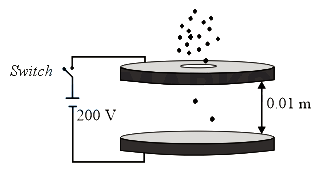
 - Two large circular discs separated by a distance of are connected to a battery via a switch as shown in the figure. Charged oil drops of density are released through a tiny hole at the centre of the top disc. Once some oil drops achieve terminal velocity, the switch is closed to apply a voltage of across the discs. As a result, an oil drop of radius stops moving vertically and floats between the discs. The number of electrons present in this oil drop is __________. (neglect the buoyancy force, take acceleration due to gravity and charge on an electron (e) )
 JEE Advanced 2020 Easy
 - Two capacitors with capacitance values and are connected in series. The voltage applied across this combination is . The percentage error in the calculation of the energy stored in this combination of capacitors is __________.JEE Advanced 2020 Medium
- The work done on a particle of mass m by a force (K being a constant of appropriate dimensions, when the particle is taken from the point (a,0) to the point (0,a) along a circular path of radius a about the origin in the x-y plane isJEE Advanced 2013 Medium
- Statement 1 For an observer looking out through the window of a fast moving train, the nearby objects appear to move in the opposite direction to the train, while the distant objects appear to be stationary.
and Statement 2 If the observer and the object are moving at velocities \(\overrightarrow{\mathbf{v}}_{\mathbf{1}}\) and \(\overrightarrow{\mathbf{v}_2}\) respectively with reference to a laboratory frame, the velocity of the object with respect to the observer is \(\overrightarrow{\mathbf{v}_2}-\overrightarrow{\mathbf{v}_1}\).JEE Advanced 2008 Easy
More PYQs from JEE Advanced
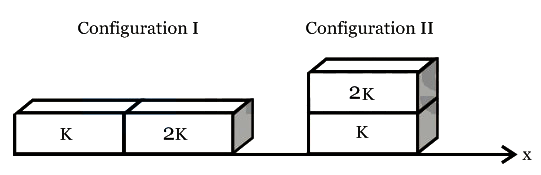
- Two rectangular blocks, having identical dimensions, can be arranged either in configuration or in configuration as shown in the figure. One of the blocks has thermal conductivity and the other . The temperature difference between the ends along the x-axis is the same in both the configurations. It takes to transport a certain amount of heat from the hot end to cold end in the configuration . The time to transport the same amount of heat in the configuration is
 JEE Advanced 2013 Medium
 - A straight line drawn from the point \(P(1,3,2)\), parallel to the line \(\frac{x-2}{1}=\frac{y-4}{2}=\frac{z-6}{1}\), intersects the plane \(L_1: x-y+3 z=6\) at the point \(Q\). Another straight line which passes through \(Q\) and is perpendicular to the plane \(L_1\) intersects the plane \(L_2: 2 x-y+z=-4\) at the point \(R\). Then which of the following statements is (are) TRUE?JEE Advanced 2024 Medium
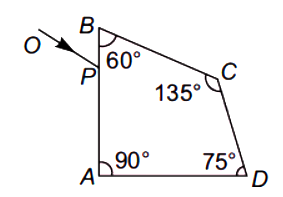
- A ray \(O P\) of monochromatic light is incident on the face \(A B\) of prism \(A B C D\) near vertex \(B\) at an incident angle of \(60^{\circ}\) (see figure). If the refractive index of the material of the prism is \(\sqrt{3}\), which of the following is (are) correct?
 JEE Advanced 2010 Easy
 - The edge length of unit cell of a metal having molecular weight \(75 \mathrm{~g} / \mathrm{mol}\) is 5 Å which crystallizes in cubic lattice. If the density is \(2 \mathrm{~g} / \mathrm{cc}\) then find the radius of metal atom, \(\left(N_A=6 \times 10^{23}\right)\). Give the answer in pm.JEE Advanced 2006 Easy
- Among the following, intensive property is (properties are)JEE Advanced 2010 Medium
- Paragraph:
Copper is the most noble of the first row transition metals and occurs in small deposits in several countries. Ores of copper include chalcanthite \(\left(\mathrm{CuSO}_4 \cdot 5 \mathrm{H}_2 \mathrm{O}\right)\), atacamite \(\left(\mathrm{Cu}_2 \mathrm{Cl}(\mathrm{OH})_3\right)\), cuprite \(\left(\mathrm{Cu}_2 \mathrm{O}\right)\), copper glance \(\left(\mathrm{Cu}_2 \mathrm{~S}\right)\) and malachite \(\left(\mathrm{Cu}_2(\mathrm{OH})_2 \mathrm{CO}_3\right)\). However, 80\% of the world copper production comes from the ore chalcopyrite \(\left(\mathrm{CuFeS}_2\right)\). The extraction of copper from chalcopyrite involves partial roasting, removal of iron and self-reduction.
Question:
In self-reduction, the reducing species isJEE Advanced 2010 Medium