


JEE Advanced · Chemistry · 21. p Block (G15-18)
Paragraph:
The reaction of \(\mathrm{K}_{3}\left[\mathrm{Fe}(\mathrm{CN})_{6}\right]\) with freshly prepared \(\mathrm{FeSO}_{4}\) solution produces a dark blue precipitate called Turnbull's blue. Reaction of \(\mathrm{K}_{4}\left[\mathrm{Fe}(\mathrm{CN})_{6}\right]\) with the \(\mathrm{FeSO}_{4}\) solution in complete absence of air produces a white precipitate \(\mathbf{X}\), which turns blue in air. Mixing the \(\mathrm{FeSO}_{4}\) solution with \(\mathrm{NaNO}_{3}\), followed by a slow addition of concentrated \(\mathrm{H}_{2} \mathrm{SO}_{4}\) through the side of the test tube produces a brown ring.
Question:
Among the following, the brown ring is due to the formation of
- A
- B
- C
- D
Answer & Solution
Correct Answer
(D)
Step-by-step Solution
Detailed explanation
\(3 Fe ^{2+}+ NO _3^{-}+4 H ^{+} \rightarrow NO +3 Fe ^{3+}~+\) \(2 H _2 O\)
\(\left[ Fe \left( H _2 O \right)_6\right]^{2+}+ NO \rightarrow \underset{\text { Brown ring }}{\left[ Fe \left( H _2 O \right)_5 NO \right]^{2+}}\) \(+~ H _2 O\)
\(\left[ Fe \left( H _2 O \right)_6\right]^{2+}+ NO \rightarrow \underset{\text { Brown ring }}{\left[ Fe \left( H _2 O \right)_5 NO \right]^{2+}}\) \(+~ H _2 O\)
See the Complete Solution
Get step-by-step explanations for this and 2.5 Lakh+ more JEE, NEET & CET questions.
- Unlock all solutions
- Practice the full chapter
- Track accuracy across PYQs
4.8 rated on Google Play · 14,000+ reviews
More questions from Chemistry
- When benzene sulphonic acid and \(p\)-nitrophenol are treated with \(\mathrm{NaHCO}_3\), the gases released respectively areJEE Advanced 2006 Hard
- A positron is emitted from \({ }_{11}^{23} \mathrm{Na}\). The ratio of the atomic mass and atomic number of the resulting nuclide isJEE Advanced 2007 Easy
- The compound(s) which generate(s) gas upon thermal decomposition below is (are)JEE Advanced 2018 Medium
- In a neutral or faintly alkaline solution, moles of permanganate anion quantitatively oxidize thiosulphate anions to produce moles of a sulphur containing product. The magnitude of is:JEE Advanced 2016 Medium
- Paragraph:
p-amino-N, N-dimethylaniline is added to a strongly acidic solution of \(X\). The resulting solution is treated with a few drops of aqueous solution of \(Y\) to yield blue colouration due to the formation of methylene blue. Treatment of the aqueous solution of \(Y\) with the reagent potassium hexacyanoferrate(II) leads to the formation of an intense blue precipitate. The precipitate dissolves an excess addition of the reagent. Similarly, treatment of the solution of \(Y\) with the solution of potassium hexacyanoferrate(III) leads to a brown colouration due to the formation of \(Z\).
Question:
The compound \(X\), isJEE Advanced 2009 Medium -

Which is correct statement if \(\mathrm{N}_2\) is added at equilibrium condition?JEE Advanced 2006 Easy
More PYQs from JEE Advanced
- \(\mathrm{Ag}^{+}+\mathrm{NH}_3 \rightleftharpoons\left[\mathrm{Ag}\left(\mathrm{NH}_3\right)\right]^{+} ; k_1=3.5 \times 10^{-3}\) \(\left[\mathrm{Ag}\left(\mathrm{NH}_3\right)\right]^{+}+\mathrm{NH}_3 \rightleftharpoons\left[\mathrm{Ag}\left(\mathrm{NH}_3\right)_2\right]^{+} ; k_2\) \(=1.7 \times 10^{-3}\) then the formation constant of \(\left[\mathrm{Ag}\left(\mathrm{NH}_3\right)_2\right]^{+}\)isJEE Advanced 2006 Medium
- The correct statement(s) regarding the binary transition metal carbonyl compounds is (are) (Atomic numbers: )JEE Advanced 2018 Medium
- The desired product X can be prepared by reacting the major product of the reactions in LIST-I with one or more appropriate reagents in LIST-II.
(given, order of migratory aptitude: aryl > alkyl hydrogen)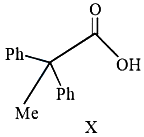
LIST-I LIST -II A) 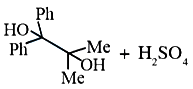
P) B) 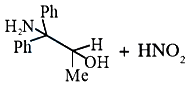
Q) C) 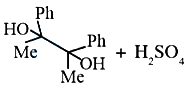
R) Fehling solution D) 
S) T) JEE Advanced 2018 Medium - In allene \(\left(\mathrm{C}_{3} \mathrm{H}_{4}\right)\), the type(s) of hybridisation of the carbon atoms is (are):JEE Advanced 2012 Medium
- Among the electrolytes \(\mathrm{Na}_2 \mathrm{SO}_4, \mathrm{CaCl}_2 \quad \mathrm{Al}_2\left(\mathrm{SO}_4\right)_3\) and \(\mathrm{NH}_4 \mathrm{Cl}\), the most effective coagulating agent for \(\mathrm{Sb}_2 \mathrm{~S}_3\) sol isJEE Advanced 2009 Easy
- Bleaching powder and bleach solution are produced on a large scale and used in several household products. The effectiveness of bleach solution is often measured by iodometry.
Question:
\(25 \mathrm{~mL}\) of household solution was mixed with \(30 \mathrm{~mL}\) of \(0.50\) M KI and \(10 \mathrm{~mL}\) of \(4 \mathrm{~N}\) acetic acid. In the titration of the liberated iodine, \(48 \mathrm{~mL}\) of \(0.25 \mathrm{~N~} \mathrm{Na}_{2} \mathrm{~S}_{2} \mathrm{O}_{3}\) was used to reach the end point. The molarity of the household bleach solution isJEE Advanced 2012 Hard