


JEE Advanced · Chemistry · 2. Atomic Structure
Paragraph:
The hydrogen-like species \(\mathrm{Li}^{2+}\) is in a spherically symmetric state \(S_1\) with one radial node. Upon absorbing light the ion undergoes transition to a state \(S_2\). The state \(S_2\) has one radial node and its energy is equal to the ground state energy of the hydrogen atom.
Question:
Energy of the state \(S_1\) in units of the hydrogen atom ground state energy is
- A \(0.75\)
- B \(1.50\)
- C \(2.25\)
- D \(4.50\)
Answer & Solution
Correct Answer
(C) \(2.25\)
Step-by-step Solution
Detailed explanation
Energy of state, \(S_1=-13.6\left(\frac{3^2}{2^2}\right) \mathrm{eV} /\) atom \(=\frac{9}{4}\) of energy of \(\mathrm{H}\)-atom in ground state \(=2.25\) of energy of \(\mathrm{H}\)-atom in ground state
See the Complete Solution
Get step-by-step explanations for this and 2.5 Lakh+ more JEE, NEET & CET questions.
- Unlock all solutions
- Practice the full chapter
- Track accuracy across PYQs
4.8 rated on Google Play · 14,000+ reviews
More questions from Chemistry
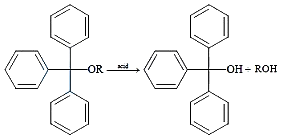
- The acidic hydrolysis of ether (X) shown below is fastest when
 JEE Advanced 2014 Medium
 - Paragraph:
Copper is the most noble of the first row transition metals and occurs in small deposits in several countries. Ores of copper include chalcanthite \(\left(\mathrm{CuSO}_4 \cdot 5 \mathrm{H}_2 \mathrm{O}\right)\), atacamite \(\left(\mathrm{Cu}_2 \mathrm{Cl}(\mathrm{OH})_3\right)\), cuprite \(\left(\mathrm{Cu}_2 \mathrm{O}\right)\), copper glance \(\left(\mathrm{Cu}_2 \mathrm{~S}\right)\) and malachite \(\left(\mathrm{Cu}_2(\mathrm{OH})_2 \mathrm{CO}_3\right)\). However, 80\% of the world copper production comes from the ore chalcopyrite \(\left(\mathrm{CuFeS}_2\right)\). The extraction of copper from chalcopyrite involves partial roasting, removal of iron and self-reduction.
Question:
In self-reduction, the reducing species isJEE Advanced 2010 Medium - The boiling point of water in a \(0.1\) molal silver nitrate solution (solution \(\mathbf{A}\) ) is \(\mathbf{x}^{\circ} \mathrm{C}\). To this solution \(\mathbf{A}\), an equal volume of \(0.1\) molal aqueous barium chloride solution is added to make a new solution B. The difference in the boiling points of water in the two solutions \(\mathbf{A}\) and \(\mathbf{B}\) is \(\mathbf{y} \times 10^{-2}{ }^{\circ} \mathrm{C}\).
(Assume: Densities of the solutions \(\mathbf{A}\) and \(\mathbf{B}\) are the same as that of water and the soluble salts dissociate completely.
Use: Molal elevation constant (Ebullioscopic Constant), \(K_{b}=0.5 \mathrm{~K} \mathrm{~kg} \mathrm{~mol}^{-1}\); Boiling point of pure water as \(100^{\circ} \mathrm{C}\).)
The value of is ___.JEE Advanced 2021 Medium - Aqueous solution of \(\text{Na} _2\text S_2\text O _3\) on reaction with \(\text{Cl} _2\) givesJEE Advanced 2008 Medium
- Considering ideal gas behavior, the expansion work done (in kJ) when 144 g of water is electrolyzed completely under constant pressure at 300 K is _____
Use: Universal gas constant \((\mathrm{R})=8.3 \mathrm{~J} \mathrm{~K}^{-1} \mathrm{~mol}^{-1}\); Atomic mass (in amu): \(\mathrm{H}=1, \mathrm{O}=16\) (mark absolute value as answer)JEE Advanced 2025 Hard - Paragraph:
An aqueous solution of metal ion \(\mathbf{M} 1\) reacts separately with reagents \(\mathbf{Q}\) and \(\mathbf{R}\) in excess to give tetrahedral and square planar complexes, respectively. An aqueous solution of another metal ion M2 always forms tetrahedral complexes with these reagents. Aqueous solution of \(\mathbf{M} 2\) on reaction with reagent \(\mathbf{S}\) gives white precipitate which dissolves in excess of \(\mathbf{S}\). The reactions are summarized in the scheme given below: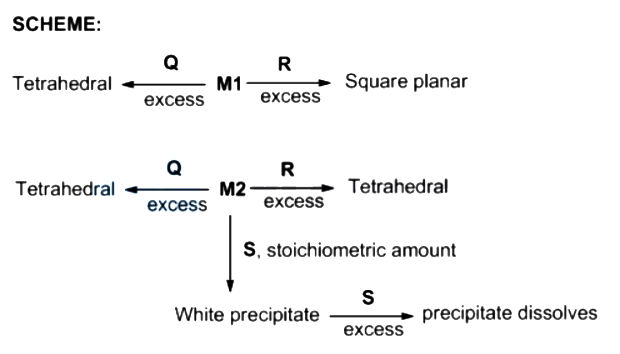
Question:
\(\mathbf{M} 1, \mathbf{Q}\) and \(\mathbf{R}\), respectively areJEE Advanced 2014 Easy
More PYQs from JEE Advanced
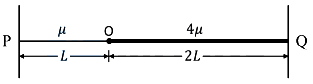
- Two uniform strings of mass per unit length \(\mu\) and \(4 \mu\), and length \(L\) and \(2 L\), respectively, are joined at point \(\mathrm{O}\), and tied at two fixed ends \(\mathrm{P}\) and \(\mathrm{Q}\), as shown in the figure. The strings are under a uniform tension \(T\). If we define the frequency \(v_0=\frac{1}{2 L} \sqrt{\frac{T}{\mu}}\), which of the following statement(s) is(are) correct?
 JEE Advanced 2024 Medium
 - The number of points in , for which , is:JEE Advanced 2013 Hard
- Total number of cis bond angles (that is, and bonds in cis positions) present in a molecule of cis- complex is _________JEE Advanced 2019 Medium
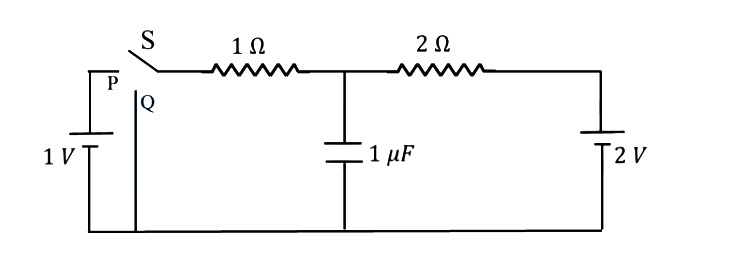
- In the circuit shown below, the switch \(\mathrm{S}\) is connected to position \(\mathrm{P}\) for a long time so that the charge on the capacitor becomes \(q_{1} \mu \mathrm{C}\). Then \(\mathrm{S}\) is switched to position \(\mathrm{Q}\). After a long time, the charge on the capacitor is \(q_{2} \mu \mathrm{C}\).
The magnitude of is _______.JEE Advanced 2021 Medium - Suppose holds for some positive integer Then equalsJEE Advanced 2019 Hard
- Match each of the diatomic molecules in Column I with its property/properties in Column II.
Column I Column II A. \(B _2\) p. Paramagnetic B. \(N_2\) q. Undergoes oxidation C. \(O _2^{-}\) r. Undergoes reduction D. \(O _2\) s. Bond order t. Mixing of 's' and 'p' orbitals JEE Advanced 2009 Medium