


JEE Advanced · Chemistry · 20. Metallurgy
Paragraph:
Copper is the most noble of the first row transition metals and occurs in small deposits in several countries. Ores of copper include chalcanthite \(\left(\mathrm{CuSO}_4 \cdot 5 \mathrm{H}_2 \mathrm{O}\right)\), atacamite \(\left(\mathrm{Cu}_2 \mathrm{Cl}(\mathrm{OH})_3\right)\), cuprite \(\left(\mathrm{Cu}_2 \mathrm{O}\right)\), copper glance \(\left(\mathrm{Cu}_2 \mathrm{~S}\right)\) and malachite \(\left(\mathrm{Cu}_2(\mathrm{OH})_2 \mathrm{CO}_3\right)\). However, 80\% of the world copper production comes from the ore chalcopyrite \(\left(\mathrm{CuFeS}_2\right)\). The extraction of copper from chalcopyrite involves partial roasting, removal of iron and self-reduction.
Question:
In self-reduction, the reducing species is
- A \(\mathrm{S}\)
- B \(\mathrm{O}^{2-}\)
- C \(\mathrm{S}^{2-}\)
- D \(\mathrm{SO}_2\)
Answer & Solution
Correct Answer
(C) \(\mathrm{S}^{2-}\)
Step-by-step Solution
Detailed explanation
\(\mathrm{S}^{2-}\) acts as reducing species \(2 \mathrm{Cu}_2 \mathrm{O}+\mathrm{Cu}_2 \mathrm{~S}^{2-} \longrightarrow 6 \mathrm{Cu}+\mathrm{SO}_2\)
Metallurgy
Conceptual
III, II, II
Metallurgy
Conceptual
III, II, II
See the Complete Solution
Get step-by-step explanations for this and 2.5 Lakh+ more JEE, NEET & CET questions.
- Unlock all solutions
- Practice the full chapter
- Track accuracy across PYQs
4.8 rated on Google Play · 14,000+ reviews
More questions from Chemistry
- A colorless aqueous solution contains nitrates of two metals, and . When it was added to an aqueous solution of , a white precipitate was formed. This precipitate was found to be partly soluble in hot water to give a residue and a solution . The residue was soluble in aq. and also in excess sodium thiosulfate. The hot solution gave a yellow precipitate with . The metals and , respectively, areJEE Advanced 2020 Medium
- ( moles) reacts completely with acidified aqueous potassium permanganate solution. In this reaction, the number of moles of water produced is , and the number of moles of electrons involved is . The value of isJEE Advanced 2023 Easy
- When is adsorbed on a metallic surface, electron transfer occurs from the metal to . The TRUE statement(s) regarding this adsorption is(are)JEE Advanced 2015 Hard
- The standard reduction potential data at is given below.
\(E ^o\left( Fe ^{3+}, Fe ^{2+}\right)=+0.77 V ; \)
\( E ^o\left( Fe ^{2+}, Fe \right)=-0 . 44 V \)
\( E ^o\left( Cu ^{2+}, Cu \right)=+0.34 V ; \)
\( E ^o\left( Cu ^{+}, Cu \right)=+0.52 V \)
\( E ^o\left[ O _2(g)+4 H ^{+}+4 e ^{-} \rightarrow 2 H _2 O \right]=\) \(+1.23~V \)
\( E ^o\left[ O _2(g)+2 H _2 O +4 e^{-} \longrightarrow \text { 4OH}^{-}\right]=\) \(+0.40~V \)
\( E ^o\left( Cr ^{3+}, Cr \right)=-0.74 V ; \)
\( E ^o\left( Cr ^{2+}, Cr \right)=-0.91 V\)
Match Eo of the redox pair in List I with the values given in List II and select the correct answer using the code given below the lists :
List I List II A. P. B. Q. C R. D. S. JEE Advanced 2013 Hard - For the process at and 1 atmosphere pressure, the correct choice isJEE Advanced 2014 Medium
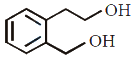
- List-I includes starting materials and reagents of selected chemical reactions. List-II gives structures of compounds that may be formed as intermediate products and/or final products from the reactions of List-I.
List-I List-II
(I)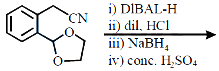
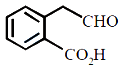
(II)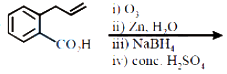
(III)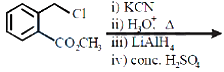

(IV)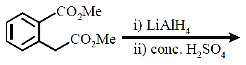
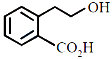
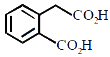

Which of the following options has correct combination considering List-I and List-II?JEE Advanced 2019 Hard
More PYQs from JEE Advanced
- An electric dipole with dipole moment is held fixed at the origin in the presence of an uniform electric field of magnitude If the potential is constant on a circle of radius centered at the origin as shown in figure, then the correct statement(s) is/are:
( is permittivity of free space, dipole size)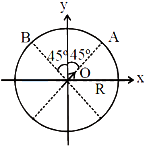 JEE Advanced 2019 Hard
 - For the reduction of \(\mathrm{NO}_3^{-}\)ion in an aqueous solution \(E^{\circ}\) is \(+0.96 \mathrm{~V}\). Values of \(E^{\circ}\) for some metal ions are given below.
\(
\begin{aligned}
& \mathrm{V}^{2+}(a q)+2 e^{-} \longrightarrow \mathrm{V} ; E^{\circ}=-1.19 \mathrm{~V} \\
& \mathrm{Fe}^{3+}(a q)+3 e^{-} \longrightarrow \mathrm{Fe} ; \mathrm{E}^{\circ}=-0.04 \mathrm{~V} \\
& \mathrm{Au}^{3+}(a q)+3 e^{-} \longrightarrow \mathrm{Au} ; E^{\circ}=+1.40 \mathrm{~V}
\end{aligned}
\)
\(
\mathrm{Hg}^{2+}(a q)+2 e^{-} \longrightarrow \mathrm{Hg} ; E^{\circ}=+0.86 \mathrm{~V}
\)
The pair(s) of metals that is (are) oxidised by \(\mathrm{NO}_3^{-}\)in aqueous solution is (are)JEE Advanced 2009 Medium - Statement I Boron always forms covalent bond
Statement II The small size of \(\mathrm{B}^{3+}\) favours formation of covalent bond.JEE Advanced 2007 Medium - Let \(z=\cos \theta+i \sin \theta\). Then, the value of \(\sum_{m=1}^{15} \operatorname{Im}\left(z^{2 m-1}\right)\) at \(\theta=2^{\circ}\) isJEE Advanced 2009 Medium
- Paragraph:
One twirls a circular ring (of mass \(M\) and radius \(R\) ) near the tip of one's finger as shown in Figure 1 . In the process the finger never loses contact with the inner rim of the ring. The finger traces out the surface of a cone, shown by the dotted line. The radius of the path traced out by the point where the ring and the finger is in contact is \(r\). The finger rotates with an angular velocity \(\omega_{0}\). The rotating ring rolls without slipping on the outside of a smaller circle described by the point where the ring and the finger is in contact (Figure 2). The coefficient of friction between the ring and the finger is \(\mu\) and the acceleration due to gravity is \(g\).
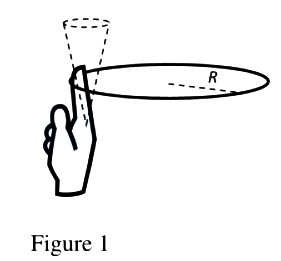
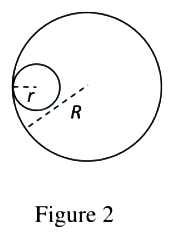
Question:
The minimum value of \(\omega_{0}\) below which the ring will drop down isJEE Advanced 2017 Medium - Paragraph :
When a particle of mass \(m\) moves on the \(x\)-axis in a potential of the form \(V(x)=k x^2\), it performs simple harmonic motion.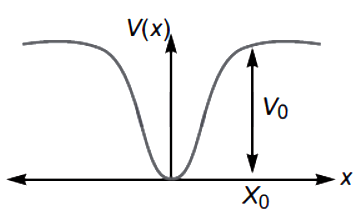
The corresponding time period is proportional to \(\sqrt{\frac{m}{k}}\), as can be seen easily using dimensional analysis. However, the motion of a particle can be periodic even when its potential energy increases on both sides of \(x=0\) in a way different from \(k x^2\) and its total energy is such that the particle does not escape to infinity. Consider a particle of mass \(\mathrm{m}\) moving on the \(x\)-axis. Its potential energy is \(V(x)=\alpha x^4(\alpha>0)\) for \(|x|\) near the origin and becomes a constant equal to \(V_0\) for \(|x| \geq X_0\) (see figure).
Question :
The acceleration of this particle for \(|x|>X_0\) isJEE Advanced 2010 Easy