


JEE Advanced · Chemistry · 23. Coordination Compounds
Total number of cis bond angles (that is, and bonds in cis positions) present in a molecule of cis- complex is _________
- A 6
- B 12
- C 5
- D 15
Answer & Solution
Correct Answer
(A) 6
Step-by-step Solution
Detailed explanation
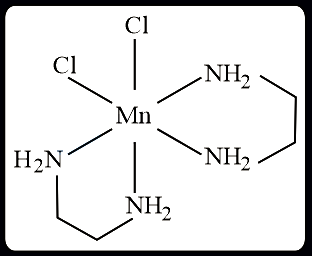
Total bonds
See the Complete Solution
Get step-by-step explanations for this and 2.5 Lakh+ more JEE, NEET & CET questions.
- Unlock all solutions
- Practice the full chapter
- Track accuracy across PYQs
4.8 rated on Google Play · 14,000+ reviews
More questions from Chemistry
- Paragraph:
The noble gases have closed-shell electronic configuration and are monoatomic gases under normal conditions. The low boiling points of the lighter noble gases are due to weak dispersion forces between the atoms and the absence of other interatomic interactions.
The direct reaction of xenon with fluorine leads to a series of compounds with oxidation numbers \(+2,+4\) and \(+6 . \mathrm{XeF}_4\) reacts violently with water to give \(\mathrm{XeO}_3\). The compounds of xenon exhibit rich stereochemistry and their geometries can be deduced considering the total number of electron pairs in the valence shell.
Question:
\(\mathrm{XeF}_4\) and \(\mathrm{XeF}_6\) are expected to beJEE Advanced 2007 Medium - Statement \(1 \mathrm{~Pb}^{4+}\) compounds are stronger oxidising agents than \(\mathrm{Sn}^{4+}\) compounds.
Statement 2 The higher oxidation states for the group 14 elements are more stable for the heavier members of the group due to 'inert pair effect'.JEE Advanced 2008 Medium - The total number of diprotic acids among the following is
\(\begin{array}{lll}\mathrm{H}_3 \mathrm{PO}_4 & \mathrm{H}_2 \mathrm{SO}_4 & \mathrm{H}_3 \mathrm{PO}_3 \\ \mathrm{H}_2 \mathrm{CO}_3 & \mathrm{H}_2 \mathrm{~S}_2 \mathrm{O}_7 & \mathrm{H}_3 \mathrm{BO}_3 \\ \mathrm{H}_3 \mathrm{PO}_2 & \mathrm{H}_2 \mathrm{CrO}_4 & \mathrm{H}_2 \mathrm{SO}_3\end{array}\)JEE Advanced 2010 Hard - In an atom, the total number of electrons having quantum numbers and isJEE Advanced 2014 Easy
- The number of (methylene) groups in the product formed from the following reaction sequence is _____ .
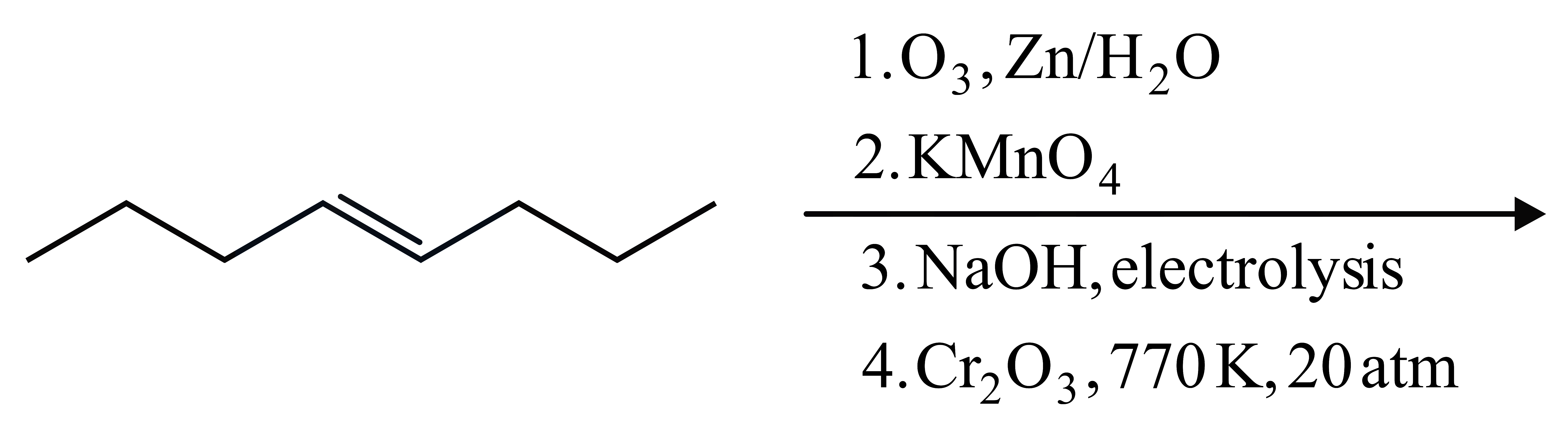 JEE Advanced 2022 Medium
 - Statement I Micelles are formed by surfactant molecules above the critical micellar concentration (CMC).
Statement II The conductivity of a solution having surfactant molecules deceases sharply at the CMC.JEE Advanced 2007 Easy
More PYQs from JEE Advanced
- A hyperbola, having the transverse axis of length \(2 \sin \theta\), is confocal with the ellipse \(3 x^2+4 y^2=12\). Then, its equation isJEE Advanced 2007 Medium
- \(75.2 \mathrm{~g}\) of \(\mathrm{C}_6 \mathrm{H}_5 \mathrm{OH}\) (phenol) is dissolved in a solvent of \(K_f=14\). If the depression in freezing point is \(7 \mathrm{~K}\), then find the \(\%\) of phenol that dimerises.JEE Advanced 2006 Medium
- Let \(f(x)\) be a continuously differentiable function on the interval \((0, \infty)\) such that \(f(1)=2\) and \(\underset{t \rightarrow x}{\lim} \frac{t^{10} f(x)-x^{10} f(t)}{t^9-x^9}=1\) for each \(x>0\). Then, for all \(x>0, f(x)\) is equal toJEE Advanced 2024 Medium
- Paragraph :
When a particle of mass \(m\) moves on the \(x\)-axis in a potential of the form \(V(x)=k x^2\), it performs simple harmonic motion.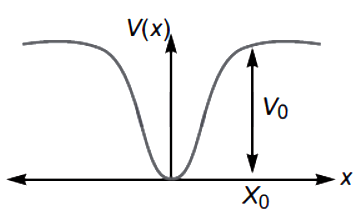
The corresponding time period is proportional to \(\sqrt{\frac{m}{k}}\), as can be seen easily using dimensional analysis. However, the motion of a particle can be periodic even when its potential energy increases on both sides of \(x=0\) in a way different from \(k x^2\) and its total energy is such that the particle does not escape to infinity. Consider a particle of mass \(\mathrm{m}\) moving on the \(x\)-axis. Its potential energy is \(V(x)=\alpha x^4(\alpha>0)\) for \(|x|\) near the origin and becomes a constant equal to \(V_0\) for \(|x| \geq X_0\) (see figure).
Question :
For periodic motion of small amplitude \(A\), the time period \(T\) of this particle is proportional toJEE Advanced 2010 Hard - Area of the region is equal toJEE Advanced 2016 Medium
- Paragraph:
Chemical reactions involve interaction of atoms and molecules. A large number of atoms/molecules (approximately \(6.023 \times 10^{23}\) ) are present in a few grams of any chemical compound varying with their atomic/molecular masses. To handle such large numbers conveniently, the mole concept was introduced. This concept has implications in diverse areas such as analytical chemistry, biochemistry, electrochemistry and radiochemistry. The following example illustrates a typical case, involving chemical/electrochemical reaction, which requires a clear understanding of the mole concept.
A \(4.0\) molar aqueous solution of \(\mathrm{NaCl}\) is prepared and \(500 \mathrm{~mL}\) of this solution is electrolysed. This leads to the evolution of chlorine gas at one of electrodes (atomic mass: \(\mathrm{Na}=23, \mathrm{Hg}=200 ; 1\) faraday \(=96500\) coulombs).
Question:
The total number of moles of chlorine gas evolved isJEE Advanced 2007 Medium