


JEE Advanced · Chemistry · 28. Amines
Paragraph:
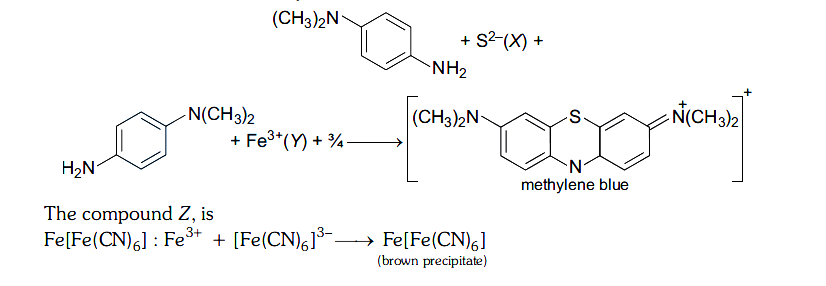
p-amino-N, N-dimethylaniline is added to a strongly acidic solution of \(X\). The resulting solution is treated with a few drops of aqueous solution of \(Y\) to yield blue colouration due to the formation of methylene blue. Treatment of the aqueous solution of \(Y\) with the reagent potassium hexacyanoferrate(II) leads to the formation of an intense blue precipitate. The precipitate dissolves an excess addition of the reagent. Similarly, treatment of the solution of \(Y\) with the solution of potassium hexacyanoferrate(III) leads to a brown colouration due to the formation of \(Z\).
Question:
The compound \(Z\), is
- A \(\mathrm{Mg}_2\left[\mathrm{Fe}(\mathrm{CN})_6\right]\)
- B \(\mathrm{Fe}\left[\mathrm{Fe}(\mathrm{CN})_6\right]\)
- C \(\mathrm{Fe}_4\left[\mathrm{Fe}(\mathrm{CN})_6\right]_3\)
- D \(\mathrm{K}_2 \mathrm{Zn}_3\left[\mathrm{Fe}(\mathrm{CN})_6\right]_2\)
Answer & Solution
Correct Answer
(B) \(\mathrm{Fe}\left[\mathrm{Fe}(\mathrm{CN})_6\right]\)
Step-by-step Solution
Detailed explanation
\(p\)-amino- \(\mathrm{N}\), N-dimethylaniline reacts with sulphide ion \(\left(\mathrm{S}^{2-}\right)\) in presence of \(\mathrm{Fe}^{3+}\) ion to form blue coloured solution of methylene blue :
See the Complete Solution
Get step-by-step explanations for this and 2.5 Lakh+ more JEE, NEET & CET questions.
- Unlock all solutions
- Practice the full chapter
- Track accuracy across PYQs
4.8 rated on Google Play · 14,000+ reviews
More questions from Chemistry
- At the reaction of with produces a xenon compound The total number of lone pair(s) of electrons present on the whole molecule of is __________JEE Advanced 2019 Medium
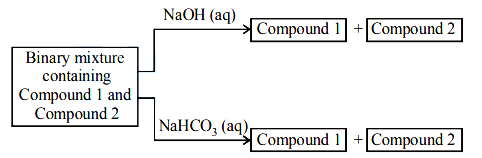
- Identify the binary mixture(s) that can be separated into individual compounds, by differential extraction as shown in the given scheme.
 JEE Advanced 2012 Medium
 - A sample \((5.6 \mathrm{~g})\) containing iron is completely dissolved in cold dilute \(\mathrm{HCl}\) to prepare a \(250 \mathrm{~mL}\) of solution. Titration of \(25.0 \mathrm{~mL}\) of this solution requires \(12.5 \mathrm{~mL}\) of \(0.03 \mathrm{M} \mathrm{KMnO}_{4}\) solution to reach the end point. Number of moles of \(\mathrm{Fe}^{2+}\) present in \(250 \mathrm{~mL}\) solution is \(\mathbf{x} \times 10^{-2}\) (consider complete dissolution of \(\mathrm{FeCl}_{2}\) ). The amount of iron present in the sample is \(\mathbf{y} \%\) by weight.
(Assume: \(\mathrm{KMnO}_{4}\) reacts only with \(\mathrm{Fe}^{2+}\) in the solution Use: Molar mass of iron as \(56 \mathrm{~g} \mathrm{~mol}^{-1}\) )
The value of is________ .JEE Advanced 2021 Medium - When benzene sulphonic acid and \(p\)-nitrophenol are treated with \(\mathrm{NaHCO}_3\), the gases released respectively areJEE Advanced 2006 Hard
- With reference to aqua regia, choose the correct option(s).JEE Advanced 2019 Hard
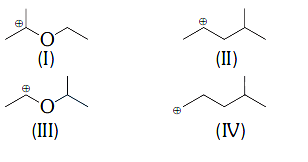
- The correct stability order for the following species is
 JEE Advanced 2008 Medium
More PYQs from JEE Advanced
- For a reaction, , the plots of with time at temperatures are given below.
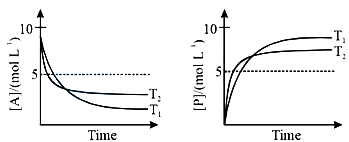
If , the correct statement(s) is (are)
(Assume are independent of temperature and ratio of is greater than . Here H, S , G and K are enthalpy, entropy, Gibbs energy and equilibrium constant, respectively.)JEE Advanced 2018 Hard - Total number of geometrical isomers for the complex \(\left[\mathrm{RhCl}(\mathrm{CO})\left(\mathrm{PPh}_3\right)\left(\mathrm{NH}_3\right)\right]\) isJEE Advanced 2010 Easy
- A biconvex lens of focal length \(15 \mathrm{~cm}\) is in front of a plane mirror. The distance between the lens and the mirror is 10 \(\mathrm{cm}\). A small object is kept at a distance of \(30 \mathrm{~cm}\) from the lens. The final image isJEE Advanced 2010 Medium
- The general motion of a rigid body can be considered to be a combination of (i) a motion of its centre of mass about an axis, and (ii) its motion about an instantaneous axis passing through the centre of mass.
These axes need not be stationary. Consider, for example, a thin uniform disc welded (rigidly fixed) horizontally at its rim to a massless, stick, as shown in the figure. When the disc-stick system is rotated about the origin on a horizontal frictionless plane with angular speed \(\omega\), the motion at any instant can be taken as a combination of (i) a rotation of the centre of mass of the disc about the \(z\)-axis and (ii) a rotation of the disc through an instantaneous vertical axis passing through its centre of mass (as is seen from the changed orientation of points \(P\) and \(Q\) ). Both these motions have the same angular speed \(\omega\) in this case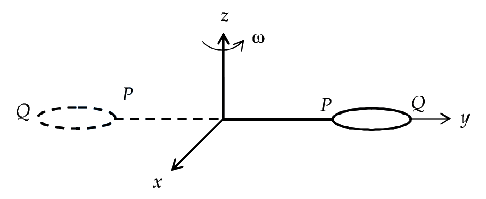
Now consider two similar systems as shown in the figure: Case
(a) the disc with its face vertical and parallel to \(x-z\) plane; Case
(b) the disc with its face making an angle of
\(45^{\circ}\) with \(x-y\) plane and its horizontal diameter parallel to \(x\)-axis. In both the cascs, the disc is welded at point \(\mathrm{P}\), and the systems are rotated with constant angular speed \(\omega\) about the \(z\) axis.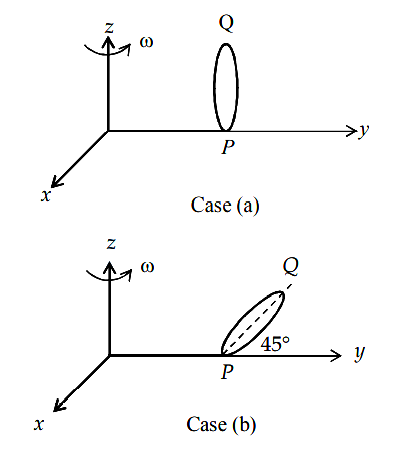
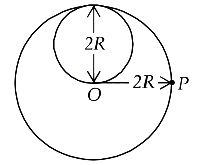
Question : Which of the following statements about the instantaneous axis (passing through the centre of mass) is correct?JEE Advanced 2012 Medium - A lamina is made by removing a small disc of diameter \(2 R\) from a bigger disc of uniform mass density and radius \(2 R\), as shown in the figure. The moment of inertia of this lamina about axes passing though \(O\) and \(P\) is \(I_{O}\) and \(I_{P}\) respectively. Both these axes are perpendicular to the plane of the lamina. The ratio \(I_{P} / I_{O}\) to the nearest integer is
 JEE Advanced 2012 Medium
 - Paragraph:
A small block of mass \(M\) moves on a frictionless surface of an inclined plane, as shown in figure. The angle of the incline suddenly changes from \(60^{\circ}\) to \(30^{\circ}\) at point \(B\). The block is initially at rest at \(A\). Assume that collisions between the block and the incline are totally inelastic \(\left(g=10 \mathrm{~m} / \mathrm{s}^2\right)\)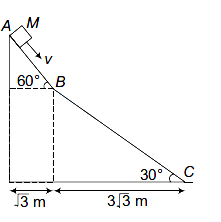
Question:
The speed of the block at point \(B\) immediately after it strikes the second incline isJEE Advanced 2008 Medium