


JEE Advanced · Physics · 8. Rotational Motion
The general motion of a rigid body can be considered to be a combination of (i) a motion of its centre of mass about an axis, and (ii) its motion about an instantaneous axis passing through the centre of mass.
These axes need not be stationary. Consider, for example, a thin uniform disc welded (rigidly fixed) horizontally at its rim to a massless, stick, as shown in the figure. When the disc-stick system is rotated about the origin on a horizontal frictionless plane with angular speed \(\omega\), the motion at any instant can be taken as a combination of (i) a rotation of the centre of mass of the disc about the \(z\)-axis and (ii) a rotation of the disc through an instantaneous vertical axis passing through its centre of mass (as is seen from the changed orientation of points \(P\) and \(Q\) ). Both these motions have the same angular speed \(\omega\) in this case
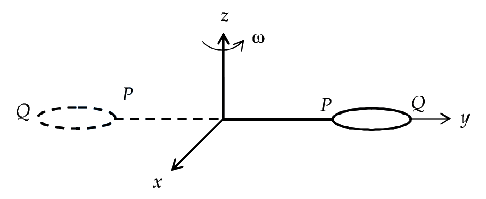
Now consider two similar systems as shown in the figure: Case
(a) the disc with its face vertical and parallel to \(x-z\) plane; Case
(b) the disc with its face making an angle of
\(45^{\circ}\) with \(x-y\) plane and its horizontal diameter parallel to \(x\)-axis. In both the cascs, the disc is welded at point \(\mathrm{P}\), and the systems are rotated with constant angular speed \(\omega\) about the \(z\) axis.
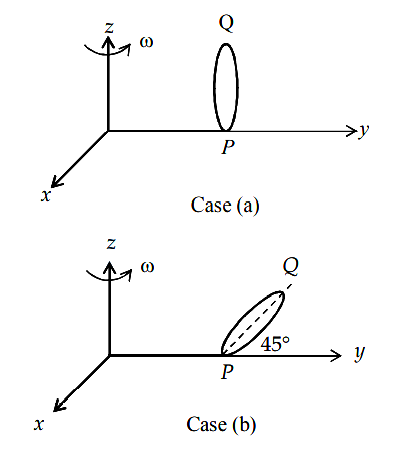
Question : Which of the following statements about the instantaneous axis (passing through the centre of mass) is correct?
- A It is vertical for both the cases (a) and (b)
- B It is vertical for case (a); and is at \(45^{\circ}\) to the \(x-z\) plane and lies in the plane of the disc for case (b).
- C It is horizontal for case (a); and is at \(45^{\circ}\) to the \(x\) - \(z\) plane and is normal to the plane of the disc for case (b).
- D It is vertical for case (a); and is \(45^{\circ}\) to the \(x-z\) plane and is normal to the plane of the disc for case (b).
Answer & Solution
Correct Answer
(A) It is vertical for both the cases (a) and (b)
Step-by-step Solution
Detailed explanation
Axis of rotation is parallel to z-axis. Hence for both the cases, in stantaneous axis passing through is vertical.
See the Complete Solution
Get step-by-step explanations for this and 2.5 Lakh+ more JEE, NEET & CET questions.
- Unlock all solutions
- Practice the full chapter
- Track accuracy across PYQs
4.8 rated on Google Play · 14,000+ reviews
More questions from Physics
- Paragraph:
If the measurement errors in all the independent quantities are known, then it is possible to determine the error in any dependent quantity. This is done by the use of series expansion and truncating the expansion at the first power of the error. For example, consider the relation . If the errors in , respectively, then
The series expansion for , to first power in . The relative errors in independent variables are always added. So the error in will be
Question :
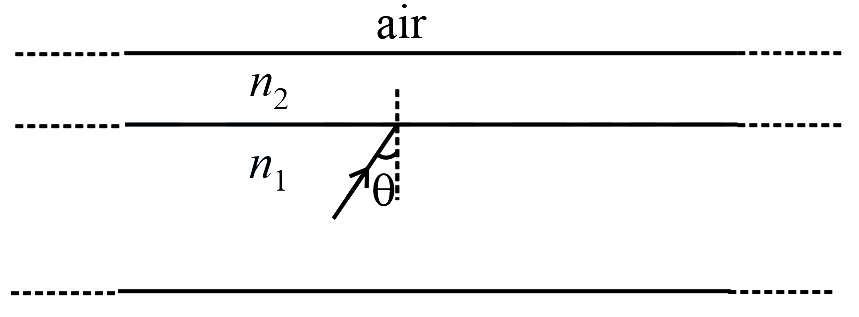
The above derivation makes the assumption that . Therefore, the higher powers of these quantities are neglected.JEE Advanced 2018 Medium - A wide slab consisting of two media of refractive indices and is placed in air as shown in the figure. A ray of light is incident from medium to at an angle , where is slightly larger than . Take refractive index of air as . Which of the following statement(s) is (are) correct?
 JEE Advanced 2021 Hard
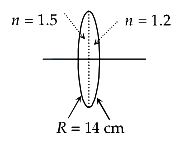
 - A bi-convex lens is formed with two thin plano-convex lenses as shown in the figure. Refractive index \(n\) of the first lens is \(1.5\) and that of the second lens is \(1.2\). Both the curved surface are of the same radius of curvature \(R=14\) \(\mathrm{cm}\). For this bi-convex lens, for an object distance of 40 \(\mathrm{cm}\), the image distance will be
 JEE Advanced 2012 Medium
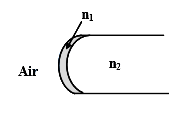
 - A transparent thin film of uniform thickness and refractive index is coated on the convex spherical surface of radius R at one end of a long solid glass cylinder of refractive index , as shown in the figure. Rays of light parallel to the axis of the cylinder traversing through the film from air to glass get focused at distance f1 from the film, while rays of light traversing from glass to air get focused at distance f2 from the film. Then
 JEE Advanced 2014 Medium
 - The positon vector \(\vec{r}\) of a particle of mass m is given by the following equation \(\vec{r}(t)=\alpha t^3 \hat{i} +\beta t^2 \hat{j}\), where \(\alpha=\frac{10}{3} m s^{-3}, \beta=5 m s^{-2}\) and \(m=0.1 kg\). At \(t=1 s\), which of the following statements (s) is (are) true about the particle?JEE Advanced 2016 Easy
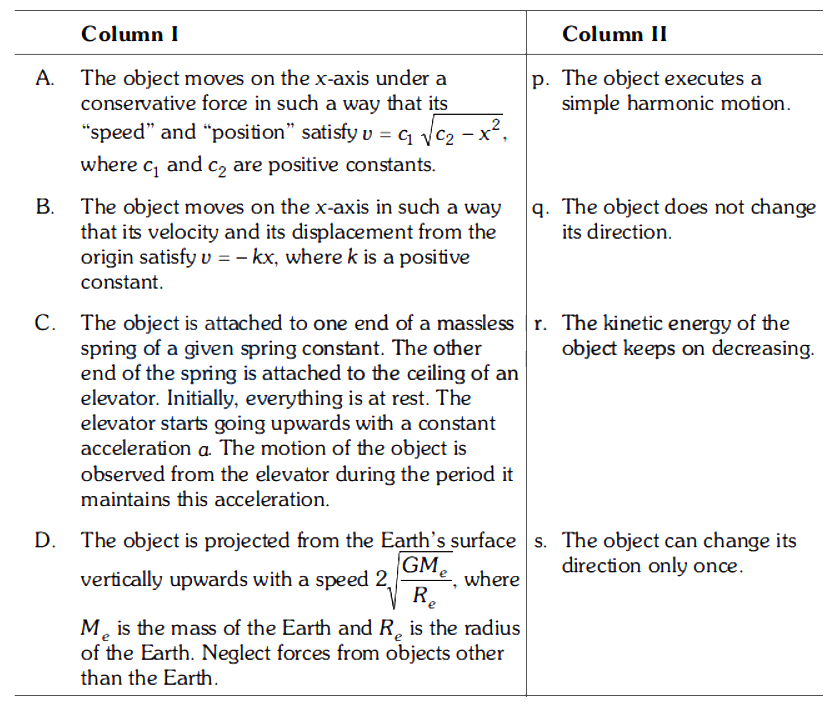
- Column I describes some situations in which a small object moves. Column II describes some characteristics of these motions. Match the situations in Column I with the characteristics in Column II and indicate your answer by darkening appropriate bubbles in the \(4 \times 4\) matrix given in the ORS.
 JEE Advanced 2007 Hard
More PYQs from JEE Advanced
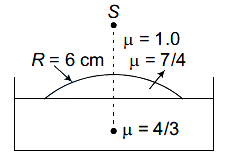
- Water (with refractive index \(=\frac{4}{3}\) ) in a tank is \(18 \mathrm{~cm}\) deep. Oil of refractive index \(\frac{7}{4}\) lies on water making a convex surface of radius of curvature \(R=6 \mathrm{~cm}\) as shown. Consider oil to act as a thin lens. An object \(S\) is placed \(24 \mathrm{~cm}\) above water surface. The location of its image is at \(x \mathrm{~cm}\) above the bottom of the tank. Then, \(x\) is
 JEE Advanced 2011 Hard
 - Let denote the parabola Let , and let and be two distinct points on such that the lines and are tangents to . Let be the focus of . Then which of the following statements is (are) TRUE?JEE Advanced 2021 Medium
- Addition of excess aqueous ammonia to a pink coloured aqueous solution of and gives an octahedral complex Y in the presence of air. In aqueous solution, complex Y behaves as 1 : 3 electrolyte. The reaction of X with excess HCl at room temperature results in the formation of a blue coloured complex Z. The calculated spin only magnetic moment of X and Z is 3.87 B.M., whereas it is zero for complex Y.
Among the following options, which statement(s) is(are) correct ?JEE Advanced 2017 Medium - The equilibrium \(2 \mathrm{Cu}^{\mathrm{I}} \rightleftharpoons \mathrm{Cu}^0+\mathrm{Cu}^{\text {II }}\) in aqueous medium at \(25^{\circ} \mathrm{C}\) shifts towards the left in the presence ofJEE Advanced 2011 Hard
- The standard reduction potential data at is given below.
\(E ^o\left( Fe ^{3+}, Fe ^{2+}\right)=+0.77 V ; \)
\( E ^o\left( Fe ^{2+}, Fe \right)=-0 . 44 V \)
\( E ^o\left( Cu ^{2+}, Cu \right)=+0.34 V ; \)
\( E ^o\left( Cu ^{+}, Cu \right)=+0.52 V \)
\( E ^o\left[ O _2(g)+4 H ^{+}+4 e ^{-} \rightarrow 2 H _2 O \right]=\) \(+1.23~V \)
\( E ^o\left[ O _2(g)+2 H _2 O +4 e^{-} \longrightarrow \text { 4OH}^{-}\right]=\) \(+0.40~V \)
\( E ^o\left( Cr ^{3+}, Cr \right)=-0.74 V ; \)
\( E ^o\left( Cr ^{2+}, Cr \right)=-0.91 V\)
Match Eo of the redox pair in List I with the values given in List II and select the correct answer using the code given below the lists :
List I List II A. P. B. Q. C R. D. S. JEE Advanced 2013 Hard - The equation of the plane passing through the point and perpendicular to the planes and isJEE Advanced 2017 Medium