


JEE Advanced · Chemistry · 26. Aldehydes & Ketones
Paragraph I: An organic compound \(\mathrm{P}\) with molecular formula \(\mathrm{C}_5 \mathrm{H}_{18} \mathrm{O}_2\) decolorizes bromine water and also shows positive iodoform test. \(\mathrm{P}\) on ozonolysis followed by treatment with \(\mathrm{H}_2 \mathrm{O}_2\) gives \(\mathrm{Q}\) and \(\mathrm{R}\). While compound \(\mathrm{Q}\) shows positive iodoform test, compound \(\mathrm{R}\) does not give positive iodoform test. \(\mathrm{Q}\) and \(\mathrm{R}\) on oxidation with pyridinium chlorochromate (PCC) followed by heating give \(\mathrm{S}\) and \(\mathrm{T}\), respectively. Both \(\mathrm{S}\) and \(\mathrm{T}\) show positive iodoform test.
Complete copolymerization of 500 moles of \(\mathrm{Q}\) and 500 moles of \(\mathrm{R}\) gives one mole of a single acyclic copolymer \(\mathrm{U}\).
[Given, atomic mass: \(\mathrm{H}=1, \mathrm{C}=12, \mathrm{O}=16\)]
Question: The molecular weight of \(\mathbf{U}\) is
- A 93018
- B 97851
- C 34852
- D 78452
Answer & Solution
Correct Answer
(A) 93018
Step-by-step Solution
Detailed explanation
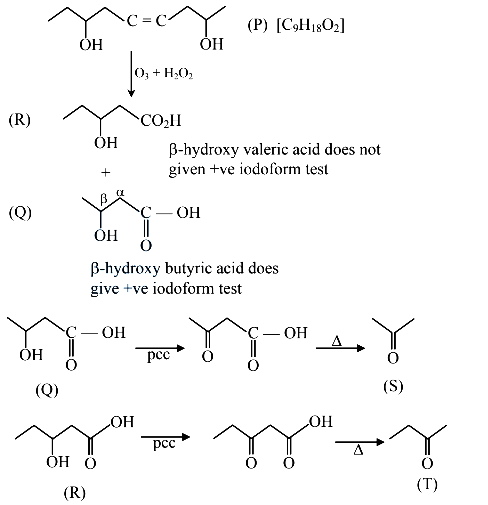
\(\mathrm{S~} \& \mathrm{~T}\) shows + ve idoform test.
\(\mathrm{Rmf} \mathrm{C}_5 \mathrm{H}_{10} \mathrm{O}_3\) (M. wt \()_{\mathrm{R}}=70+48=118\)
\(\mathrm{Q} \mathrm{mf} \mathrm{C}_4 \mathrm{H}_8 \mathrm{O}_3(\mathrm{M} . \mathrm{wt})_{\mathrm{Q}}=56+48=104\)
500 mole \(\mathrm{Q}+500\) mole \(\mathrm{R} \xrightarrow[\text { polymer }]{\text { Condensation }}\)

U molecular weight \(=500 \times 118+500 \times 104-999 \times 18\) \(=500 \times 222-17982 \)
\( =111000-17982=93018\)
Ans. is \(\Rightarrow 93018\)
See the Complete Solution
Get step-by-step explanations for this and 2.5 Lakh+ more JEE, NEET & CET questions.
- Unlock all solutions
- Practice the full chapter
- Track accuracy across PYQs
4.8 rated on Google Play · 14,000+ reviews
More questions from Chemistry
- Some standard electrode potentials at are given below: To a solution containing of and of , the metal rods and are inserted at and connected by a conducting wire. This resulted in dissolution of . The correct combination(s) of and , respectively, is(are) (Given: Gas constant, , Faraday constant, )JEE Advanced 2021 Easy
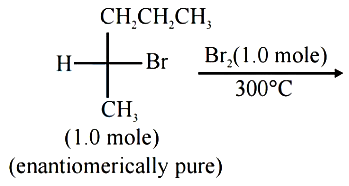
- In the following monobromination reaction, the number of possible chiral products is
 JEE Advanced 2016 Medium
 - In a neutral or faintly alkaline solution, moles of permanganate anion quantitatively oxidize thiosulphate anions to produce moles of a sulphur containing product. The magnitude of is:JEE Advanced 2016 Medium
- The wave function, \(\psi_{ n , 1, m_{ l }}\) is a mathematical function whose value depends upon spherical polar coordinates \(( r , \theta, \phi)\) of the electron and characterized by the quantum numbers \(n , 1\) and \(m _{ l }\). Here \(r\) is the distance from the nucleus, \(\theta\) is colatitude and \(\phi\) is azimuth. In the mathematical functions given in the Table, Z is the atomic number and \(a_0\) is Bohr radius
For \(\text{He} ^{+}\)ion, the only incorrect combinationColumn 1 Column 2 Column 3 (I) 1s orbital \(\text {(i) } \psi_{ n , 1, m_1}\)
\(\propto\left(\frac{ Z }{ a _{ o }}\right)^{\frac{3}{2}} e ^{-\left(\frac{ Zr }{ e _{ o }}\right)}\)(P) 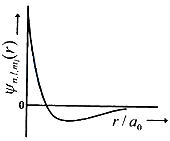
(II) 2s orbital (ii) One radial node (Q) Probability density at the nucleus \(\propto \frac{1}{ a _{ o }^3}\). (III) \(2 p _{ z }\) orbital \(\text {(iii) } \psi_{ n }, 1, m_{ l }\)
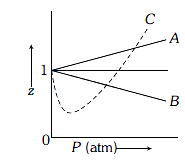
\(\propto\left(\frac{ Z }{ a _{ o }}\right)^{\frac{5}{2}} re ^{-\left(\frac{ Zr }{2 a _{ o }}\right)} \cos \theta\)(R) Probability density is maximum at the nucleus. (IV) \(3 d_{ z }^2\) orbital (iv) \(x y\)-plane is a nodal plane (S) Energy needed to excite an electron from \(n =2\) state to \(n =4\) state is \(\frac{27}{32}\) times the energy needed to excite are electron from \(n =2\) state to \(n =6\) state. JEE Advanced 2017 Hard - The given graph represent the variations of compressibility factor \((Z)=\frac{P V}{n R T}\) versus \(P\), for three real gases \(A, B\) and \(C\). Identify the only incorrect statement
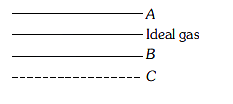 JEE Advanced 2006 Medium
 - The periodic table consists of 18 groups. An isotope of copper, on bombardment with protons, undergoes a nuclear reaction yielding element \(X\) as shown below. To which group, element \(X\) belongs in the periodic table?
\({ }_{29}^{63} \mathrm{Cu}+{ }_{1}^{1} \mathrm{H} \rightarrow 6_{0}^{1} n+{ }_{2}^{4} \alpha+2{ }_{1}^{1} \mathrm{H}+\mathrm{X}\)JEE Advanced 2012 Easy
More PYQs from JEE Advanced
- At the reaction of with produces a xenon compound The total number of lone pair(s) of electrons present on the whole molecule of is __________JEE Advanced 2019 Medium
- A student performs a titration with different burettes and finds titre values of \(25.2 \mathrm{~mL}, 25.25 \mathrm{~mL}\), and \(25.0 \mathrm{~mL}\).
The number of significant figures in the average titre value isJEE Advanced 2010 Medium - An organic compound rotates plane-polarized light. It produces pink color with neutral solution. What is the total number of all the possible isomers for this compound?JEE Advanced 2020 Hard
- Newman projections and are shown below:
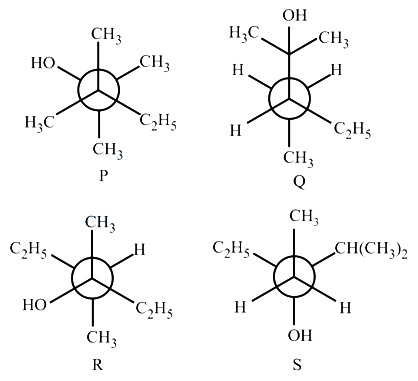
Which one of the following options represent identical molecules?JEE Advanced 2020 Medium - The IUPAC name of the following compound, is
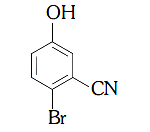 JEE Advanced 2009 Easy
 - Paragraph:
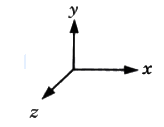
In a thin rectangular metallic strip a constant current \(I\) flows along the positive \(x\)-direction, as shown in the figure. The length, width and thickness of the strip are \(l, w\) and \(d\), respectively.
A uniform magnetic field \(\vec{B}\) is applied on the strip along the positive \(y\)-direction. Due to this, the charge carriers experience a net deflection along the \(z\)-direction. This results in accumulation of charge carriers on the surface \(P Q R S\) and appearance of equal and opposite charges on the face opposite to \(P Q R S\). A potential difference along the \(z\)-direction is thus developed. Charge accumulation continues until the magnetic force is balanced by the electric force. The current is assumed to be uniformly distributed on the cross section of the strip and carried by electrons.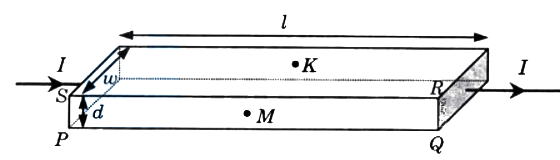
Question:
Consider two different metallic strips (\(1\) and \(2\)) of same dimensions (length \(l\), width \(w\) and thickness \(d\) ) with carrier densities \(n_{1}\) and \(n_{2}\), respectively. Strip \(1\) is placed in magnetic field \(B_{1}\) and strip \(2\) is placed in magnetic field \(B_{2}\), both along positive \(y\)-directions. Then \(V_{1}\) and \(V_{2}\) are the potential differences developed between \(K\) and \(M\) in strips \(1\) and \(2\), respectively. Assuming that the current \(I\) is the same for both the strips, the correct option(s) is(are)JEE Advanced 2015 Medium