


JEE Advanced · Chemistry · 5. States of Matter
The given graph represent the variations of compressibility factor \((Z)=\frac{P V}{n R T}\) versus \(P\), for three real gases \(A, B\) and \(C\). Identify the only incorrect statement
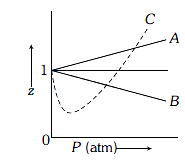
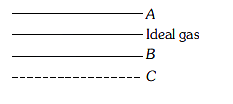
- A For the gas \(A, a=0\) and its dependence on \(P\) is linear at all pressure.
- B For the gas \(B, b=0\) and its dependence on \(P\) is linear at all pressure.
- C For the gas \(C\), which is typical real gas for which neither \(a\) nor \(b=0\). By knowing the minima and point of the intersection, with \(Z=1, a\) and \(b\) can be calculated.
- D At high pressure, the slope is positive for all real gases.
Answer & Solution
Correct Answer
(B) For the gas \(B, b=0\) and its dependence on \(P\) is linear at all pressure.
Step-by-step Solution
Detailed explanation
From the graph it is clear that the value of \(Z\) decreases with increase of pressure. We can explain as follows on the basis of van der Waals' equation.
At high pressure, when ' \(P\) ' is large, \(V\) will be small and one can not ignore ' \(b\) ' in comparison to \(V\).
However, the term \(\frac{a}{V^2}\) may be considered negligible in comparison to ' \(p\) ' in van der Waals' equation
or
\(\left(p+\frac{a}{V^2}\right)(V-b) =n R T \)
\( P(V-b) =n R T \)
\( p V-p b =n R T \)
\( \frac{p V}{n R T} =1+\frac{p b}{n R T} \)
\( Z =1+\frac{p b}{n R T}\)
or
Here, \(Z\) is greater than one and it increases linearly with pressure. Hence, statement (b) is false.
At high pressure, when ' \(P\) ' is large, \(V\) will be small and one can not ignore ' \(b\) ' in comparison to \(V\).
However, the term \(\frac{a}{V^2}\) may be considered negligible in comparison to ' \(p\) ' in van der Waals' equation
or
\(\left(p+\frac{a}{V^2}\right)(V-b) =n R T \)
\( P(V-b) =n R T \)
\( p V-p b =n R T \)
\( \frac{p V}{n R T} =1+\frac{p b}{n R T} \)
\( Z =1+\frac{p b}{n R T}\)
or
Here, \(Z\) is greater than one and it increases linearly with pressure. Hence, statement (b) is false.
See the Complete Solution
Get step-by-step explanations for this and 2.5 Lakh+ more JEE, NEET & CET questions.
- Unlock all solutions
- Practice the full chapter
- Track accuracy across PYQs
4.8 rated on Google Play · 14,000+ reviews
More questions from Chemistry
- In the nuclear transmutation , identify .JEE Advanced 2013 Medium
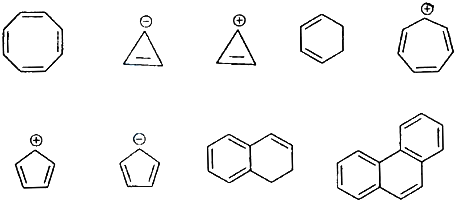
- Among the following, the number of aromatic compound (s) is/are
 JEE Advanced 2017 Medium
 - According to Molecular Orbital Theory,JEE Advanced 2016 Medium
- An aqueous solution of X is added slowly to an aqueous solution of Y as shown in List I. The variation in conductivity of these reactions is given in List II. Match List I with List II and select the correct using answer the code given below the lists :
List - I List - II a. \(\underset{\quad\quad~~ X }{( C _2 H _5)_3 N}+\underset{ Y }{CH _3 COOH}\) p. Conductivity decreases and then increases b. \(\underset{\quad\quad~~ X }{KI (0.1 M )}+\underset{ Y }{AgNO _3(0.01 M )}\) q. Conductivity decreases and then does not change much c. \(\underset{\text X }{CH _3 COOH}+\underset{\text Y }{KOH}\) r. Conductivity increases and then
does not change muchd. \(\underset{\text X }{NaOH}+\underset{\text Y }{HI}\) s. Conductivity does not change much and
then increasesJEE Advanced 2013 Medium - Paragraph:
Properties such as boiling point, freezing point and vapour pressure of a pure solvent change when solute molecules are added to get homogeneous solution. These are called colligative properties. Applications of colligative properties are very useful in day-to-day life. One of its examples is the use of ethylene glycol and water mixture as anti-freezing liquid in the radiator automobiles.
A solution \(M\) is prepared by mixing ethanol and water. The mole fraction of ethanol in the mixtrue is \(0.9\)
Given Freezing point depression constant of water \(\left(k^{\text {water }}\right)=1.86 \mathrm{~K} \mathrm{~kg} \mathrm{~mol}^{-1}\)
Freezing point depression constant of ethanol \(\left(k_f^{\text {ethanol }}\right)=2.0 \mathrm{Kkg} \mathrm{mol}^{-1}\)
Boiling point elevation constant of water \(\left(k_b^{\text {water }}\right)=0.52 \mathrm{Kkg} \mathrm{mol}^{-1}\)
Boiling point elevation constant of ethanol \(\left(k_b^{\text {ethanol }}\right)=1.2 \mathrm{Kkg} \mathrm{mol}^{-1}\)
Standard freezing point of water \(=273 \mathrm{~K}\)
Standard freezing point of ethanol \(=155.7 \mathrm{~K}\)
Standard boiling point of water \(=373 \mathrm{~K}\)
Standard boiling point of ethanol \(=351.5 \mathrm{~K}\)
Vapour pressure of pure water \(=328 \mathrm{~mm}\) of \(\mathrm{Hg}\)
Vapour pressure of pure ethanol \(=40 \mathrm{~mm}\) of \(\mathrm{Hg}\)
Molecular weight of water \(=18 \mathrm{~g} \mathrm{~mol}^{-1}\)
Molecular weight of ethanol \(=46 \mathrm{~g} \mathrm{~mol}^{-1}\)
In answering the following questions, consider the solutions to be ideal dilute solutions and solutes to be non-volatile and non-dissociative.
Question:
The freezing point of the solution \(M\) isJEE Advanced 2008 Medium - In the following reaction sequence, the amount of (in g) formed from moles of acetophenone is ____.
(Atomic weights in The yield (%) corresponding to the product in each step is given in the parenthesis)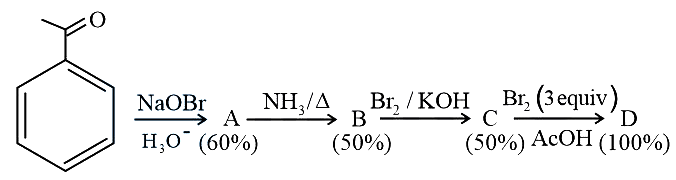 JEE Advanced 2018 Medium
More PYQs from JEE Advanced
- Among the following options, select the option in which each complex in Set-I shows geometrical isomerism and the two complexes in Set-II are ionization isomers of each other.
\(\text { [en } \left.=\mathrm{H}_2 \mathrm{NCH}_2 \mathrm{CH}_2 \mathrm{NH}_2\right]\)JEE Advanced 2024 Medium - Consider the matrix, \(P=\left(\begin{array}{lll}2 & 0 & 0 \\ 0 & 2 & 0 \\ 0 & 0 & 3\end{array}\right)\)
Let the transpose of a matrix \(X\) be denoted by \(\mathrm{X}^T\). Then the number of \(3 \times 3\) invertible matrices Q with integer entries, such that \(Q^{-1}=Q^T\) and \(P Q=Q P\) isJEE Advanced 2025 Easy - Let be an integer. Take n distinct points on a circle and join each pair of points by a line segment. Colour the line segment joining every pair of adjacent points by blue and the rest by red. If the number of red and blue line segments are equal, then the value of n is ________JEE Advanced 2014 Hard
- A charge is kept at the central point \(\mathrm{P}\) of a cylindrical region. The two edges subtend a half-angle \(\theta\) at \(\mathrm{P}\), as shown in the figure. When \(\theta=30^{\circ}\), then the electric flux through the curved surface of the cylinder is \(\Phi\). If \(\theta=60^{\circ}\), then the electric flux through the curved surface becomes \(\Phi / \sqrt{n}\), where the value of \(n\) is _______ .
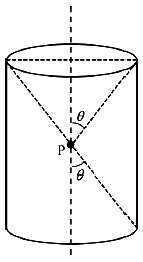 JEE Advanced 2024 Hard
 - Let be the set of all complex numbers satisfying . Then which of the following statements is/are TRUE?JEE Advanced 2020 Hard
- The reagent(s) that can selectively precipitate from a mixture of and in aqueous solution is (are)JEE Advanced 2016 Medium