


JEE Advanced · Chemistry · 2. Atomic Structure
The wave function, \(\psi_{ n , 1, m_{ l }}\) is a mathematical function whose value depends upon spherical polar coordinates \(( r , \theta, \phi)\) of the electron and characterized by the quantum numbers \(n , 1\) and \(m _{ l }\). Here \(r\) is the distance from the nucleus, \(\theta\) is colatitude and \(\phi\) is azimuth. In the mathematical functions given in the Table, Z is the atomic number and \(a_0\) is Bohr radius
| Column 1 | Column 2 | Column 3 |
| (I) 1s orbital | \(\text {(i) } \psi_{ n , 1, m_1}\) \(\propto\left(\frac{ Z }{ a _{ o }}\right)^{\frac{3}{2}} e ^{-\left(\frac{ Zr }{ e _{ o }}\right)}\) | (P)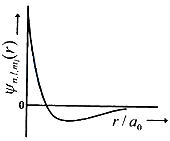 |
| (II) 2s orbital | (ii) One radial node | (Q) Probability density at the nucleus \(\propto \frac{1}{ a _{ o }^3}\). |
| (III) \(2 p _{ z }\) orbital | \(\text {(iii) } \psi_{ n }, 1, m_{ l }\) \(\propto\left(\frac{ Z }{ a _{ o }}\right)^{\frac{5}{2}} re ^{-\left(\frac{ Zr }{2 a _{ o }}\right)} \cos \theta\) | (R) Probability density is maximum at the nucleus. |
| (IV) \(3 d_{ z }^2\) orbital | (iv) \(x y\)-plane is a nodal plane | (S) Energy needed to excite an electron from \(n =2\) state to \(n =4\) state is \(\frac{27}{32}\) times the energy needed to excite are electron from \(n =2\) state to \(n =6\) state. |
- A
- B
- C
- D
Answer & Solution
Correct Answer
(C)
Step-by-step Solution
Detailed explanation
The option (iii) is incorrect because in the wave function of orbital, no angular function should be present.
See the Complete Solution
Get step-by-step explanations for this and 2.5 Lakh+ more JEE, NEET & CET questions.
- Unlock all solutions
- Practice the full chapter
- Track accuracy across PYQs
4.8 rated on Google Play · 14,000+ reviews
More questions from Chemistry
- Paragraph:
When a metal rod \(M\) is dipped into an aqueous colourless concentrated solution of compound \(\mathrm{N}\), the solution turns light blue. Addition of aqueous \(\mathrm{NaCl}\) to the blue solution gives a white precipitate \(\mathrm{O}\). Addition of aqueous \(\mathrm{NH}_3\) dissolves \(\mathrm{O}\) and gives an intense blue solution.
Question:
The metal \(\operatorname{rod} M\) isJEE Advanced 2011 Medium - Among the following, the number of reaction(s) that produce(s) benzaldehyde is
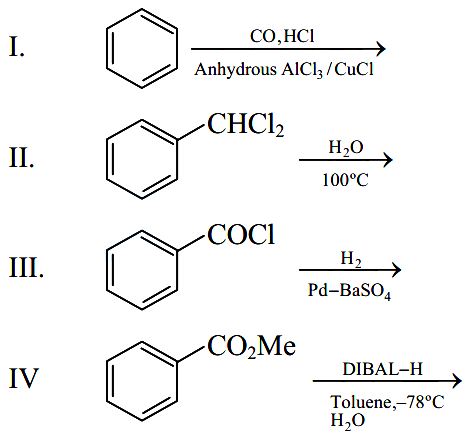 JEE Advanced 2015 Easy
 - Consider the following cell reaction,
\(2 \mathrm{Fe}(\mathrm{s})+\mathrm{O}_2(g)+4 \mathrm{H}^{+}(a q) \longrightarrow \)
\( 2 \mathrm{Fe}^{2+}(a q)+2 \mathrm{H}_2 \mathrm{O}(l), E^{\circ}=1.67 \mathrm{~V} \)
\( \text {At } {\left[\mathrm{Fe}^{2+}\right]=10^{-3} \mathrm{M}, \mathrm{P}\left(\mathrm{O}_2\right)=0.1 \mathrm{~atm}}\)
and \(\mathrm{pH}=3\), the cell potential at \(25^{\circ} \mathrm{C}\) isJEE Advanced 2011 Easy - The entropy versus temperature plot for phases and at bar pressure is given. and are entropies of the phases at temperatures and , respectively.
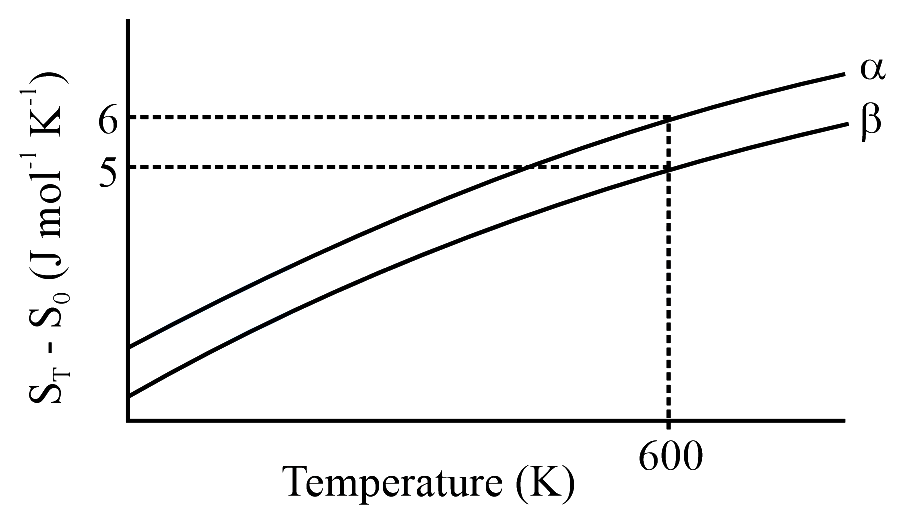 The transition temperature for to phase change is and . Assume is independent of temperature in the range of to and are heat capacities of and phases, respectively.
The value of entropy change, (in ), at is [Use: 0. Given: at ]JEE Advanced 2023 Medium - Paragraph:
The reactions of \(\mathrm{Cl}_{2}\) gas with cold-dilute and hot-concentrated \(\mathrm{NaOH}\) in water give sodium salts of two (different) oxoacids of chlorine, \(\boldsymbol{P}\) and \(\boldsymbol{Q}\), respectively. The \(\mathrm{Cl}_{2}\) gas reacts with \(\mathrm{SO}_{2}\) gas, in presence of charcoal, to give a product \(\boldsymbol{R}\). \(\boldsymbol{R}\) reacts with white phosphorus to give a compound \(\boldsymbol{S}\). On hydrolysis, \(\boldsymbol{S}\) gives an oxoacid of phosphorus, \(\boldsymbol{T}\).
Question:
\(R, S\) and \(T\), respectively, areJEE Advanced 2013 Medium - The number of structural isomers for \(\mathrm{C}_6 \mathrm{H}_{14}\) isJEE Advanced 2007 Medium
More PYQs from JEE Advanced
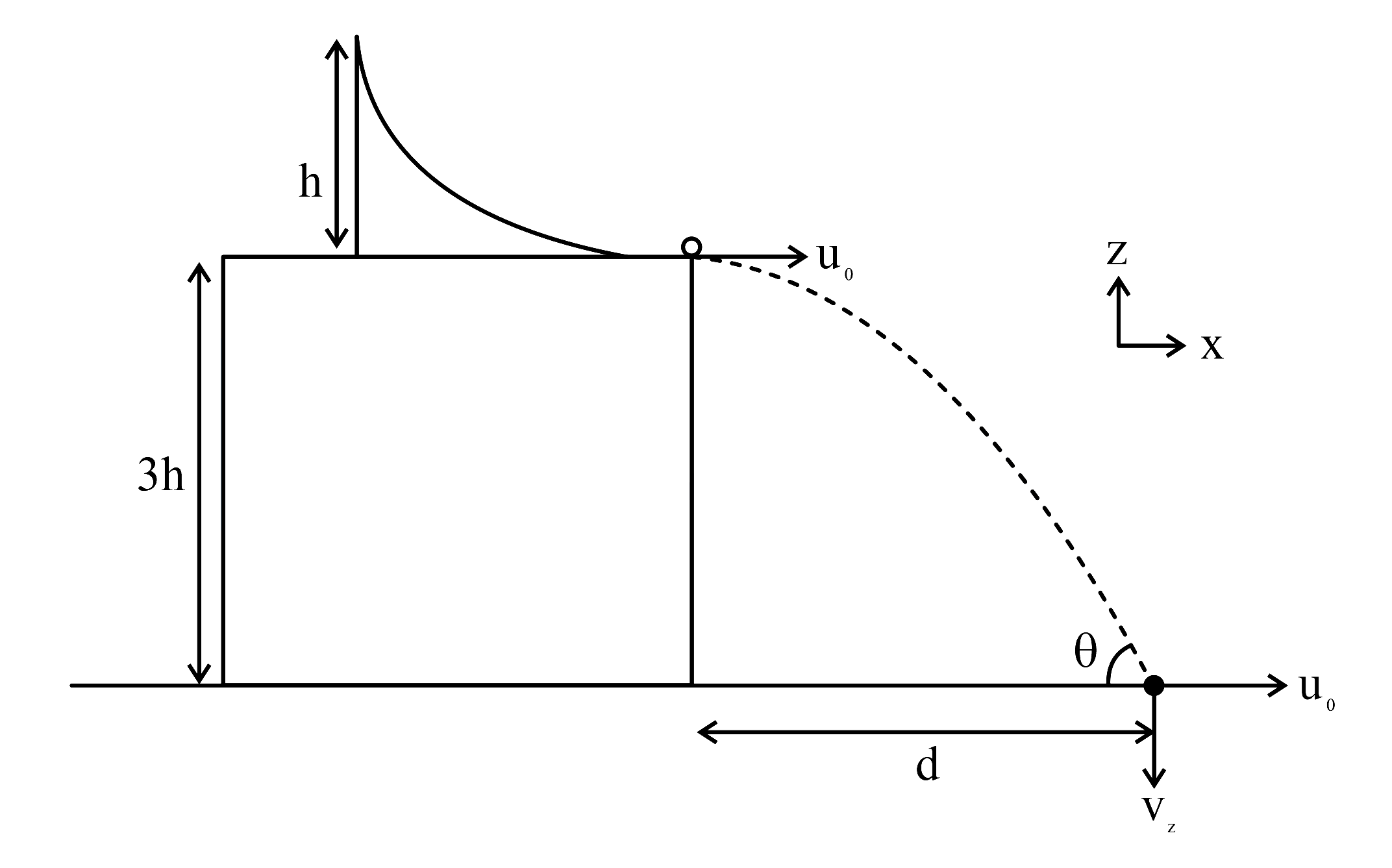
- A slide with a frictionless curved surface, which becomes horizontal at its lower end, is fixed on the terrace of a building of height from the ground, as shown in the figure. A spherical ball of mass is released on the slide from rest at a height from the top of the terrace. The ball leaves the slide with a velocity and falls on the ground at a distance from the building making an angle with the horizontal. It bounces off with a velocity and reaches a maximum height . The acceleration due to gravity is and the coefficient of restitution of the ground is . Which of the following statement(s) is(are) correct?
 JEE Advanced 2023 Hard
 - A bag contains \(N\) balls out of which 3 balls are white, 6 balls are green, and the remaining balls are blue. Assume that the balls are identical otherwise. Three balls are drawn randomly one after the other without replacement. For \(i=1,2,3\), let \(W_i, G_i\), and \(B_i\) denote the events that the ball drawn in the \(i^{\text {th }}\) draw is a white ball, green ball, and blue ball, respectively. If the probability \(P\left(W_1 \cap G_2 \cap B_3\right)=\frac{2}{5 N}\) and the conditional probability \(P\left(B_3 \mid W_1 \cap G_2\right)=\frac{2}{9}\), then \(N\) equals ________.JEE Advanced 2024 Medium
- The smallest ketone and its next homologoue are reacted with \(\mathrm{NH}_2 \mathrm{OH}\) to form oximeJEE Advanced 2006 Medium
- Upon treatment with ammoniacal , the metal ion that precipitates as a sulphide isJEE Advanced 2013 Easy
- If \(y(x)\) satisfies the differential equation \(y^{\prime}-y \tan x\) \(=2 x \sec x\) and \(y(0)=0\), thenJEE Advanced 2012 Medium
- Let and be positive real numbers. Suppose and are adjacent sides of a parallelogram Let and be the projection vectors of along and , respectively. If and if the area of the parallelogram is then which of the following statements is/are TRUE?JEE Advanced 2020 Medium