


JEE Advanced · Chemistry · 20. Metallurgy
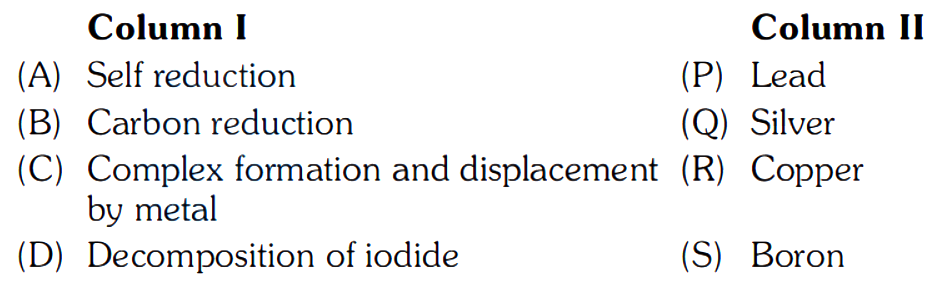
Match the extraction processes listed in column I with metals listed in column II.
- A (A) P,S, (B) R, (C) P,Q, (D) P,S
- B (A) Q,S, (B) R, (C) S, (D) S
- C (A) P,R, (B) P, R, (C) Q, (D) R
- D (A) P,R, (B) P, (C) Q, (D) S
Answer & Solution
Correct Answer
(D) (A) P,R, (B) P, (C) Q, (D) S
Step-by-step Solution
Detailed explanation
Column I
Column II
(A) Self reduction \(\left[\begin{array}{c}P \text { - Lead } \\ R \text { - Copper }\end{array}\right]\)
\(
\begin{aligned}
& \text { i.e., } A \rightleftarrows P \text { and } R \\
& \text { In lead metal } \\
& \qquad\left\{\begin{array}{c}
2 \mathrm{PbS}+3 \mathrm{O}_2 \longrightarrow 2 \mathrm{PbO}+2 \mathrm{SO}_2 \\
2 \mathrm{PbO}+\mathrm{PbS} \longrightarrow 3 \mathrm{~Pb}+\mathrm{SO}_2
\end{array}\right.
\end{aligned}
\)
(self reduction)
In copper metal
\(
\begin{aligned}
& 2 \mathrm{Cu}_2 \mathrm{~S}+3 \mathrm{O}_2 \longrightarrow 2 \mathrm{Cu}_2 \mathrm{O}+2 \mathrm{SO}_2 \\
& \mathrm{Cu}_2 \mathrm{~S}+2 \mathrm{Cu}_2 \mathrm{O} \longrightarrow 6 \mathrm{Cu}+\mathrm{SO}_2
\end{aligned}
\)
(self reduction)
(B) Carbon reduction \(P\)-lead
\(
\begin{aligned}
& \text { i.e., } \mathrm{B}-\mathrm{P} \\
& \text { In lead metal } \\
& \qquad \mathrm{PbO}+\mathrm{C} \longrightarrow \mathrm{Pb}+\mathrm{CO} \\
& \mathrm{PbO}+\mathrm{CO} \longrightarrow \mathrm{Pb}+\mathrm{CO}_2
\end{aligned}
\)
Carbon reduction process is used for the reduction of oxides of electropositive metals like \(\mathrm{Fe}, \mathrm{Pb}\) etc. This reduction is carried out with coal or coke on strongly heating.
(C) Complex formation and displacement by metal.
i.e., \(C-Q\) (silver)
In silver metal
Argentite mineral of \(\mathrm{Ag}\left(\mathrm{Ag}_2 \mathrm{~S}\right)\) is treated with \(0.7 \% \mathrm{NaCN}\) solution in presence of air, therefore firstly sodium argento cyanide complex is formed which on heating with zinc metal, therefore by displacement silver is isolated.
\(
\begin{aligned}
& \mathrm{Ag}_2 \mathrm{~S}+4 \mathrm{NaCN} \longrightarrow 2 \mathrm{Na}\left[\mathrm{Ag}(\mathrm{CN})_2\right]+\mathrm{Na}_2 \mathrm{~S} \\
& 2 \mathrm{Na}\left[\mathrm{Ag}(\mathrm{CN})_2\right]+\mathrm{Zn} \longrightarrow \mathrm{Na}\left[\mathrm{Zn}(\mathrm{CN})_4\right]+\underset{\text { Soluble }}{2 \mathrm{Ag}} \downarrow
\end{aligned}
\)
(D) Decomposition of iodide-(S) Boron
\(
\text { i.e., }(D)-(S)
\)
By decomposition of iodide boron metal is isolated.
Column II
(A) Self reduction \(\left[\begin{array}{c}P \text { - Lead } \\ R \text { - Copper }\end{array}\right]\)
\(
\begin{aligned}
& \text { i.e., } A \rightleftarrows P \text { and } R \\
& \text { In lead metal } \\
& \qquad\left\{\begin{array}{c}
2 \mathrm{PbS}+3 \mathrm{O}_2 \longrightarrow 2 \mathrm{PbO}+2 \mathrm{SO}_2 \\
2 \mathrm{PbO}+\mathrm{PbS} \longrightarrow 3 \mathrm{~Pb}+\mathrm{SO}_2
\end{array}\right.
\end{aligned}
\)
(self reduction)
In copper metal
\(
\begin{aligned}
& 2 \mathrm{Cu}_2 \mathrm{~S}+3 \mathrm{O}_2 \longrightarrow 2 \mathrm{Cu}_2 \mathrm{O}+2 \mathrm{SO}_2 \\
& \mathrm{Cu}_2 \mathrm{~S}+2 \mathrm{Cu}_2 \mathrm{O} \longrightarrow 6 \mathrm{Cu}+\mathrm{SO}_2
\end{aligned}
\)
(self reduction)
(B) Carbon reduction \(P\)-lead
\(
\begin{aligned}
& \text { i.e., } \mathrm{B}-\mathrm{P} \\
& \text { In lead metal } \\
& \qquad \mathrm{PbO}+\mathrm{C} \longrightarrow \mathrm{Pb}+\mathrm{CO} \\
& \mathrm{PbO}+\mathrm{CO} \longrightarrow \mathrm{Pb}+\mathrm{CO}_2
\end{aligned}
\)
Carbon reduction process is used for the reduction of oxides of electropositive metals like \(\mathrm{Fe}, \mathrm{Pb}\) etc. This reduction is carried out with coal or coke on strongly heating.
(C) Complex formation and displacement by metal.
i.e., \(C-Q\) (silver)
In silver metal
Argentite mineral of \(\mathrm{Ag}\left(\mathrm{Ag}_2 \mathrm{~S}\right)\) is treated with \(0.7 \% \mathrm{NaCN}\) solution in presence of air, therefore firstly sodium argento cyanide complex is formed which on heating with zinc metal, therefore by displacement silver is isolated.
\(
\begin{aligned}
& \mathrm{Ag}_2 \mathrm{~S}+4 \mathrm{NaCN} \longrightarrow 2 \mathrm{Na}\left[\mathrm{Ag}(\mathrm{CN})_2\right]+\mathrm{Na}_2 \mathrm{~S} \\
& 2 \mathrm{Na}\left[\mathrm{Ag}(\mathrm{CN})_2\right]+\mathrm{Zn} \longrightarrow \mathrm{Na}\left[\mathrm{Zn}(\mathrm{CN})_4\right]+\underset{\text { Soluble }}{2 \mathrm{Ag}} \downarrow
\end{aligned}
\)
(D) Decomposition of iodide-(S) Boron
\(
\text { i.e., }(D)-(S)
\)
By decomposition of iodide boron metal is isolated.
See the Complete Solution
Get step-by-step explanations for this and 2.5 Lakh+ more JEE, NEET & CET questions.
- Unlock all solutions
- Practice the full chapter
- Track accuracy across PYQs
4.8 rated on Google Play · 14,000+ reviews
More questions from Chemistry
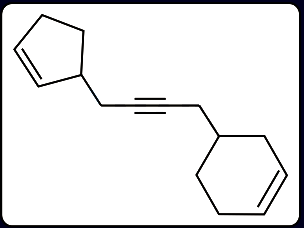
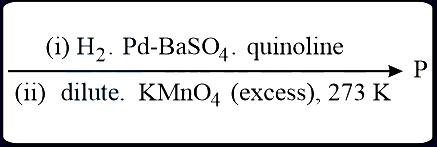
- Total number of hydroxyl groups present in a molecule of the major product is ______
 JEE Advanced 2019 Medium
 - Paragraph I: An organic compound \(\mathrm{P}\) with molecular formula \(\mathrm{C}_5 \mathrm{H}_{18} \mathrm{O}_2\) decolorizes bromine water and also shows positive iodoform test. \(\mathrm{P}\) on ozonolysis followed by treatment with \(\mathrm{H}_2 \mathrm{O}_2\) gives \(\mathrm{Q}\) and \(\mathrm{R}\). While compound \(\mathrm{Q}\) shows positive iodoform test, compound \(\mathrm{R}\) does not give positive iodoform test. \(\mathrm{Q}\) and \(\mathrm{R}\) on oxidation with pyridinium chlorochromate (PCC) followed by heating give \(\mathrm{S}\) and \(\mathrm{T}\), respectively. Both \(\mathrm{S}\) and \(\mathrm{T}\) show positive iodoform test.
Complete copolymerization of 500 moles of \(\mathrm{Q}\) and 500 moles of \(\mathrm{R}\) gives one mole of a single acyclic copolymer \(\mathrm{U}\).
[Given, atomic mass: \(\mathrm{H}=1, \mathrm{C}=12, \mathrm{O}=16\)]
Question: The molecular weight of \(\mathbf{U}\) isJEE Advanced 2024 Medium - In the following reaction sequence, the amount of (in g) formed from moles of acetophenone is ____.
(Atomic weights in The yield (%) corresponding to the product in each step is given in the parenthesis)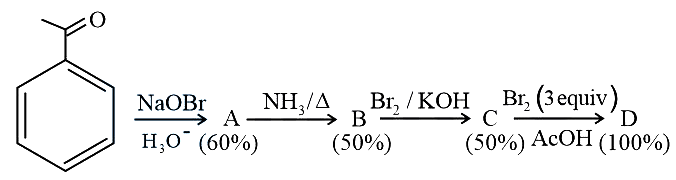 JEE Advanced 2018 Medium
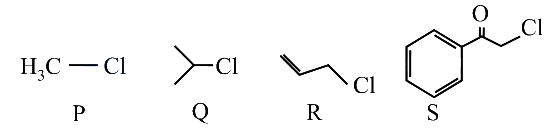
 - KI in acetone, undergoes SN2 reaction with each of P, Q, R and S. The rates of the reaction vary as
 JEE Advanced 2013 Medium
 - Paragraph:
An aqueous solution of metal ion \(\mathbf{M} 1\) reacts separately with reagents \(\mathbf{Q}\) and \(\mathbf{R}\) in excess to give tetrahedral and square planar complexes, respectively. An aqueous solution of another metal ion M2 always forms tetrahedral complexes with these reagents. Aqueous solution of \(\mathbf{M} 2\) on reaction with reagent \(\mathbf{S}\) gives white precipitate which dissolves in excess of \(\mathbf{S}\). The reactions are summarized in the scheme given below: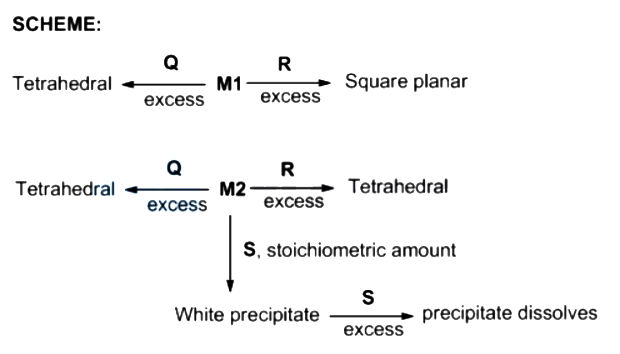
Question:
\(\mathbf{M} 1, \mathbf{Q}\) and \(\mathbf{R}\), respectively areJEE Advanced 2014 Easy - The total number of cyclic isomers possible for a hydrocarbon with the molecular formula \(\mathrm{C}_4 \mathrm{H}_6\) isJEE Advanced 2010 Medium
More PYQs from JEE Advanced
- Two non-conducting solid spheres of radii and , having uniform volume charge densities and , respectively, touch each other. The net electric field at a distance from the centre of the smaller sphere, along the line joining the centres of the spheres, is zero. The ratio can beJEE Advanced 2013 Hard
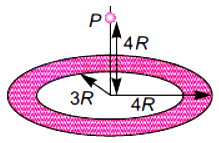
- A thin uniform annular disc (see figure) of mass \(M\) has outer radius \(4 R\) and inner radius \(3 R\). The work required to take a unit mass from point \(P\) on its axis to infinity is
 JEE Advanced 2010 Hard
 - For the function \(f(x)=x \cos \frac{1}{x}, x \geq 1\),JEE Advanced 2009 Hard
- If \(\alpha=\int_{\frac{1}{2}}^2 \frac{\tan ^{-1} x}{2 x^2-3 x+2} d x\)
then the value of \(\sqrt{7} \tan \left(\frac{2 \alpha \sqrt{7}}{\pi}\right)\) is ____________.
(Here, the inverse trigonometric function \(\tan ^{-1} x\) assumes values in \(\left(-\frac{\pi}{2}, \frac{\pi}{2}\right)\).)JEE Advanced 2025 Hard - let be defined by
List – I List – II (A) is (P) Onto but not one – one (B) is (Q) neither continuous nor one-one (C) of is (R) differentiable but not one-one (D) is (S) continuous and one-one JEE Advanced 2014 Medium - Two spherical stars and have densities and , respectively. and have the same radius, and their masses and are related by . Due to an interaction process, star loses some of its mass, so that its radius is halved, while its spherical shape is retained, and its density remains . The entire mass lost by is deposited as a thick spherical shell on with the density of the shell being . If and are the escape velocities from and after the interaction process, the ratio . The value of isJEE Advanced 2022 Medium