


JEE Advanced · Physics · 24. Ray Optics
A bi-convex lens is formed with two thin plano-convex lenses as shown in the figure. Refractive index \(n\) of the first lens is \(1.5\) and that of the second lens is \(1.2\). Both the curved surface are of the same radius of curvature \(R=14\) \(\mathrm{cm}\). For this bi-convex lens, for an object distance of 40 \(\mathrm{cm}\), the image distance will be
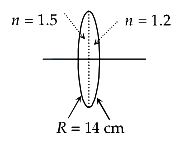
- A \(-280.0 \mathrm{~cm}\)
- B \(40.0 \mathrm{~cm}\)
- C \(21.5 \mathrm{~cm}\)
- D \(13.3 \mathrm{~cm}\)
Answer & Solution
Correct Answer
(B) \(40.0 \mathrm{~cm}\)
Step-by-step Solution
Detailed explanation
The focal length \(\left(f_{1}\right)\) of the plano-cöneex Tens with \(n=1.5\) using lens-maker formula
\(\frac{1}{f_{1}}=\left(n_{1}-1\right)\left[\frac{1}{R_{1}}-\frac{1}{R_{2}}\right]=(1.5-1)\)\(\left[\frac{1}{14}-\frac{1}{\infty}\right]=\frac{1}{28}\)
The focal length \(\left(f_{2}\right)\) of the plano-convex lens with \(n=1.2\)
\(\frac{1}{f_{2}}=\left(n_{2}-1\right)\left[\frac{1}{R_{1}}-\frac{1}{R_{2}}\right]=(1.2-1)\)\(\left[\frac{1}{\infty}-\frac{1}{-14}\right]=\frac{1}{70}\)
Focal length F of the combination
\(\frac{1}{F}=\frac{1}{f_{1}}+\frac{1}{f_{2}}=\frac{1}{20}\)
Now, applying lens formula for the combination of lens
\(\frac{1}{V}-\frac{1}{U}=\frac{1}{F} \Rightarrow \frac{1}{V}-\frac{1}{-40}=\frac{1}{20}\)\([\text { Given } \mu=40 \mathrm{~cm}]\)
\(\therefore V=40 \mathrm{~cm}\)
\(\frac{1}{f_{1}}=\left(n_{1}-1\right)\left[\frac{1}{R_{1}}-\frac{1}{R_{2}}\right]=(1.5-1)\)\(\left[\frac{1}{14}-\frac{1}{\infty}\right]=\frac{1}{28}\)
The focal length \(\left(f_{2}\right)\) of the plano-convex lens with \(n=1.2\)
\(\frac{1}{f_{2}}=\left(n_{2}-1\right)\left[\frac{1}{R_{1}}-\frac{1}{R_{2}}\right]=(1.2-1)\)\(\left[\frac{1}{\infty}-\frac{1}{-14}\right]=\frac{1}{70}\)
Focal length F of the combination
\(\frac{1}{F}=\frac{1}{f_{1}}+\frac{1}{f_{2}}=\frac{1}{20}\)
Now, applying lens formula for the combination of lens
\(\frac{1}{V}-\frac{1}{U}=\frac{1}{F} \Rightarrow \frac{1}{V}-\frac{1}{-40}=\frac{1}{20}\)\([\text { Given } \mu=40 \mathrm{~cm}]\)
\(\therefore V=40 \mathrm{~cm}\)
See the Complete Solution
Get step-by-step explanations for this and 2.5 Lakh+ more JEE, NEET & CET questions.
- Unlock all solutions
- Practice the full chapter
- Track accuracy across PYQs
4.8 rated on Google Play · 14,000+ reviews
More questions from Physics
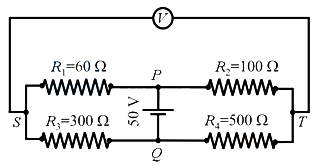
- In the balanced condition, the values of the resistances of the four arms of a Wheatstone bridge are shown in the figure below. The resistance has temperature coefficient . If the temperature of is increased by the voltage developed between and will be __________ volt.
 JEE Advanced 2020 Medium
 - Two non-reactive monoatomic ideal gases have their atomic masses in the ratio 2 : 3. The ratio of their partial pressures, when enclosed in a vessel kept at a constant temperature, is 4 : 3. The ratio of their densities isJEE Advanced 2013 Medium
- A horizontal stretched string, fixed at two ends, is vibrating in its fifth harmonic according to the equation, \(y ( x , t )=(0.01 m) \sin \left[\left(62.8 m^{-1}\right) x \right]\) \(\cos \left[\left(628 s^{-1}\right) t \right]\). Assuming \(\pi=3.14\), the correct statement(s) is (are)JEE Advanced 2013 Hard
- Paragraph:
The mass of a nucleus \({ }_{Z}^{A} X\) is less than the sum of the masses of \((A-Z)\) number of neutrons and \(Z\) number of protons in the nucleus. The energy equivalent to the corresponding mass difference is known as the binding energy of the nucleus. A heavy nucleus of mass \(M\) can break into two light nuclei of masses \(m_{1}\) and \(m_{2}\) only if \(\left(m_{1}+m_{2}\right) \lt M\). Also two light nuclei of masses \(m_{3}\) and \(m_{4}\) can undergo complete fusion and form a heavy nucleus of mass \(M^{\prime}\) only if \(\left(m_{3}+m_{4}\right) \gt M^{\prime}\). The masses of some neutral atoms are given in the table below:
\(\left(1 u=932 M e V / c^{2}\right)\)
Question:
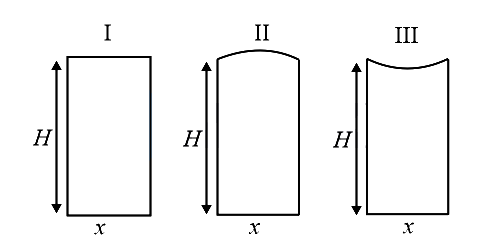
The kinetic energy (in \(k e V\) ) of the alpha particle, when the nucleus \({ }_{84}^{210} P o\) at rest undergoes alpha decay, isJEE Advanced 2013 Easy - Three glass cylinders of equal height and same refractive index are placed on a horizontal surface shown in figure. Cylinder has a flat top, cylinder has a convex top and cylinder has a concave top. The radii of curvature of the two curved tops are same If and are the apparent depths of a point on the bottom of the three cylinders, respectively, the correct statement(s) is/are
 JEE Advanced 2019 Hard
 - Paragraph :
Phase space diagrams are useful tools in analyzing all kinds of dynamical problems. They are especially useful in studying the changes in motion as initial position and momentum are changed. Here we consider some simple dynamical systems in one-dimension. For such systems, phase space is a plane in which position is plotted along horizontal axis and momentum is plotted along vertical axis. The phase space diagram is \(x(t) v s p(t)\) curve in this plane. The arrow on the
curve indicates the time flow. For example, the phase space diagram for a particle moving with constant velocity is a straight line as shown in the figure. We use the sign convention in which position or momentum upwards (or to right) is positive and downwards (or to left) is negative.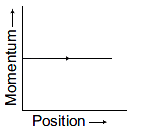
Question :
The phase space diagram for simple harmonic motion is a circle centered at the origin. In the figure, the two circles represent the same oscillator but for different initial conditions, and \(E_1\) and \(E_2\) are the total mechanical energies respectively. Then,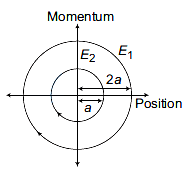 JEE Advanced 2011 Easy
More PYQs from JEE Advanced
- Match the complexes in Column I with their properties listed in Column II. Indicates your answer by darkening the appropriate bubbles of \(4 \times 4\) matrix given in the ORS.
 JEE Advanced 2007 Easy
 - The density (in \(\mathrm{g} \mathrm{cm}^{-3}\) ) of the metal which forms a cubic close packed (ccp) lattice with an axial distance (edge length) equal to 400 pm is \(\qquad\) .
Use: Atomic mass of metal \(=105.6 \mathrm{amu}\) and Avogadro's constant \(=6 \times 10^{23} \mathrm{~mol}^{-1}\)JEE Advanced 2025 Medium - Statement I The formula connecting \(u, v\) and \(f\) for a spherical mirror is valid only for mirrors whose sizes are very small compared to their radii of curvature.
Statement II Laws of reflection are strictly valid for plane surfaces, but not for large spherical surfaces.JEE Advanced 2007 Hard - At \(298 \mathrm{~K}\), the limiting molar conductivity of a weak monobasic acid is \(4 \times 10^{2} \mathrm{~S} \mathrm{~cm}^{2} \mathrm{~mol}^{-1}\). At \(298 \mathrm{~K}\), for an aqueous solution of the acid the degree of dissociation is \(\boldsymbol{\alpha}\) and the molar conductivity is \(\mathbf{y} \times 10^{2} \mathrm{~S} \mathrm{~cm}^{2} \mathrm{~mol}^{-1}\). At \(298 \mathrm{~K}\), upon 20 times dilution with water, the molar conductivity of the solution becomes \(3 \mathbf{y} \times 10^{2} \mathrm{~S} \mathrm{~cm}^{2} \mathrm{~mol}^{-1}\)
The value of is _________ .JEE Advanced 2021 Hard - Match each of the diatomic molecules in Column I with its property/properties in Column II.
Column I Column II A. \(B _2\) p. Paramagnetic B. \(N_2\) q. Undergoes oxidation C. \(O _2^{-}\) r. Undergoes reduction D. \(O _2\) s. Bond order t. Mixing of 's' and 'p' orbitals JEE Advanced 2009 Medium - Let be a triangle. Let If and then which of the following is (are) true ?JEE Advanced 2015 Medium